RAG vs Fine-Tuning for AI Agents: Which Approach Gives Better Results?
 Sasikumar
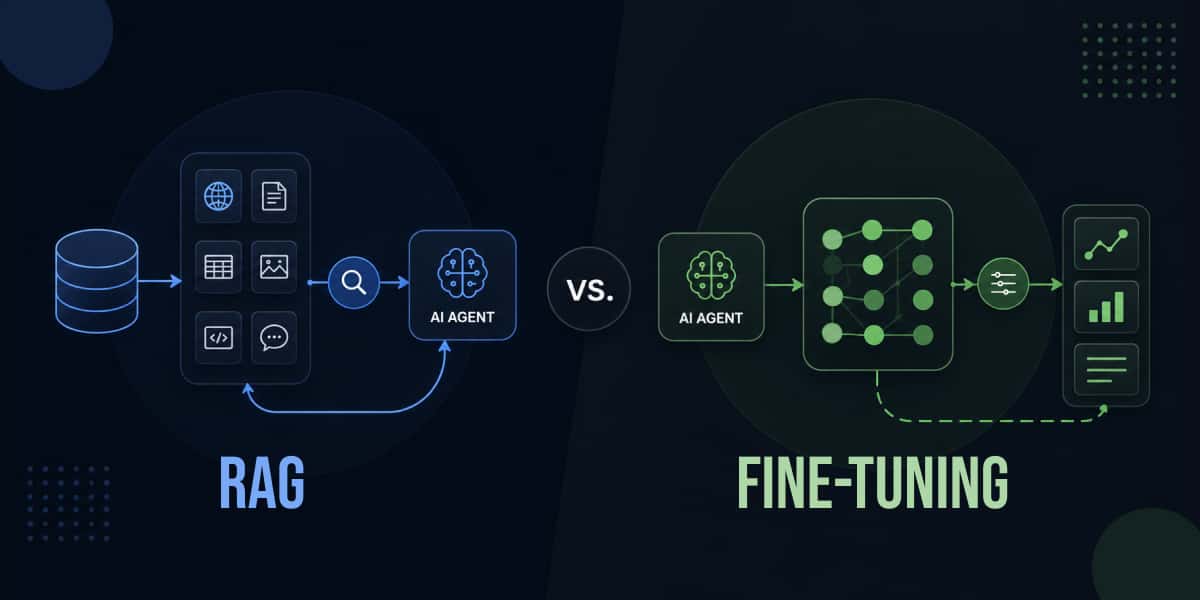
RAG and fine-tuning are two popular ways to improve AI agents.
RAG stands for Retrieval-Augmented Generation.
It helps AI agents find information from external sources before creating a response.
Fine-tuning trains an AI model on custom data so it learns specific patterns and behaviours.
For most businesses building AI agents, RAG is usually the better starting point because it is
- Faster to implement
- Easier to update
- More cost-effective
- Better for changing information
Fine-tuning is useful when the AI needs specialised behaviour, tone, or industry knowledge.
Many modern AI systems use both.
What You'll Learn
In this guide, you'll learn:
- What RAG is
- What fine-tuning is
- How each approach works
- Benefits and limitations
- Real-world use cases
- Cost comparison
- Performance comparison
- Which option is best for AI agents
Why This Decision Matters
Many businesses want to build AI agents.
The first question is often the following:
Should we use RAG or fine-tuning?
The answer affects:
- Cost
- Development time
- Accuracy
- Maintenance
- Scalability
Choosing the wrong approach can increase expenses and reduce performance.
Choosing the right approach can improve user experience and business outcomes.
What Is RAG?
RAG stands for Retrieval-Augmented Generation.
It allows an AI model to search external information before generating a response.
Think of it like an open-book exam.
Many organisations building AI agent development services use RAG to improve accuracy and reduce hallucinations.
Instead of relying only on memory, the AI can look up information.
How RAG Works
The process is simple.
Step 1
A user asks a question.
Example:
"How do I upgrade my subscription plan?"
Step 2
The system searches relevant documents.
Examples:
- Knowledge bases
- Product documentation
- Databases
- Internal files
Step 3
The AI retrieves relevant information.
Step 4
The AI creates a response based on the retrieved content.
Example of RAG
Without RAG:
The AI guesses.
The answer may be outdated.
With RAG:
The AI retrieves current product documentation.
The answer is more accurate.
What Is Fine-Tuning?
Fine-tuning is the process of training an AI model on custom data.
The model learns patterns from your examples.
Think of it like specialised training.
Instead of looking up information, the model learns from repeated examples.
How Fine-Tuning Works
Step 1
Collect training data.
Examples:
- Customer conversations
- Product support tickets
- Industry-specific content
Step 2
Train the model.
The model learns from the examples.
Step 3
Deploy the model.
The new model responds based on its training.
Example of Fine-Tuning
A healthcare company trains a model using medical support conversations.
The model learns:
- Medical terminology
- Response style
- Industry language
The result is a more specialised AI assistant.
RAG vs Fine-Tuning: Key Differences

Many modern AI agents rely on RAG.
Why Do Most AI Agents Use RAG?
RAG has become a core component of modern enterprise AI agent development projects.
Because business information changes often.
Examples:
- Pricing
- Policies
- Documentation
- Product features
With RAG, updates happen instantly.
No retraining is required.
This makes RAG ideal for:
- Customer support agents
- Knowledge assistants
- SaaS support bots
- Internal company assistants
Benefits of RAG for AI Agents
More Accurate Answers
The AI uses real information.
This reduces hallucinations.
Easy Updates
Update the knowledge base.
The AI immediately uses the latest content.
Lower Costs
No expensive retraining process.
Faster Development
Teams can deploy AI agents quickly.
Better Enterprise Scalability
Large companies often have thousands of documents.
RAG makes them searchable.
Benefits of Fine-Tuning for AI Agents
Fine-tuning also has advantages.
Better Personality
The AI can learn a specific tone.
Examples:
- Professional
- Friendly
- Technical
Industry Expertise
The model learns specialised language.
Examples:
- Healthcare
- Finance
- Legal
- Manufacturing
Consistent Responses
The model follows learned patterns.
Improved Task Performance
Fine-tuning can improve:
- Classification
- Summarization
- Prediction tasks
Limitations of RAG
No solution is perfect.
Retrieval Quality Matters
Poor document retrieval creates poor responses.
Additional Infrastructure
RAG requires:
- Vector databases
- Embeddings
- Search systems
Latency
Retrieval adds extra processing time.
Limitations of Fine-Tuning
Fine-tuning also has challenges.
Higher Cost
Training requires resources.
Harder Updates
New information requires retraining.
Longer Development Cycles
Training and testing take time.
Risk of Outdated Knowledge
The model only knows what it learned during training.
RAG vs Fine-Tuning for AI Agents
Let's compare common AI agent scenarios.
Customer Support Agent
Best Choice:
✅ RAG
Reason:
Support information changes frequently.
Internal Knowledge Agent
Best Choice:
✅ RAG
Reason:
Employees need access to current information.
Sales AI Agent
Best Choice:
✅ RAG + Fine-Tuning
Reason:
Current product information plus personalised behaviour.
Healthcare Agent
Best Choice:
✅ Fine-Tuning + RAG
Reason:
Industry language plus current information.
Enterprise AI Agent
Best Choice:
✅ Hybrid Approach
Reason:
Large organisations need both accuracy and customisation.
The Hybrid Approach: Best of Both Worlds
Today, many advanced AI systems combine RAG and fine-tuning.
This is often the best solution.
The model learns behaviour through fine-tuning.
The model accesses current information through RAG.
This creates:
- Better accuracy
- Better personalization
- Better scalability
Real Example: AI Customer Support Agent
Imagine a SaaS company.
The company has:
- 10,000 customers
- 2,000 documentation pages
- Frequent product updates
Using only fine-tuning:
Every update requires retraining.
Using only RAG:
Documentation stays current.
Using both:
The AI learns company tone and support style.
The AI also accesses current documentation.
This delivers the best customer experience.
RAG Architecture for AI Agents
Most RAG systems include:
AI Model
Examples:
- GPT-4o
- Claude
- Gemini
Embedding Model
Converts text into vectors.
Vector Database
Examples:
- Pinecone
- Weaviate
- ChromaDB
Retrieval Layer
Finds relevant information.
Generation Layer
Creates the final response.
Fine-Tuning Architecture for AI Agents
Typical components include the following:
Base Model
The starting AI model.
Training Data
Custom examples.
Fine-Tuning Process
The model learns patterns.
Evaluation Layer
Measures quality.
Deployment Layer
Delivers responses to users.
Common Mistakes Businesses Make
Fine-Tuning When RAG Is Enough
Many teams train models unnecessarily.
RAG solves many problems.
Poor Data Quality
Bad data creates bad AI.
Ignoring Security
Protect sensitive information.
No Monitoring
AI systems need continuous improvement.
Choosing One Approach Too Early
Evaluate the use case first.
How to Choose the Right Approach
Ask these questions:
Does information change often?
Use RAG.
Do you need a unique tone?
Use fine-tuning.
Do you need both?
Use a hybrid approach.
Do you need enterprise-scale AI agents?
Use RAG plus fine-tuning.
Frequently Asked Questions
What is better, RAG or fine-tuning?
For most business applications, RAG is the better starting point.
Does RAG replace fine-tuning?
No. They solve different problems.
Can AI agents use both?
Yes. Many advanced AI agents combine both approaches.
Is RAG cheaper than fine-tuning?
In most cases, yes.
Which approach is best for enterprise AI agents?
A hybrid approach often delivers the best results.
Conclusion
RAG and fine-tuning are both valuable tools for building AI agents.
The best choice depends on your goals.
If your business needs access to changing information, RAG is often the best solution.
If your business needs specialised behaviour and industry expertise, fine-tuning can provide additional value.
For many organisations, the strongest approach is combining both technologies.
This creates AI agents that are accurate, personalised, scalable, and ready for real-world business use.
Ready to Build Smarter AI Agents?
Whether you need a RAG-powered knowledge assistant, a fine-tuned AI model, or a fully customised enterprise AI agent, choosing the right architecture is critical.
At InfiniApps AI, we help businesses design, build, and deploy intelligent AI solutions tailored to their goals.
Our services include:
✅ AI Agent Development
✅ Custom AI Agent Development
✅ Enterprise AI Agent Development
✅ RAG Implementation
✅ Fine-Tuning Services
✅ AI SaaS Platform Development
Talk to our AI experts today and discover which approach can deliver the best results for your business.