AI Chatbot vs AI Agent vs Autonomous Agent: The Complete 2026
 Sasikumar
What Is an AI Chatbot?
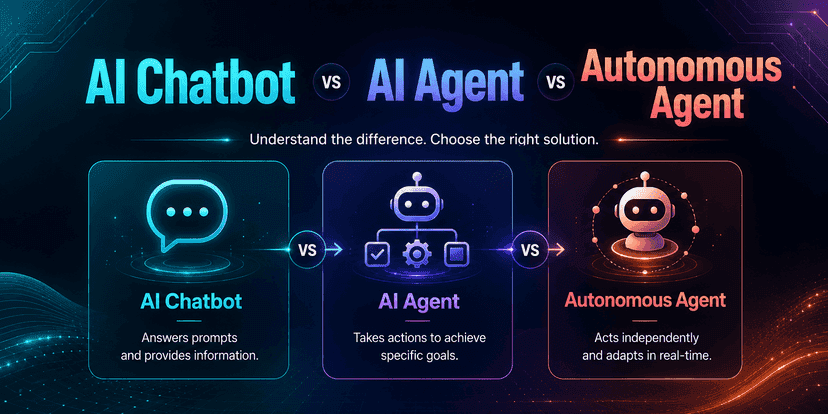
An AI chatbot is a software application that uses natural language processing (NLP) or a large language model (LLM) to understand and respond to user messages in a conversational format.
Key characteristic: It responds. It does not act.
How AI Chatbots Work
User Message → NLP/LLM Processing → Intent Recognition → Scripted or Generated Response
No API calls. No external tool use. No memory beyond the current session (in most basic implementations).
Types of AI Chatbots
Rule-Based Chatbots (Old Generation)
- Follow decision trees and fixed scripts
- Cannot handle unexpected inputs
- Examples: Early Drift bots, basic Intercom bots pre-2023
LLM-Powered Chatbots (Current Generation)
- Use GPT-4, Claude, or Gemini for natural language understanding
- Can handle varied phrasing and unexpected questions
- Can be grounded with RAG for accuracy
- Examples: ChatGPT (basic mode), standard FAQ bots with GPT under the hood
AI Chatbot Strengths
- Fast to deploy (days, not months)
- Low cost to run
- Easy to maintain
- Great for FAQ and knowledge base queries
- Safe — no real-world actions possible
AI Chatbot Limitations
- Cannot take actions (no API calls, no database updates)
- No persistent memory across sessions
- Cannot handle multi-step tasks
- Hallucinations without RAG grounding
- Users hit the ceiling fast on complex queries
What Is an AI Agent?
An AI agent is an LLM-powered system that can not only understand and respond to user messages but also use external tools, call APIs, and take limited actions to complete tasks — typically within a defined scope and with human oversight at key steps.
Key characteristic: It responds AND acts — but within defined boundaries.
How AI Agents Work
User Message → LLM Reasoning → Intent + Action Planning → Tool Selection → API Call → Result Processing → Response
The key addition over a chatbot: tool use and action capability.
The LangChain ReAct Pattern (Most Common AI Agent Architecture)
Most production AI agents in 2026 use the ReAct (Reasoning + Acting) pattern from LangChain:
Thought: What does the user need? Action: Which tool should I call? Observation: What did the tool return? Thought: Is the task complete? Final Answer: Respond to the user.
This loop repeats until the agent has enough information to answer or act.
LangChain Agent — Core Components
- LLM Brain: GPT-4o, Claude 3.5, or Gemini 1.5
- Tools: Defined functions the agent can call (CRM lookup, ticket creation, billing check)
- Memory: ConversationBufferMemory for short-term context
- RAG Integration: Retrieval from knowledge base for accurate answers
- Guardrails: Rules about what the agent can and cannot do
AI Agent Strengths
- Handles multi-step tasks within defined scope
- Can take real actions (update records, send emails, create tickets)
- RAG-grounded responses reduce hallucinations dramatically
- Feels like a real assistant, not just a search box
- Human escalation paths built in
AI Agent Limitations
- Cannot plan beyond its defined tool set
- Does not self-correct across multiple sessions
- Needs human-defined tools — cannot discover new tools autonomously
- Fails gracefully but cannot recover complex failure states alone
What Is an Autonomous Agent?
An autonomous agent is an AI system that can independently set goals, plan sequences of actions, use multiple tools, learn from intermediate results, self-correct when something fails, and complete complex multi-step tasks — without requiring human input at each step.
Key characteristic: It plans, acts, self-corrects, and operates independently.
How Businesses Automate Operations with Autonomous Agents
How Autonomous Agents Work
Goal Given → Agent Plans Sub-Tasks → Executes Step 1 → Observes Result → Re-Plans if Needed → Executes Step 2 → ... (repeats autonomously) → Final Output
The key additions to an AI agent:
- Self-directed planning (decides its own steps)
- Self-correction (detects failures and re-routes)
- Long-term memory (persists across sessions)
- Multi-agent coordination (can spawn or coordinate with other agents)
LangGraph — The Framework for Autonomous Agents
While LangChain handles single-agent tool use, LangGraph is the framework that enables true autonomous agent behaviour:
- Stateful execution — the agent remembers where it is in a multi-step workflow
- Graph-based logic — branching, looping, and parallel execution of tasks
- Human-in-the-loop nodes — pause at critical decisions, resume after approval
- Multi-agent graphs — Specialist agents (researcher, writer, reviewer) working in parallel
- Error recovery — automatic retry and re-routing on failures
Autonomous Agent Strengths
- Handles genuinely complex, open-ended tasks
- Self-corrects without human intervention
- Long-term memory enables deeply personalized interactions
- Multi-agent systems parallelize work dramatically
- Can discover and combine tools dynamically
Autonomous Agent Limitations
- Higher risk of runaway behavior (must have hard guardrails)
- More expensive (more LLM calls per task)
- Harder to debug and monitor
- Requires mature observability (LangSmith essential)
- Not suitable for high-stakes actions without human approval gates
Side-by-Side Deep Comparison
Architecture Comparison

How RAG Changes the Game for All Three
RAG (Retrieval-Augmented Generation) is the most important accuracy improvement for any AI system in SaaS:
Without RAG
User: "How do I export my data?" AI: [Answers from general training data] Result: Generic, potentially wrong answer about a competitor's feature
With RAG
User: "How do I export my data?" AI: [Retrieves from YOUR product documentation] → [Grounds answer in your actual docs] Result: Accurate, specific answer about YOUR product's export feature
RAG Impact by System Type
Without RAG, the AI chatbot has 60–70% accuracy on product questions. With RAG, AI Agent Hallucinates on tool decisions, 90–95% accuracy. Accurate tool selection Autonomous Agent: Unreliable planning Reliable, grounded plans
RAG Tech Stack for SaaS in 2026:
- Embeddings: OpenAI text-embedding-3-small or Cohere
- Vector DB: Pinecone (production), ChromaDB (development)
- Retrieval: LangChain Retrieval chains
- Re-ranking: Cohere Rerank for precision at scale
Which One Should Your SaaS Platform Build?
Decision Framework
Build an AI chatbot if:
- You have a knowledge base and need instant FAQ resolution
- You have < 200 support queries/week
- You're just starting with AI
- The budget is under $15,000
- You need something live in under 3 weeks
- Your queries are mostly informational
Build an AI agent if:
- You have 200–1,000 support queries/week
- Users need actions taken (ticket creation, plan changes, password resets)
- You have APIs that can be safely connected
- The budget is $15,000–$60,000
- You want 40–60% ticket deflection
- LangChain ReAct pattern fits your use cases
Build an autonomous agent if:
- You have 1,000+ queries/week with high complexity
- You need genuinely multi-step, self-directed automation
- You have mature engineering team + observability infrastructure
- Budget is $60,000–$200,000+
- You're building a core product feature, not just a support add-on
- You want a 6–12 month competitive moat
SaaS Use Cases by System Type
Customer Support
Scenario Best Fit Answer "How do I reset my password?" AI Chatbot (with RAG) Actually reset the password via API AI agent, detect churning user, proactively reach out, offer discounts, and update CRM Autonomous Agent
Sales & Onboarding
Scenario Best Fit Answer, "What's included in the Pro plan?" AI Chatbot: Qualify a lead and book demo via calendar API AI Agent Research lead, personalize outreach, sequence follow-ups, update pipeline Autonomous Agent
Product Guidance
Scenario Best Fit Explain a feature from the help docs. AI Chatbot (with RAG) Walk the user through the setup step-by-step with API state checks. AI agents monitor user behaviour, detect confusion, proactively guide, and measure outcomes. Autonomous Agent
Real Case Study: Evolving from Chatbot → Agent → Autonomous
Company: B2B SaaS Platform (Project Management Tool, 15,000 users)
Phase 1 — AI Chatbot (Month 1–3)
Stack: GPT-4o + RAG over 1,800 help articles + Pinecone
Results:
- 38% of support tickets resolved without human
- Response time: < 2 seconds
- Cost: $12,000 to build, $300/month to run
- Remaining gap: users frustrated when AI couldn't take actions
Phase 2 — AI Agent (Month 4–7)
Stack: LangChain ReAct + GPT-4o + 7 tools (ticket creation, account lookup, plan info, password reset, billing check, usage stats, escalation) + LangSmith observability
Results:
- 57% total ticket deflection (up from 38%)
- Average session resolution: 12 seconds
- Cost: $35,000 additional to build, $800/month to run
- New issue: Complex multi-step requests (onboarding sequences, bulk operations) still needed human
Phase 3 — Autonomous Agent (Month 8–12)
Stack: LangGraph + LangChain + GPT-4o + Specialist agents (support agent, onboarding agent, retention agent) + Long-term memory in PostgreSQL
Results:
- 71% total automation rate
- Proactive churn detection: Agent identifies at-risk users, reaches out, offers plan options, logs outcome
- Support team refocused from ticket resolution to quality assurance and edge cases
- Customer CSAT: 91% (up from 74% before any AI)
- Cost: $85,000 additional to build, $2,200/month to run (fully justified by team cost savings)
Total 12-month ROI:
- Support team headcount unchanged but handling 3x the user base
- Annual support cost savings: ~$180,000
- Total AI investment: ~$132,000
- Net ROI: +$48,000 in year 1, fully positive in year 2+
Building Your System: Tech Stack Reference 2026
AI Chatbot Stack
Frontend: React chat widget / Intercom / Crisp LLM: GPT-4o-mini (cost-efficient for FAQ) RAG: LangChain + Pinecone + OpenAI Embeddings Backend: FastAPI / Node.js Monitoring: Basic logging + Sentry
AI Agent Stack
Frontend: Custom chat widget LLM: GPT-4o or Claude 3.5 Sonnet Orchestration: LangChain ReAct Agent Tools: Custom Python functions for each API RAG: LangChain Retrieval + Pinecone Memory: ConversationSummaryBufferMemory Observability: LangSmith Backend: FastAPI + Docker
Autonomous Agent Stack
Frontend: Custom chat widget + Admin dashboard LLM: GPT-4o (primary) + GPT-4o-mini (sub-tasks) Orchestration: LangGraph (multi-agent graph) Agent Types: Supervisor, Researcher, Action, Review RAG: Advanced hybrid search (semantic + BM25) + Cohere Rerank Memory: Long-term: PostgreSQL + pgvector Short-term: Redis Observability: LangSmith + Helicone + custom dashboards Backend: FastAPI + Kubernetes Security: OAuth 2.0, Row-level security, Audit logging
Common Mistakes When Choosing
Mistake 1: Starting with Autonomous When You Need a Chatbot
Many SaaS teams over-engineer. If 80% of your queries are "How do I do X?", start with a RAG chatbot. You'll get 80% of the benefit for 10% of the cost.
Mistake 2: Building an Agent Without RAG
An AI agent that can take actions but hallucinates on product questions is dangerous. RAG is not optional — it's the foundation of accuracy.
Mistake 3: No Human Fallback in Autonomous Systems
Autonomous agents that have no human escalation path will frustrate users on complex edge cases. Always design the "I need a human" exit.
Mistake 4: Skipping Observability
Without LangSmith or an equivalent, you cannot see why your agent made a decision. Flying blind in production with an agent that takes real actions is a serious risk.
Mistake 5: Treating All Three as the Same Thing
The terms "chatbot", "AI agent", and "autonomous agent" are used interchangeably in marketing. In engineering and investment decisions, they are completely different systems with different costs, capabilities, and risks.
FAQ
What is the difference between an AI chatbot and an AI agent?
An AI chatbot responds to user messages using NLP or an LLM but cannot take real-world actions. An AI agent uses LLM reasoning plus tool calls to take actions — like updating records, calling APIs, or creating tickets — within a defined scope.
What is the difference between an AI agent and an autonomous agent?
An AI agent acts within predefined tools and boundaries set by developers. An autonomous agent can plan its own multi-step approach, self-correct when steps fail, use tools dynamically, and operate independently across extended periods – without needing human direction at each step.
Is LangChain for AI agents or autonomous agents?
LangChain primarily supports AI agents through its ReAct agent pattern and tool-use framework. For true autonomous agent behaviour — stateful multi-step workflows, parallel agent coordination, and self-directed planning — LangGraph (built on top of LangChain) is the right framework.
What is RAG, and is it required for all three?
RAG (Retrieval-Augmented Generation) retrieves relevant content from your knowledge base before generating a response, grounding the AI in your actual data. It is optional but highly recommended for chatbots, strongly recommended for AI agents, and essentially essential for autonomous agents where accuracy directly drives downstream actions.
Which is best for SaaS customer support in 2026?
It depends on your volume and complexity. For less than 200 tickets/week with mostly informational queries: AI chatbot with RAG. For 200–1,000 tickets/week with action needs: AI Agent with LangChain. For more than 1,000 complex tickets/week with automation goals: Autonomous Agent with LangGraph.
Can an autonomous agent replace my support team?
No — and the most successful implementations don't try to. Intercom's Fin, Zendesk AI, and Amazon Connect all use autonomous agents to handle 50–75% of routine interactions while routing complex, sensitive, or high-stakes cases to human agents. The goal is to free your team for work that actually requires human judgement.
How much does each system cost to build?
AI Chatbot: $2,000–$10,000. AI Agent: $15,000–$50,000. Autonomous Agent: $50,000–$200,000+. Ongoing monthly costs scale with LLM usage, vector DB hosting, and observability tooling.
What is LangGraph, and when should I use it?
LangGraph is an orchestration framework built on LangChain that enables stateful, graph-based multi-agent workflows. Use it when your SaaS AI needs true autonomous behaviour — branching logic, parallel agent execution, human-in-the-loop pauses, and multi-agent coordination. For simpler single-agent use cases, standard LangChain is sufficient.
How do I prevent an autonomous agent from taking wrong actions?
Implement hard guardrails (action limits requiring human approval), the principle of least privilege for all API access, circuit breakers to halt runaway loops, comprehensive audit logging (LangSmith), and regular red teaming. Never deploy a production autonomous agent without observability and a kill switch.
What are examples of real autonomous agents in production?
Amazon Bedrock Agents (AWS workflow automation), GitHub Copilot Workspace (autonomous code writing and testing), Notion AI (workspace-level document creation and cross-referencing), and Salesforce Agentforce (autonomous CRM operations) are among the most widely deployed autonomous agent systems in 2026.
Conclusion: Choose the Right Tool for the Right Problem
The AI landscape in 2026 is not "chatbots are dead" or "autonomous agents are the only answer".
It is a spectrum – and your SaaS platform should move up that spectrum intelligently.
An AI chatbot is the fastest, cheapest way to deflect FAQ traffic and improve first-response time. Start here.
AI Agent = the production-grade system for companies ready to automate real actions, integrate APIs, and achieve 50–60% ticket deflection. The LangChain + RAG stack makes this accessible to any engineering team.
An autonomous agent is the competitive moat for companies with the engineering maturity, data infrastructure, and risk management to let AI operate independently. LangGraph is the framework. LangSmith is the safety net.
The companies that will dominate in 2027 are those that started in 2026 — not with the most sophisticated system, but with the right system for their current stage.
Start with RAG. Build toward autonomy. Measure everything.
Ready to build the right AI system for your SaaS platform? Talk to the InfiniApps AI team — we specialise in LangChain, LangGraph, and RAG implementations across all three tiers.