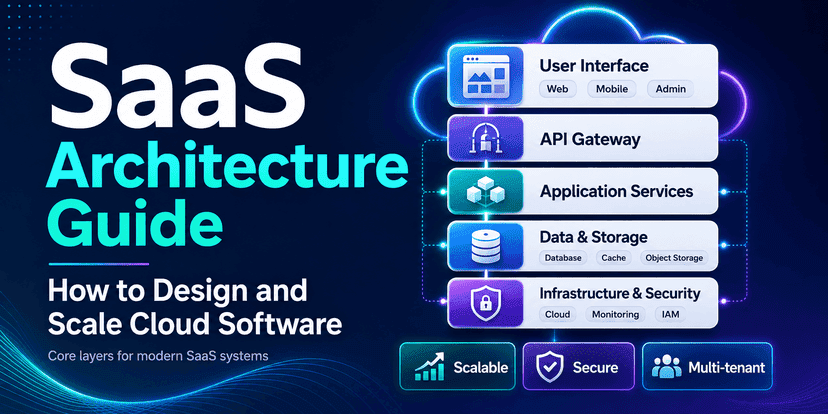
SaaS Architecture Guide: How to Design and Scale Cloud Software
 Karuna
SaaS architecture is the foundation of any successful cloud software. To understand how AI improves this, explore AI-powered SaaS solutions. If your architecture is strong, your product will scale. If it is weak, your system will fail as users grow.
Many SaaS startups fail not because of bad ideas, but because of poor architecture and scaling decisions. This guide will help you understand SaaS architecture in a simple way and show you how to design systems that grow without breaking.
What Is SaaS Architecture?
SaaS architecture is the structure of cloud-based software. It includes servers, databases, APIs, security systems, and scaling mechanisms.
Users access SaaS products through a browser or app. They do not install software. Everything runs in the cloud.
Building a strong system requires the right strategy and expertise. Many businesses choose AI SaaS development services to design scalable cloud platforms.
Simple definition:
SaaS architecture is the system design that powers cloud software and allows it to scale efficiently.
Why SaaS Architecture Is Important
Bad SaaS architecture creates problems like slow apps, downtime, and high cloud costs.
Good SaaS architecture ensures the following:
- Fast performance
- High uptime (99.9%+)
- Secure data handling
- Easy scaling
Real impact:
A well-designed SaaS architecture can reduce downtime by 80% and improve performance significantly.
Core Components of SaaS Architecture
1. Frontend Layer
This is what users see, such as web apps, dashboards, and mobile apps.
This is what users see.
- Web app
- Mobile app
- Dashboard
- Admin panel
Keep it:
- Fast
- Simple
- Mobile-first
2. Backend Layer
The backend handles business logic, authentication, payments, and processing.
This is the brain.
It handles:
- Login
- Business logic
- Payments
- Data processing
Clean backend code reduces scaling issues later.
3. Database Layer
The database stores all data like users, products, and logs.
Stores:
- Users
- Products
- Billing
- Logs
Optimise early:
- Use indexing
- Use caching
- Archive old data
- Add read replicas
Most SaaS apps slow down because of database design.
4. Cloud Infrastructure
Top cloud providers:
- Amazon Web Services
- Microsoft Azure
- Google Cloud
Cloud enables:
- Auto scaling
- Global servers
- Load balancing
- Security tools
5. API Layer
APIs connect everything.
Good API rules:
- Keep response time under 200 ms.
- Avoid heavy queries
- Limit payload size
- Use version control
API speed directly impacts scaling.
6. Security Layer
Security protects trust.
Include:
- HTTPS
- Data encryption
- Role-based access
- Multi-factor authentication
- Daily backups
One breach can destroy a SaaS brand.
Types of SaaS Architecture
Single-Tenant vs Multi-Tenant

Most modern SaaS platforms use a multi-tenant design.
Monolith vs. Microservices

Start with monolith. Move to microservices when needed.
What Is SaaS Scaling?
Scaling means growth without failure.
Growth includes:
- More users
- More data
- More traffic
- More features
Users should not feel system stress.
Two Types of Scaling
Vertical Scaling
Add more CPU or RAM to one server.
Easy but limited.
Horizontal Scaling
Add more servers.
Traffic spreads across them.
This is best for SaaS growth.
Real Metrics for Healthy SaaS Scaling
Use these benchmarks:
- API response time: < 200 ms
- Page load time: < 3 seconds
- Uptime target: 99.9% or higher
- Error rate: < 1%
- CPU usage: below 70% average
- Cloud cost growth: slower than user growth
If these metrics fail, scaling needs improvement.
Mini Case Study: 80% Downtime Reduction
A SaaS startup had:
- 8,000 users
- One main server
- Frequent downtime
Problem:
Traffic spikes crashed the app.
Solution:
- Added load balancer
- Enabled auto scaling
- Added database read replica
Result:
- Downtime reduced by 80%
- 99.9% uptime achieved
- 30% lower cloud cost due to auto-scaling
Lesson:
Scaling is not about bigger servers. It is about smarter systems.
Key Strategies for SaaS Scaling
1. Use load balancers
They:
- Spread traffic
- Prevent overload
- Improve uptime
2. Enable Auto Scaling
During high traffic:
- Servers increase
During low traffic:
- Servers decrease
This can reduce cloud cost by up to 30%.
3. Use CDN
CDN stores static files globally.
It reduces:
- Load time
- Server pressure
- Latency
4. Optimize Database Early
Use:
- Caching (like Redis)
- Read replicas
- Query optimization
The database is the #1 scaling bottleneck.
5. Monitor Everything
Track:
- Response time
- Errors
- CPU usage
- Memory
- User behavior
Fix before users complain.
Expert Insight: Common First-Year Mistakes
Founders often:
- Overbuild too early
- Choose microservices too soon
- Ignore monitoring
- Skip load testing
- Focus only on features
Big mistake:
Building for 100 users when the goal is 100,000 users.
Design for scale early. But keep the system simple.
Step-by-Step SaaS Scaling Plan
Step 1: Start with clean architecture.
Step 2: Use a multi-tenant model.
Step 3: Enable load balancer
Step 4: Activate auto scaling
Step 5: Optimise database
Step 6: Add monitoring tools.
Step 7: Load test for 10x traffic
Scaling is continuous work.
Future Trends in SaaS Architecture
1. Serverless SaaS
No server management.
Cloud handles scaling automatically.
Good for:
- Startups
- MVPs
- Low DevOps teams
2. Edge Computing
Data processed near user location.
Benefits:
- Faster load time
- Lower latency
- Better global performance
3. AI-Driven Auto Scaling
AI predicts traffic spikes.
The system scales before overload.
This reduces downtime risk.
Cost of Poor Architecture
Bad design causes:
- Rebuilding system
- Losing customers
- Security breaches
- High DevOps cost
Fixing later costs 5x more.
SaaS Architecture Checklist
Before launch, confirm:
- Multi-tenant ready
- Load balancer active
- Auto-scaling enabled
- Database optimized
- Caching layer added
- Monitoring enabled
- Backup system running
- Security tested
- Load test completed
If yes, you are ready for growth.
FAQs
1. What is SaaS architecture?
It is the design structure of cloud software that users access online by subscription.
2. How do SaaS platforms scale?
They scale using:
- Horizontal scaling
- Load balancers
- Auto scaling
- Database optimization
3. What uptime should SaaS target?
At least 99.9% uptime.
4. What is ideal API speed?
Under 200 milliseconds.
5. When should SaaS move to microservices?
When the system becomes large and different parts need independent scaling.
SaaS architecture is long-term thinking. Scaling is smart planning.
If your product grows fast, your system must grow faster.
Keep it simple.
Build strong.
Monitor daily.
Improve continuously.
Final Thoughts
Ready to build a scalable SaaS platform?
At Infiniapps.ai, we design high-performance SaaS architecture built for 10x growth.
We help you:
- Design cloud-native systems
- Reduce infrastructure cost
- Improve uptime to 99.9%+
- Prepare for global scaling
Start building smarter today with infiniapps.ai
Let’s scale your SaaS the right way.