How Businesses Automate Operations with Autonomous Agents
 Sasikumar
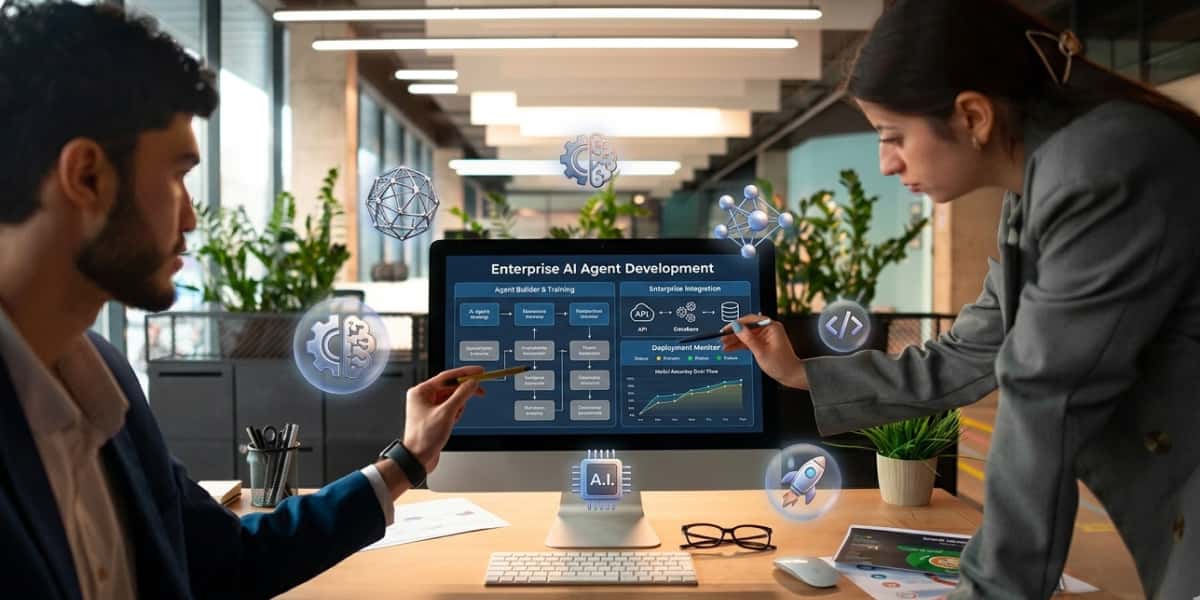
Enterprise AI agent development is the process of building intelligent software agents that can understand information, make decisions, perform tasks, and improve business operations with little human input. These AI agents help companies automate customer service, operations, finance, IT support, sales, and many other business functions.
Table of Contents
- What Is Enterprise AI Agent Development?
- Why Businesses Need AI Agents
- How Autonomous AI Agents Work
- Key Components of Enterprise AI Agents
- Benefits of Enterprise AI Agent Development
- Real-World Business Use Cases
- Enterprise AI Agent Development Process
- Common Challenges and Solutions
- Best Practices for Success
- Future of Enterprise AI Agents
- FAQs
- Conclusion
What Is Enterprise AI Agent Development?
Many businesses struggle with slow processes, rising costs, and too much manual work.
Teams spend hours on repetitive tasks. Customer requests pile up. Data sits in different systems.
This is where enterprise AI agent development helps.
Enterprise AI Agent Development is the process of creating intelligent software agents that can:
- Understand business data
- Make decisions
- Perform actions
- Communicate with systems
- Learn from outcomes
Unlike traditional automation, AI agents can adapt to new situations and solve problems without following fixed rules.
Think of them as digital employees that work 24/7.
AI Agent vs Traditional Automation

For businesses looking to build custom AI solutions, advanced AI agent development focuses on creating autonomous systems tailored to specific operational goals.
Why Businesses Need AI Agents
The Problem
Modern companies face several challenges:
- Growing operational costs
- Staff shortages
- Slow customer response times
- Too many manual processes
- Data overload
- Competitive pressure
Many organisations cannot scale efficiently because employees spend too much time on repetitive work.
The Solution
Enterprise AI agents solve these problems by:
- Automating repetitive work
- Making faster decisions
- Reducing human errors
- Working around the clock
- Improving customer experiences
According to McKinsey, organisations using advanced AI automation often see significant productivity improvements across business functions.
How Autonomous AI Agents Work
AI agents follow a simple cycle.
Step 1: Understand
The agent collects information from:
- CRM systems
- ERP platforms
- Databases
- Emails
- Documents
- Customer interactions
Step 2: Analyze
The AI evaluates:
- Business goals
- Context
- Historical data
- Current conditions
Step 3: Decide
The system determines:
- Best action
- Priority level
- Required resources
Step 4: Act
The AI performs tasks through:
- APIs
- Business software
- Internal systems
- External platforms
Step 5: Learn
The agent improves through feedback and performance data.
Example
A customer asks about an order.
The AI agent:
- Receives the request
- Finds the order
- Checks shipping status
- Creates a response
- Sends the answer
- Updates records
The entire process happens automatically.
Key Components of Enterprise AI Agents
Large Language Models (LLMs)
LLMs provide:
- Reasoning
- Language understanding
- Decision support
Examples include GPT, Claude, Gemini, and enterprise models.
Memory Systems
Memory allows agents to:
- Remember past actions
- Track conversations
- Store business knowledge
Planning Engine
Planning systems help agents:
- Break down goals
- Prioritize tasks
- Execute workflows
Tool Integration
Agents connect with:
- Salesforce
- HubSpot
- SAP
- ServiceNow
- Microsoft Dynamics
- Slack
Security Layer
Enterprise systems require:
- Data protection
- Access control
- Compliance monitoring
Benefits of Enterprise AI Agent Development
1. Lower Costs
AI agents reduce operational expenses by handling repetitive work automatically.
Examples
- Customer support
- Invoice processing
- Data entry
- Report generation
2. Faster Operations
Tasks that once took hours can now take minutes.
3. Better Customer Service
Customers receive:
- Faster answers
- 24/7 support
- Personalized experiences
4. Improved Accuracy
AI agents reduce:
- Manual mistakes
- Process delays
- Data inconsistencies
5. Greater Scalability
Businesses can grow without hiring large teams.
Enterprise AI Agent Development Use Cases
Customer Support
Problems
- Long wait times
- High support costs
- Ticket overload
Solution
AI agents can:
- Answer questions
- Resolve issues
- Escalate complex cases
Results
- Faster response times
- Lower support costs
- Better customer satisfaction
Sales Operations
AI agents help sales teams by:
- Qualifying leads
- Scheduling meetings
- Updating CRM records
- Following up automatically
Human Resources
HR teams use AI agents for:
- Employee onboarding
- Candidate screening
- Policy questions
- Leave management
Finance
Finance departments automate:
- Invoice processing
- Expense approvals
- Risk monitoring
- Compliance reporting
IT Operations
AI agents can:
- Detect issues
- Monitor systems
- Resolve incidents
- Create support tickets
Supply Chain Management
Agents improve:
- Inventory tracking
- Demand forecasting
- Logistics planning
- Vendor coordination
Enterprise AI Agent Development Process
Step 1: Identify High-Impact Problems
Start with areas that create the biggest bottlenecks.
Questions to ask:
- What consumes the most time?
- Where do errors occur?
- Which tasks are repetitive?
Step 2: Define Business Goals
Examples:
- Reduce support costs by 30%
- Improve response times by 50%
- Increase productivity by 40%
Step 3: Choose the Right Architecture
Options include:
Single-Agent Systems
One agent handles a specific task.
Multi-Agent Systems
Several agents collaborate toward a goal.
Step 4: Connect Data Sources
Integrate:
- Databases
- CRM platforms
- ERP systems
- Business applications
Step 5: Test Thoroughly
Measure:
- Accuracy
- Reliability
- Security
- Performance
Step 6: Deploy and Improve
Monitor:
- KPIs
- User adoption
- ROI
- System performance
Common Challenges and Solutions

Best Practices for Successful AI Agent Deployment
Start Small
Begin with one process.
Scale after proving value.
Keep Humans Involved
Use human oversight for:
- Sensitive decisions
- Compliance checks
- Customer escalations
Measure Results
Track:
- Cost savings
- Productivity gains
- Customer satisfaction
Build Securely
Implement:
- Access controls
- Encryption
- Audit logs
Focus on User Experience
Successful AI projects improve employee and customer experiences.
Future of Enterprise AI Agents
The future is moving toward fully autonomous operations.
Key trends include:
Multi-Agent Collaboration
Specialised agents working together.
Autonomous Workflows
AI handling entire business processes.
Industry-Specific Agents
Custom solutions for:
- Healthcare
- Finance
- Manufacturing
- Retail
Agentic AI Ecosystems
Networks of AI agents collaborating across organisations.
Companies adopting AI agents today will likely gain a strong competitive advantage over the next decade.
Quick Comparison: Traditional Software vs AI Agents

Frequently Asked Questions
1. What is Enterprise AI Agent Development?
Enterprise AI agent development is the creation of intelligent software systems that automate business tasks and make decisions with minimal human involvement.
2. How do enterprise AI agents differ from chatbots?
Chatbots mainly answer questions. AI agents can analyse data, make decisions, and perform actions across multiple systems.
3. Are AI agents safe for businesses?
Yes. When implemented with security controls, governance, and monitoring, AI agents can operate securely.
4. Which industries benefit most from AI agents?
Healthcare, finance, retail, manufacturing, logistics, technology, and customer service industries benefit significantly.
5. How much does enterprise AI agent development cost?
Costs vary based on complexity, integrations, and business requirements.
6. Can AI agents replace employees?
AI agents are designed to assist employees, automate repetitive work, and improve productivity rather than fully replace people.
7. How long does implementation take?
Simple deployments may take a few weeks, while enterprise-wide systems can take several months.
8. What technologies power AI agents?
Common technologies include large language models, machine learning, vector databases, APIs, and workflow automation tools.
Conclusion
Businesses today face increasing pressure to do more with fewer resources.
Manual processes, rising costs, and growing customer expectations make traditional operations difficult to scale.
Enterprise AI Agent Development offers a practical solution.
By automating repetitive work, improving decision-making, and operating around the clock, AI agents help organisations become faster, smarter, and more efficient.
The businesses that start building AI-powered operations today will be better prepared for tomorrow's competitive landscape.
Ready to Build Enterprise AI Agents?
Discover how custom AI solutions can automate workflows, reduce costs, and transform operations across your organisation. Start exploring enterprise-grade AI agent development strategies today.