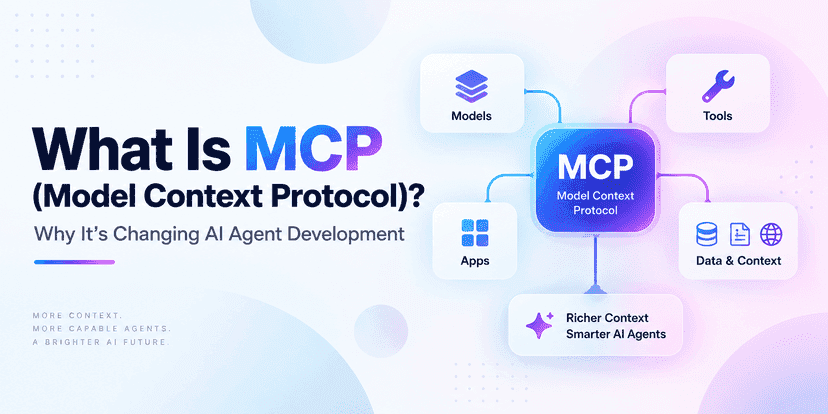
What Is MCP (Model Context Protocol)? Why It’s Changing AI Agent Development
 Sasikumar
AI agents are getting better at reasoning.
But reasoning alone does not make an agent useful.
Imagine asking an AI agent:
“Check whether the customer has paid the latest invoice. If they have, update the CRM and send the onboarding email.”
The AI may understand the request perfectly.
But it still needs access to three different systems:
The billing platform.
The CRM.
The email service.
Without those connections, the agent can explain what should happen but cannot actually complete the work.
Developers have traditionally solved this by building custom integrations.
One API for the CRM.
Another for billing.
Another for email.
Then more code for authentication, schemas, permissions, errors, and tool descriptions.
Add another AI application and some of that work may need to be done again.
Model Context Protocol, or MCP, is trying to simplify that problem.
MCP provides a standard way for AI applications and agents to discover and use external tools, data, and services.
That sounds like a small infrastructure change.
For AI agent development, it is much bigger.
What Is MCP?
MCP stands for Model Context Protocol.
It is an open protocol designed to connect AI applications with external systems.
Those systems might include:
- Databases
- CRMs
- File systems
- Business applications
- Developer tools
- Search systems
- APIs
- Internal knowledge
- Cloud services
Anthropic introduced MCP in November 2024 as an open standard for connecting AI assistants with the systems where data lives. The idea was to reduce the need for a separate custom integration every time an AI application needed a new source of context or a new tool.
Since then, MCP has moved well beyond its early use as a way to connect local AI tools. The current project describes it as infrastructure for agentic workflows, and the July 2026 specification introduced a stateless protocol core and further security and authorisation improvements.
The important idea is simple:
MCP gives AI applications a common way to understand what an external system can provide and how to use it.
Why Did AI Agents Need Something Like MCP?
The problem becomes easier to understand when you look at how agents were often built before MCP.
Suppose you are building an AI sales assistant.
It needs to:
Read customer details from Salesforce.
Check an account in your billing platform.
Search product documentation.
Create a task in your project system.
Send an email.
Every service has its own API.
Each API has different authentication.
Each response has a different structure.
Each tool needs to be explained to the AI.
You may end up writing a lot of integration code before the agent does anything useful.
Now imagine building another agent.
This one supports customer service.
It needs access to some of the same systems.
You may find yourself solving similar integration problems again.
MCP introduces a common interface between the AI application and those external capabilities.
Instead of teaching every agent about every system from scratch, developers can expose approved functionality through MCP servers.
How Does MCP Work?
The basic MCP architecture has two important sides:
MCP client
and
MCP server
The client normally lives inside the AI application or agent platform.
The server exposes capabilities that the AI application can use.
A simple flow may look like this:
User
↓
AI Agent
↓
MCP Client
↓
MCP Server
↓
Business System
Suppose the user asks:
“What is the status of order #5821?”
The agent understands that it needs order information.
An MCP server may expose an approved tool for checking order status.
The agent calls that tool.
The server connects to the real order system.
The result comes back.
The AI turns the structured result into a useful response.
The model does not need unrestricted access to the order database.
It only needs access to the capability you chose to expose.
That distinction matters.
What Does an MCP Server Provide?
MCP has several concepts, but three are especially useful when first learning the protocol.
Tools
Tools allow an AI application to perform an operation.
For example:
get_customer
search_orders
create_support_ticket
check_inventory
schedule_meeting
send_invoice
The model can decide when a tool is useful based on the user's request and the information provided about that tool.
Resources
Resources provide information the AI application can use.
A resource may represent:
A document.
A file.
Database information.
Configuration.
Business knowledge.
A developer repository.
Resources are useful when the AI needs context rather than an action.
Prompts
MCP can also expose reusable prompt templates or workflows.
These can help applications provide structured ways to perform common tasks.
Together, these concepts give AI applications a clearer way to discover what an external system offers.
MCP Is Not the AI Agent
This is an important distinction.
MCP does not make decisions for the agent.
It does not replace the language model.
It does not decide your business workflow.
It does not automatically make an AI system intelligent.
MCP is the connection layer.
Think about an employee.
Their intelligence and judgement are one thing.
Their access to email, CRM, reports, and company tools is another.
An AI agent has a similar problem.
The language model provides reasoning.
MCP can help provide structured access to the systems the agent needs.
You still need to design what the agent should be allowed to do.
Why Is MCP Changing AI Agent Development?
The biggest shift is not that MCP makes integrations possible.
Developers could already connect AI systems to APIs.
The shift is standardisation.
Standards reduce repeated work.
The web became easier to build because browsers and servers agreed on protocols.
Email works across different providers because common standards exist.
MCP is trying to bring a similar idea to AI-tool connectivity.
That can change agent development in several ways.
1. Agents Can Connect to More Systems Without Starting From Zero
Before MCP, an AI team might write a custom connector for every application.
That can become difficult as the number of systems grows.
Imagine an enterprise agent that needs:
CRM access.
Support tickets.
Internal documentation.
Analytics.
Cloud storage.
Project management.
Source code.
Databases.
Building eight connections is manageable.
Building dozens becomes a larger platform problem.
With MCP, each system can expose capabilities through a standard interface.
The agent still needs security and business rules, but developers spend less time inventing the connector pattern itself.
2. Tools Can Become Reusable
Suppose your company creates an MCP server for its internal product database.
Today, your customer-support agent uses it.
Tomorrow, your sales assistant may use the same approved server.
Later, an internal operations agent may use it too.
You do not necessarily need to rebuild the same integration every time a new agent appears.
That changes the economics of agent development.
Integration work becomes reusable infrastructure rather than code tied to one chatbot.
3. AI Models Become Easier to Change
AI models are improving quickly.
A company may use one model today and a different one next year.
If every business integration is tightly connected to one model's custom tool format, switching models can become harder.
MCP creates another layer between the model and the systems around it.
A simplified architecture may look like:
AI Model
↓
Agent Runtime
↓
MCP
↓
Company Tools
The goal is not perfect model independence.
Real applications still have model-specific behaviour.
But reducing the number of direct integrations can make the architecture easier to change.
4. AI Agents Can Move From Answering to Acting
Many early generative AI products followed one pattern:
User asks a question.
AI generates text.
Conversation ends.
Agents are different.
An agent may need to complete work.
For example:
A customer asks to move an appointment.
The agent checks available slots.
It verifies the customer's booking.
It offers suitable times.
The customer chooses one.
The agent updates the appointment.
It sends a confirmation.
The AI is no longer only generating text.
It is coordinating a workflow.
MCP becomes useful because these workflows depend on access to real systems and tools.
5. Developers Can Focus More on Agent Behaviour
Without a common integration layer, a large amount of development time can disappear into connector code.
Once connectivity becomes more standardised, teams can spend more time on harder questions.
Should the agent take this action?
Does it need confirmation?
What happens when a tool fails?
Which information should the model see?
How should the agent recover from an error?
Should a human approve this step?
Those questions have more impact on the quality of the product than the syntax of another API wrapper.
A Real-World MCP Example
Consider a B2B company that receives this request:
“Our customer Acme renewed their subscription. Make sure their account is active and tell the account manager.”
An AI agent may need several systems.
First, it checks the billing platform.
The subscription is active.
Next, it checks the CRM.
It finds the account manager.
Then it updates the customer's account.
Finally, it creates a notification for the account manager.
Behind the scenes, the agent may have access to MCP tools such as:
get_subscription_status
find_customer
activate_account
get_account_manager
create_notification
The model decides which capability is needed at each stage.
But the MCP server controls how those capabilities connect to the actual business applications.
This is much safer than giving the model unrestricted database access.
Build an AI agent for your SaaS platform
MCP vs Traditional APIs
MCP does not replace APIs.
This is one of the most common misunderstandings.
Your CRM will still have an API.
Your accounting system will still have an API.
Your database still needs normal database access.
MCP can sit above those systems and expose selected capabilities in a form that AI applications understand.
For example:
Your CRM API might provide hundreds of endpoints.
Your AI agent may only need four actions:
Find customer
Read customer status.
Create a note.
Update follow-up date
An MCP server can expose those specific capabilities.
The normal CRM API still works underneath.
MCP is the AI-facing interface.
MCP vs Function Calling
Function calling lets an AI model choose and invoke functions defined by an application.
That is useful.
MCP solves a broader integration problem.
With function calling, the application normally defines the tools available to the model.
With MCP, tools and other capabilities can be exposed through standardised external servers.
You can also use both.
For example:
Model function/tool calling
↓
Agent runtime
↓
MCP server
↓
Business API
They are not competing ideas.
MCP can become part of the infrastructure behind tool-enabled models.
MCP vs RAG
MCP and Retrieval-Augmented Generation, or RAG, also solve different problems.
RAG usually helps the AI find relevant information before answering.
For example:
A support assistant searches company documentation.
It retrieves the right pages.
The model uses those pages to answer the question.
MCP can help expose that search system to the AI.
But MCP can also expose actions.
An MCP-enabled agent might:
Search the support documentation.
Check the customer's order.
Create a support ticket.
Schedule a callback.
RAG mainly improves access to knowledge.
MCP can provide access to knowledge and tools.
Why MCP Matters for Enterprise AI Agents
Enterprise agents rarely live inside one isolated application.
They need to interact with existing systems.
That creates several problems:
Access.
Authentication.
Permissions.
Auditability.
Integration maintenance.
Tool discovery.
Error handling.
Security.
MCP does not magically solve all of them.
But a standard integration layer gives companies a more consistent place to address those problems.
The MCP project has continued to put significant attention on enterprise authorisation. The July 2026 specification added further authorization hardening, while enterprise-managed authorisation is now available as a stable extension.
That work matters because agents are becoming more powerful.
The more an agent can do, the more important access control becomes.
Security Becomes Critical With MCP
Giving an AI agent access to tools creates risk.
Suppose an agent can:
Read financial records.
Delete files.
Send emails.
Issue refunds.
Change customer information.
Deploy software.
One bad decision can now have consequences outside the chat window.
That means developers should treat MCP tools like real application permissions.
A useful rule is:
Give an agent the minimum access needed to complete its task.
A support agent that needs to check an order should not automatically receive permission to delete the order.
A reporting assistant that only reads analytics should not have write access.
MCP's security work increasingly focuses on authorisation and identity because this problem becomes more important as agents move into enterprise environments.
Human Confirmation Still Matters
Not every agent action should happen automatically.
Imagine an AI assistant preparing a refund.
There are several possible designs.
Bad design:
The customer asks for a refund → AI issues a refund.
Safer design:
Customer asks for refund → AI checks eligibility → AI prepares refund → User or employee confirms → System processes refund
MCP makes the tool available.
Your product decides when that tool may be called.
For low-risk tasks, automation may be fine.
For financial, legal, medical, security, or destructive actions, stronger controls may be needed.
MCP Makes Multi-Agent Systems More Interesting
Now imagine several agents working together.
A sales agent identifies an opportunity.
A research agent gathers background.
A pricing agent prepares options.
A contract agent creates a draft.
Each agent may need different systems.
MCP can give those agents standardised access to shared business capabilities.
That does not automatically solve agent-to-agent communication.
But it makes the tool and context side of the architecture easier to organise.
The MCP roadmap for late 2026 includes continued work around agent identity and enterprise security as agents increasingly run as independent cloud workloads rather than only acting during a user-controlled chat session.
Where Can MCP Be Used?
MCP can support many agent use cases.
Customer Support Agents
An agent could search documentation, check orders, review account history, and create support tickets.
Sales Agents
The agent could search leads, update CRM records, research accounts, and prepare meeting notes.
Developer Agents
Developer agents can work with repositories, documentation, databases, issue trackers, CI systems, and development tools.
Finance Agents
An approved agent could retrieve invoice information, reconcile records, prepare reports, or flag unusual transactions.
HR Agents
An HR assistant could search company policies, check leave information, answer employee questions, or prepare routine requests.
Operations Agents
An operations agent could connect inventory, logistics, customer, and workflow systems to help teams manage daily tasks.
The value is not the conversation.
The value is completing useful work across existing systems.
MCP Apps Are Expanding What Agents Can Show
Agent interactions do not have to be text only.
The MCP ecosystem has also introduced MCP Apps, which allow MCP tools to return interactive user interfaces that a host application can render.
For example, instead of an agent returning hundreds of database rows as text, an MCP app could let the user interact with a table or visualisation.
This is another sign of where agent development is going.
The agent may increasingly become a coordinator between:
Reasoning.
Tools.
Data.
Actions.
And interactive interfaces.
MCP Has Changed Quickly
MCP is still a young technology.
The protocol was introduced in late 2024.
By 2026, it had already gone through major specification changes.
The July 2026 release introduced a stateless protocol core, improved authorisation, caching support, extensions, and changes to several earlier protocol features.
That is important for development teams.
Do not build your architecture around old tutorials without checking the current specification.
For example, the latest specification deprecated several earlier concepts, including Roots, Sampling, Logging, and the legacy HTTP+SSE transport for new implementations.
MCP is becoming more mature, but it is still evolving.
Does Every AI Agent Need MCP?
No.
This is where teams can over-engineer a product.
Imagine you are building a simple AI writing assistant.
The user enters a paragraph.
The model rewrites it.
Nothing else happens.
You probably do not need an MCP architecture.
Now consider an agent that needs:
Google Drive.
A CRM.
A database.
Support tickets.
Calendar access.
Internal search.
Billing.
Email.
That is a different problem.
MCP becomes more valuable as the number of integrations and reusable agent tools grows.
Use it because it solves an integration problem.
Do not use it because it is a popular AI term.
Common Mistakes When Building With MCP
Exposing Too Many Tools
An agent rarely needs every function your system supports.
Expose the smallest useful set.
Giving Tools Too Much Permission
Read access and write access are very different.
Treat permissions carefully.
Trusting Model Output Without Validation
The model may select a tool correctly but still provide bad arguments.
Validate inputs before changing real business data.
Skipping Human Approval
High-impact actions may need confirmation.
Build that into the workflow.
Putting Business Rules Inside the Prompt
Important rules should live in normal application code where possible.
A prompt should not be the only thing preventing an unauthorised refund.
Ignoring Tool Errors
APIs fail.
Databases time out.
Credentials expire.
Agents need clear fallback behaviour.
Using MCP Where a Simple API Call Is Enough
Not every integration needs an agent protocol.
Keep simple systems simple.
How Should Businesses Start With MCP?
Start with one real workflow.
Not an “AI agent platform".
Imagine your support team spends ten minutes on every refund request because employees must check three systems.
That is a useful starting point.
Map the process.
Find the tools the agent would need.
Decide which steps can be read-only.
Decide where human approval is required.
Then expose only those capabilities.
A narrow agent that reliably completes one expensive workflow is usually more valuable than an impressive demo that has access to twenty systems but cannot be trusted with any of them.
What Does MCP Mean for the Future of AI Agent Development?
AI models will continue to change.
Some will become faster.
Some will become cheaper.
Others will improve at planning or reasoning.
But businesses still have the same problem:
Their valuable information and actions live inside real systems.
Agents need a safe way to reach them.
That is why MCP matters.
The biggest shift in agent development may not be a smarter model.
It may be the move from:
Every agent builds its own integrations.
to:
Business capabilities are exposed once and reused by many AI applications.
If that pattern continues, MCP could become an important part of the infrastructure behind enterprise AI agents.
The model may change.
The interface may change.
The agent framework may change.
The business tools will still need a reliable way to connect.
Frequently Asked Questions
What is MCP in AI?
MCP, or Model Context Protocol, is an open protocol that lets AI applications connect with external tools, data sources, and services through a standard interface.
Who created the Model Context Protocol?
Anthropic introduced Model Context Protocol as an open-source standard in November 2024. It has since developed into a broader open-source protocol ecosystem with community maintainers and contributors.
Why is MCP important for AI agents?
AI agents need access to real tools and business data to complete tasks. MCP provides a standard way to expose those capabilities, reducing the need for separate custom integration patterns for every agent.
Is MCP an API?
MCP is a protocol rather than a replacement for normal APIs. An MCP server often connects to existing APIs, databases, or services and exposes selected capabilities to AI applications.
Does MCP replace function calling?
No. Function calling and MCP can work together. Function calling helps a model select tools, while MCP can provide a standardised way for an application to discover and connect to external tools.
What is an MCP server?
An MCP server exposes approved tools, resources, prompts, or other capabilities that an MCP-enabled client can discover and use.
What is an MCP client?
An MCP client is the part of an AI application that communicates with MCP servers. It discovers available capabilities, sends requests, and receives results.
Is MCP only for Claude?
No. MCP is an open protocol and is not limited to one AI model. Its purpose is to provide a common integration layer that can be used by different AI applications and development environments.
Is MCP secure?
MCP includes authorisation mechanisms, but security still depends on how the application is built. Developers need authentication, least-privilege access, input validation, user confirmation, logging, and normal application security controls.
Does every AI agent need MCP?
No. A simple AI feature that calls one model may not need MCP. MCP becomes more useful when agents need access to several tools, systems, or reusable data sources.
Can MCP connect to a database?
Yes. An MCP server can expose carefully designed database operations to an AI application. Direct unrestricted database access is usually not a good design; expose only the queries or actions the agent actually needs.
Is MCP the future of AI agents?
MCP is becoming an important standard for connecting agents with external systems, but it is still evolving. It is best viewed as one part of a wider agent architecture rather than a complete agent-development solution.
Ready to Build an AI Agent That Can Do Real Work?
A useful AI agent needs more than a good prompt.
It needs access to the right information.
It needs clear permissions.
It needs safe tools.
And it needs business rules that still apply when the model makes a mistake.
MCP can make those connections easier to organise, but the value still comes from choosing the right workflow and designing it carefully.
At InfiniappsAI, we help businesses turn AI ideas into practical applications by connecting models, APIs, data, backend systems, and business workflows.
If you are planning an MCP-enabled AI agent, talk to our development team about the architecture, integrations, security, and first workflow worth automating.