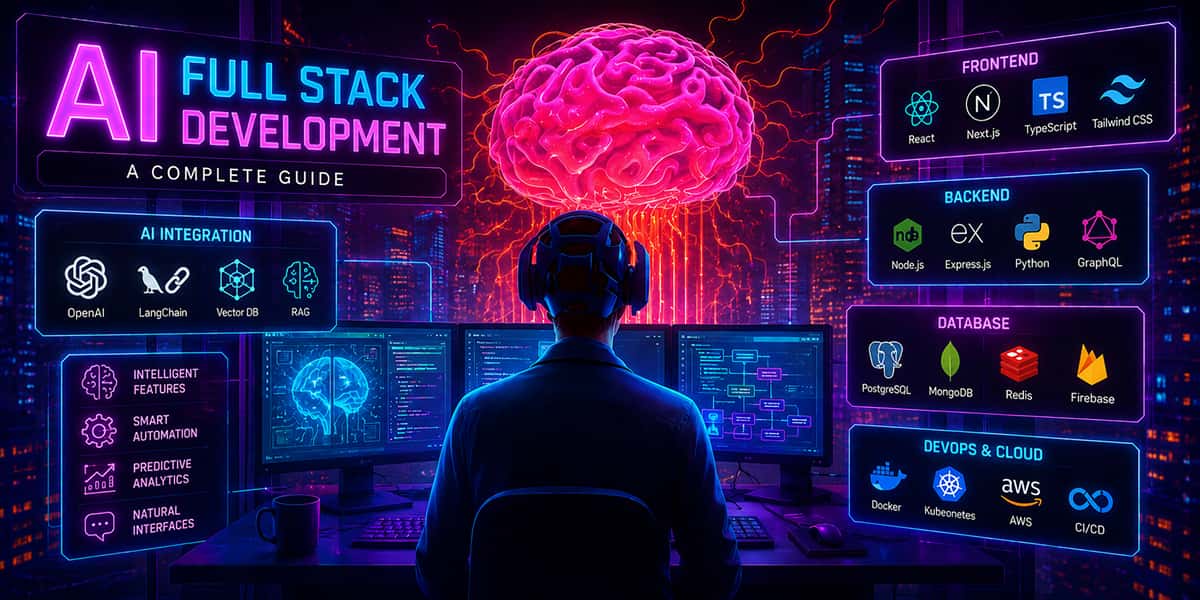
How AI Agents Are Reshaping Full-Stack SaaS Development
 Naveen KT
SaaS development is getting harder.
Users expect:
- Faster apps
- Zero downtime
- Instant updates
- Smart features
But development teams face
- Tight deadlines
- Rising cloud costs
- Complex infrastructure
- Growing codebases
This is where AI agents change the game.
AI agents are not just tools.
They act like digital teammates.
They think. They plan. They execute. They improve.
If you build SaaS products, AI agents can:
- Reduce build time
- Cut operational costs.
- Improve code quality
- Prevent downtime
- Scale systems automatically
This guide explains exactly how.
AI agents reshape full-stack SaaS development by automating coding, testing, monitoring, and scaling. They reduce manual work, improve reliability, and help SaaS teams ship faster with lower cost and fewer errors.
What Is an AI Agent in SaaS?
An AI agent is a smart system that can:
- Understand a goal
- Make decisions
- Take action
- Learn from results
Unlike basic automation, AI agents:
- Adapt to changes
- Analyze patterns
- Improve over time
In full-stack SaaS, they support:
- Frontend
- Backend
- Database
- DevOps
- Testing
The Real Problem in Full-Stack SaaS Today
Before AI agents, teams face the following:
- Repetitive debugging
- Manual testing cycles
- Infrastructure surprises
- Late-night deployment failures
- Slow feature rollouts
These issues cost:
- Time
- Money
- Customer trust
AI agents reduce these risks.
Where AI Agents Reshape Full-Stack SaaS
Let’s break it down layer by layer.
1. Frontend Development
The frontend drives user experience.
AI agents help by:
- Generating UI components
- Detecting layout issues
- Personalizing dashboards
- Improving UX flows
Example:
If users ignore a feature, the agent detects low interaction and suggests layout change.
Result:
- Higher engagement
- Better retention
2. Backend Development
The backend handles logic and APIs.
AI agents:
- Suggest API structure
- Refactor inefficient code
- Detect security gaps
- Optimize performance
They scan:
- API response time
- Memory usage
- Error logs
Result:
- Faster APIs
- Cleaner architecture
- Stronger security
3. Database Optimisation
Databases slow down as data grows.
AI agents:
- Detect slow queries
- Suggest indexing
- Predict storage growth
- Identify unused data
Result:
- Faster queries
- Stable performance
- Lower infrastructure waste
4. DevOps and Infrastructure
Downtime reduces SaaS revenue.
AI agents:
- Monitor system health
- Predict traffic spikes
- Auto-scale resources
- Detect unusual behaviour.
Instead of reacting after failure, teams prevent it.
5. Automated Testing
Testing is time-heavy.
AI agents:
- Generate test scripts
- Run regression tests
- Detect edge cases
- Flag risky changes
Result:
- Fewer bugs
- Faster releases
Measurable Business Impact
Companies adopting AI agents often see:
- 30–40% faster development cycles
- 20–35% fewer production bugs
- Reduced cloud waste
- Faster deployment time
- Higher uptime
AI agents reduce cost and increase stability.
Step-by-Step Implementation Roadmap
Follow this structured approach.
Step 1: Identify One High-Impact Area
Start with:
- Automated testing
- Monitoring
- Code review
- Scaling
Do not automate everything at once.
Step 2: Define Clear Metrics
Measure:
- Deployment speed
- Bug frequency
- Downtime hours
- Developer hours saved
Without metrics, ROI cannot be measured.
Step 3: Integrate With Core Systems
AI agents must connect to:
- Code repository
- CI/CD pipeline
- Database
- Monitoring tools
Seamless integration is critical.
Step 4: Train Using Real Data
Feed the agent:
- Codebase
- Logs
- User behavior data
- Documentation
The more relevant data, the better the performance.
Step 5: Maintain Human Oversight
AI agents assist.
Engineers review decisions.
Balanced automation ensures quality control.
Common Mistakes to Avoid
Avoid these common errors:
- Full automation too fast
- No security validation
- No performance monitoring
- No measurable goals
Adopt gradually. Scale wisely.
AI Agents vs Traditional Automation
Traditional automation:
- Fixed rules
- No learning
- Manual updates required
AI agents:
- Learn patterns
- Adapt to changes
- Make contextual decisions
This adaptability reshapes SaaS development.
Who Should Adopt AI Agents Now?
AI agents are ideal for:
- SaaS startups
- Scaling tech companies
- Product-based businesses
- Cloud-heavy platforms
If you handle frequent deployments or large user bases, AI agents provide strong ROI.
- AI agents automate coding, testing, and monitoring.
- They improve speed, reduce cost, and enhance reliability.
- They work across frontend, backend, database, and DevOps.
- Adoption should start small with measurable goals.
- Human oversight remains important.
AI agents are transforming SaaS from manual-heavy development to intelligent automation-driven systems.
Frequently Asked Questions
What is an AI agent in SaaS?
It is a smart system that can plan, decide, and act to automate development tasks.
Do AI agents replace developers?
No. They reduce repetitive work and improve efficiency.
Are AI agents expensive?
Cost depends on scope. Start small for controlled investment.
Can startups benefit?
Yes. Startups gain faster releases and lower operational costs.
Key Takeaways
- AI agents reduce manual work.
- They improve speed and safety.
- They help across frontend, backend, and DevOps.
- Start small and track results.
- Keep humans involved.
Final Thoughts
Full-stack SaaS development is evolving.
Manual-heavy workflows are slowing teams down.
AI agents introduce:
- Intelligent automation
- Continuous monitoring
- Smart scaling
- Faster innovation
They are not future tools.
They are present-day competitive advantages.
SaaS companies that adopt early tend to move faster.
Those who delay risk higher cost and slower growth.
The shift has started.
The question is simple:
Will your SaaS platform evolve with AI agents—or compete against companies that already have them?
Ready to Build an AI-Driven SaaS Product?
If you are planning to build or scale a SaaS product, an AI-powered full-stack approach can reduce development time by up to 30%.
Our AI-driven full-stack development team helps businesses:
- Build scalable SaaS platforms
- Integrate custom AI agents
- Optimize development cost
- Accelerate product launch
Contact us to discuss your project and see how AI can improve your software strategy.