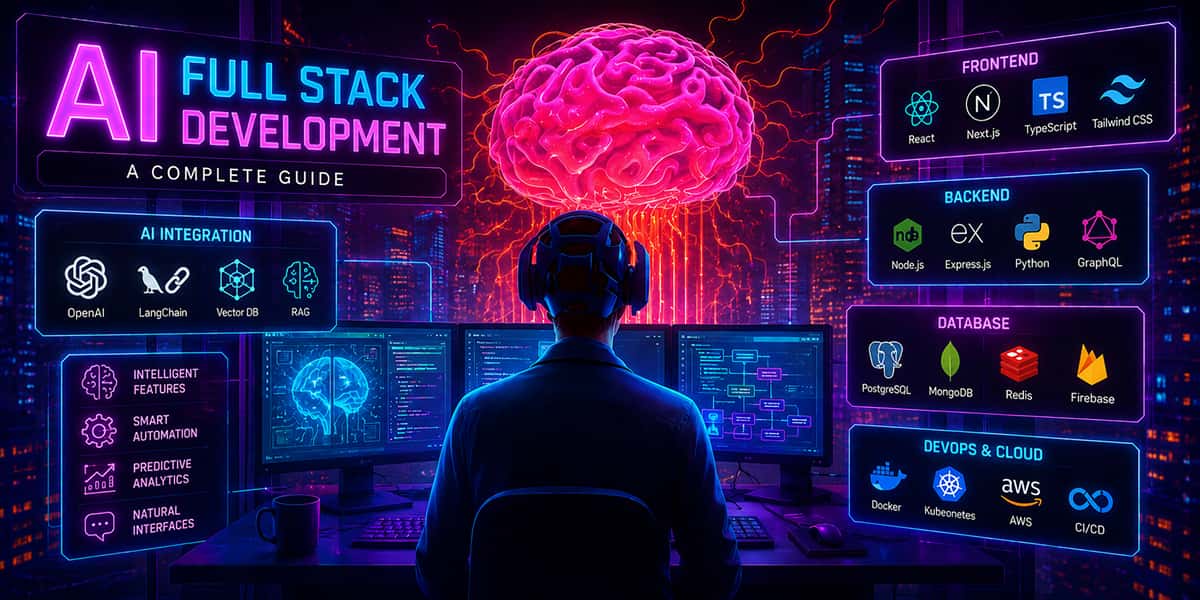
The Rise of AI-Native Full-Stack Development
 Naveen KT
AI-powered full-stack development is the practice of using AI tools to assist with building software across frontend, backend, databases, testing, and deployment. Developers use tools like ChatGPT, GitHub Copilot, and Cursor to generate and improve code faster.
AI-powered full-stack development is a new way to build software using artificial intelligence tools across the entire development stack.
Developers now use AI tools like ChatGPT, GitHub Copilot, and Cursor to help build:
- Frontend interfaces
- Backend APIs
- Databases
- Tests
- Deployment pipelines
Instead of writing every line of code manually, developers guide AI systems to generate, review, and improve code.
This approach helps teams:
- build software faster
- reduce development costs
- launch products quickly
- automate repetitive coding tasks
AI-powered development is quickly becoming the new standard workflow for modern developers.
What Is AI-Powered Full-Stack Development?
AI-powered full-stack development means using artificial intelligence tools to assist in building software across the entire technology stack.
The full stack includes the following:
- Frontend applications
- Backend services
- Databases
- APIs
- Testing systems
- Deployment infrastructure
AI tools can help developers generate code, fix bugs, write tests, and optimize systems.
Simple Definition
AI-powered full-stack development is:
Using AI tools to design, build, test, and deploy complete software applications.
In this model:
- Developers focus on system design and logic
- AI handles repetitive coding tasks
AI becomes a coding partner, not a replacement.
Why AI-Native Development Is Growing Fast
Several major changes are driving the rise of AI-powered development.
1. AI Coding Tools Have Improved Dramatically
Modern AI models understand programming languages, frameworks, and system design.
They can generate working code for:
- React components
- API endpoints
- SQL queries
- test cases
- infrastructure configs
For example, a developer can ask:
Create a REST API in Node.js with JWT authentication and PostgreSQL.
AI tools can generate a full working template in seconds.
Many developers now report that AI helps write 40–80% of their code.
2. Development Is Becoming Much Faster
Traditional development can take weeks or months.
AI-assisted workflows reduce development time dramatically.
Because of this speed, startups can now build Minimum Viable Products (MVPs) in days.
For example, many developers now build MVPs using AI-assisted workflows.
A small startup team can generate a React dashboard and Node.js API using tools like ChatGPT and GitHub Copilot in a few hours instead of several days.
3. Developers Focus on Problem Solving
AI removes many repetitive coding tasks.
Developers now spend more time on:
- architecture design
- product strategy
- performance optimization
- user experience
Coding becomes higher-level engineering work.
4. AI Development Agents Are Emerging
AI tools are evolving from simple assistants to development agents.
AI agents can:
- plan development tasks
- write code across files
- run tests
- fix errors
- refactor code
Some tools can even generate entire applications from prompts.
This shift is accelerating the rise of AI-native development workflows.
What Makes Development “AI-Native”?
Using AI occasionally does not mean a workflow is AI-native.
AI-native development means AI is integrated into every stage of development.
Traditional Development Workflow
- Write code manually
- Test manually
- Debug errors
- Deploy application
AI-Native Development Workflow
- Define feature requirements
- Prompt AI tools
- Generate code
- Review and refine with AI
- Generate automated tests
- Deploy faster
AI becomes part of the entire development lifecycle.
The AI-Powered Full-Stack Development Workflow
Here is a common workflow used by modern AI-assisted development teams.
Step 1: Idea and Planning
Development starts with defining the product idea.
Example prompt:
Build a SaaS dashboard for tracking marketing campaign performance.
AI tools can help developers:
- define system architecture
- choose frameworks
- design data models
This helps teams move from idea to architecture quickly.
Step 2: Frontend Development
AI tools generate frontend components quickly.
Common tasks include:
- creating React components
- building UI layouts
- adding responsive design
- writing form validation logic
Example prompt:
Create a responsive React dashboard with charts and filters using Tailwind CSS.
AI tools return usable frontend code instantly.
Developers then refine and customize the UI.
Step 3: Backend Development
AI tools also assist with backend development.
Typical tasks include:
- building REST APIs
- implementing authentication
- writing business logic
- integrating external services
Example prompt:
Create a Node.js Express API for managing user accounts with JWT authentication.
AI can generate a full project structure in seconds.
Step 4: Database Design
AI tools can generate database schemas based on application needs.
Examples include:
- SQL table structures
- relationships between entities
- optimized queries
- indexing strategies
This can save developers hours of manual work.
Step 5: Testing and Debugging
AI can help generate automated tests.
AI-assisted testing can include:
- unit tests
- integration tests
- error analysis
- debugging suggestions
Developers spend less time identifying bugs.
Step 6: Deployment and DevOps
AI tools are also used for DevOps tasks.
Examples include:
- creating Docker containers
- configuring CI/CD pipelines
- managing cloud deployments
- generating environment configurations
This enables end-to-end AI-assisted development pipelines.
Tools Powering AI-Powered Full-Stack Development
Several tools are leading the AI-native development movement.
ChatGPT
ChatGPT helps developers:
- generate code
- debug errors
- explain frameworks
- write documentation
It acts as a powerful AI coding assistant.
GitHub Copilot
GitHub Copilot provides real-time coding suggestions inside IDEs.
Key benefits:
- faster development
- reduced syntax errors
- automated code completion
Many developers report that Copilot writes 30–40% of their code.
Cursor AI
Cursor is an AI-first code editor designed for AI-native development.
Features include:
- full project understanding
- AI-assisted refactoring
- code generation across files
- automated bug fixing
Replit AI
Replit provides an AI-powered development environment.
Developers can:
- build applications from prompts
- run code instantly
- collaborate online
It is popular for rapid prototyping.
AI Development Agents
AI agents are the next generation of development tools.
They can:
- plan tasks
- generate full project structures
- edit multiple files
- run tests automatically
These tools move development toward automation and autonomous coding.
Benefits of AI-Powered Full-Stack Development
AI-native development offers several major advantages.
Faster Development
AI tools dramatically reduce coding time.
Teams can build software faster by automating repetitive tasks.
Lower Development Costs
Small teams can now build large systems.
AI tools reduce the need for large engineering teams.
Rapid Prototyping
Developers can quickly build MVPs.
This helps startups:
- test ideas quickly
- gather user feedback
- iterate faster
Better Developer Productivity
AI tools act as intelligent assistants.
They help developers:
- learn frameworks faster
- debug issues quickly
- explore new technologies
Challenges of AI-Native Development
AI-powered development also has challenges.
Code Quality Issues
AI-generated code may include:
- inefficient logic
- outdated practices
- security weaknesses
Developers must review AI-generated code carefully.
Over-Reliance on AI
Developers should avoid relying too heavily on AI tools.
Strong programming fundamentals remain important.
Security Risks
AI-generated code can include insecure dependencies.
Security reviews and testing are still required.
Best Practices for AI-Powered Full-Stack Development
Developers can use AI tools more effectively by following these practices.
1. Write Clear Prompts
Clear prompts produce better code.
Example:
Bad prompt:
build login system
Better prompt:
Create a secure JWT authentication system using Node.js Express and PostgreSQL.
2. Review AI-Generated Code
Always review code before deploying.
Check for:
- security issues
- logic errors
- performance problems
3. Use AI for Repetitive Tasks
AI works best for:
- boilerplate code
- documentation
- test generation
- refactoring
This allows developers to focus on architecture.
4. Maintain Strong Architecture
AI writes code.
Developers design systems.
Strong architecture still requires human expertise.
The Future of AI-Powered Development
AI-assisted development is still evolving.
Several trends are shaping the future.
Autonomous AI Developers
Future AI systems may build full applications with minimal human input.
Developers will guide AI rather than write every line of code.
AI-Driven DevOps
AI will automate infrastructure tasks such as:
- deployment
- scaling
- monitoring
- system optimization
Smaller and Faster Engineering Teams
AI tools allow small teams to build complex systems quickly.
This will reshape the software industry.
Why Developers Should Learn AI-Powered Development Now
AI will not replace developers.
But developers who use AI effectively will have a strong advantage.
Learning AI-assisted workflows helps developers:
- build software faster
- stay competitive in the job market
- create more advanced systems
AI acts as a force multiplier for modern software engineering.
Final Thoughts
AI-powered full-stack development is transforming how software is built.
Developers are moving from manual coding to AI-assisted engineering.
The future developer will:
- design systems
- collaborate with AI tools
- build applications faster than ever before
Teams that adopt AI-native development workflows will create better products and innovate faster.
AI is not replacing developers.
It is amplifying what developers can achieve.
At InfiniApps.ai, we help teams build modern applications using AI-powered full-stack development workflows.
Our experts combine AI tools, scalable architecture, and modern frameworks to help businesses build smarter software faster.
Whether you're building a startup MVP, SaaS platform, or AI-driven product, our team can help you move from idea to production quickly.
Explore how InfiniApps.ai can accelerate your AI-powered development journey.