AI Agent Development Company for HR
 Sasikumar
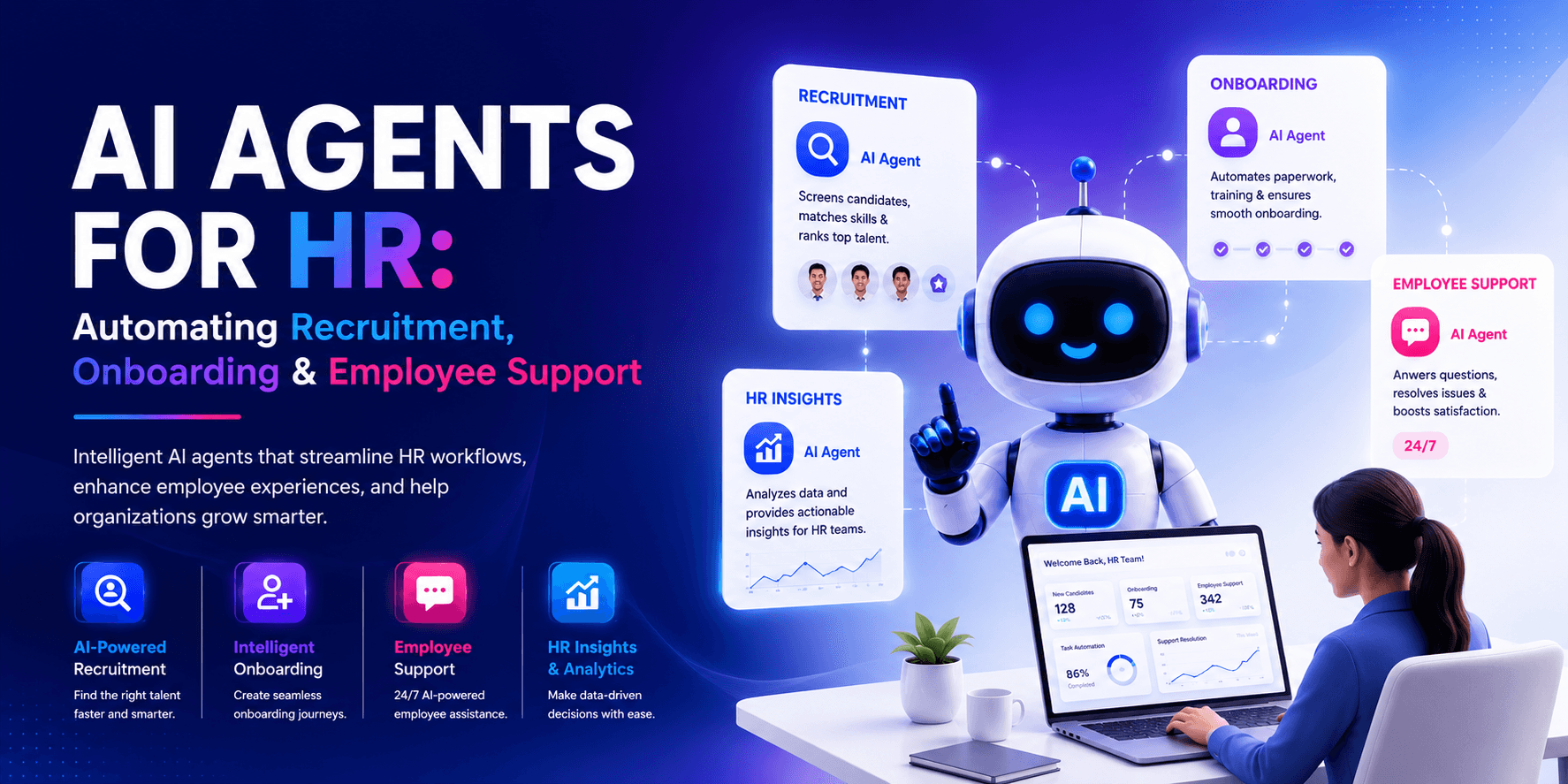
Hiring great talent is becoming harder every year. HR teams spend hours screening resumes, answering employee questions, scheduling interviews, preparing onboarding documents, and managing repetitive administrative tasks. These manual processes slow down hiring, increase costs, and reduce the employee experience.
AI agents are changing this.
Unlike traditional HR software, AI agents can understand requests, make decisions, automate workflows, interact with employees, and continuously improve from organisational knowledge. They help HR teams spend less time on repetitive work and more time on strategic people management.
Whether you are a startup, mid-sized company, or enterprise, AI agents can automate recruitment, employee onboarding, internal support, policy assistance, performance insights, and much more.
What are AI agents for HR?
AI agents for human resources are intelligent software assistants that automate HR tasks such as candidate screening, interview scheduling, employee onboarding, document management, HR support, and workforce analytics.
What can AI agents automate?
- Resume screening
- Candidate ranking
- Interview scheduling
- Employee onboarding
- HR helpdesk
- Leave management
- Policy assistance
- Benefits support
- Employee engagement
- Performance insights
- Document generation
- Internal knowledge search
Key Benefits
- Faster hiring
- Better candidate experience
- Reduced HR workload
- Lower operational costs
- Improved employee satisfaction
- Higher HR productivity
- Data-driven HR decisions
Learn more what an AI agent is.
What Are AI Agents for HR?
An AI agent is an intelligent digital assistant that understands goals, reasons through tasks, uses company knowledge, and performs actions automatically.
Instead of waiting for someone to complete each HR task manually, an AI agent can complete many of them independently.
For example:
An employee asks:
"How many leave days do I have left?"
The AI agent can:
- Understand the request
- Check the HR system
- Retrieve the leave balance
- Explain the policy if needed
- Answer instantly
No manual HR involvement is required.
Similarly, a recruiter can ask:
"Show me the top five candidates for the Senior Java Developer role."
The AI agent can:
- Search resumes
- Compare required skills
- Rank candidates
- Provide reasoning
- Recommend the best matches
This reduces hours of manual work to just a few minutes.
Why Traditional HR Processes Need Improvement
Many HR departments still rely heavily on manual work.
Common challenges include:
Recruitment Delays
Recruiters receive hundreds of resumes for every job posting.
Manually reviewing each application is slow and time-consuming.
As a result:
- Hiring takes longer
- Qualified candidates may lose interest
- Recruiter productivity decreases
Repetitive Employee Questions
Employees frequently ask questions like the following:
- How many leave days do I have?
- Where can I download my salary slip?
- What is the maternity leave policy?
- How do I apply for reimbursement?
- When is the appraisal cycle?
HR teams answer the same questions repeatedly.
This limits their ability to focus on strategic initiatives.
Manual Onboarding
New employee onboarding often includes:
- Collecting documents
- Creating accounts
- Sharing policies
- Scheduling orientation
- Assigning equipment
- Tracking completion
Without automation, onboarding becomes inconsistent and time-intensive.
Limited Employee Experience
Employees expect quick responses.
Waiting hours or days for simple HR queries leads to frustration.
AI agents provide instant support 24/7.
Data Scattered Across Multiple Systems
HR information often exists in different tools:
- HRMS
- Payroll software
- ATS (Applicant Tracking System)
- Knowledge base
- Document storage
- Calendar
Employees struggle to find the information they need.
AI agents connect these systems to deliver accurate answers from one interface.
How AI Agents Work in Human Resources
AI agents combine several technologies to automate HR workflows.
Step 1: Employee or Recruiter asks a question.
Examples:
- Find suitable candidates.
- Schedule an interview.
- Explain the leave policy.
- Generate an offer letter.
Step 2: AI Understands the Intent
The AI identifies what the user wants instead of relying on predefined keywords.
Step 3: The Agent Uses Business Knowledge
It retrieves information from:
- HRMS
- ATS
- Employee handbook
- Internal documents
- Payroll system
- Knowledge base
- Policy documents
Step 4: The Agent Performs Actions
Depending on permissions, the AI agent can:
- Schedule interviews
- Send emails
- Generate offer letters
- Create onboarding tasks
- Update employee records
- Answer employee questions
- Create reports
Step 5: Continuous Learning
The AI improves over time by learning from:
- Frequently asked questions
- HR documents
- Company policies
- Employee interactions
- Feedback
This enables more accurate and personalised responses.
AI Agent vs Traditional HR Software

Traditional HR software stores information.
AI agents help users understand, retrieve, and act on that information intelligently.
Why Businesses Are Investing in AI Agents for HR
Organisations are adopting AI agents because they deliver measurable business value:
- Faster recruitment cycles
- Reduced administrative workload
- Improved candidate experience
- Consistent onboarding
- Better employee engagement
- Increased HR productivity
- Lower operational costs
- More informed workforce decisions
Instead of replacing HR professionals, AI agents handle repetitive work so HR teams can focus on strategic initiatives such as talent development, culture, leadership, and employee experience.
AI Agents for Recruitment: Finding the Right Talent Faster
Recruitment is one of the most time-consuming responsibilities for HR teams. Recruiters often spend hours reviewing resumes, coordinating interviews, communicating with candidates, and following up with hiring managers. AI agents automate these repetitive tasks while helping recruiters make faster and more informed hiring decisions.
Instead of manually reviewing hundreds of applications, an AI agent understands job descriptions, analyses candidate profiles, ranks applicants based on skills and experience, and recommends the best matches.
How AI Agents Improve Recruitment
Resume Screening
An AI agent automatically reviews resumes and compares them with the job requirements.
It can identify:
- Required technical skills
- Years of experience
- Educational qualifications
- Certifications
- Industry experience
- Missing qualifications
Instead of reviewing 500 resumes manually, recruiters receive a shortlist of the most suitable candidates.
Candidate Ranking
Rather than simply filtering resumes by keywords, AI agents evaluate candidates using multiple factors.
For example:
Job Opening
Senior React Developer
Required Skills:
- React
- TypeScript
- Next.js
- REST APIs
The AI agent ranks candidates by matching their skills, experience, and project history to the role.
Recruiters can then focus on interviewing the strongest applicants.
Interview Scheduling
Scheduling interviews often involves multiple emails between recruiters, candidates, and hiring managers.
AI agents simplify this process by:
- Checking interviewer availability
- Finding suitable time slots
- Sending calendar invitations
- Sending reminders
- Rescheduling if needed
This reduces delays and improves the candidate experience.
Candidate Communication
Candidates often ask questions such as:
- What is the interview process?
- What documents should I bring?
- What is the office location?
- Can I reschedule my interview?
AI agents provide instant answers 24/7, keeping candidates informed throughout the hiring process.
Offer Letter Generation
After a candidate is selected, AI agents can automatically:
- Generate offer letters
- Personalize compensation details
- Send documents for approval
- Track acceptance status
This speeds up the hiring process while reducing manual work.
AI Agents for Employee Onboarding
Employee onboarding creates the first impression of an organisation. A smooth onboarding experience helps new employees become productive more quickly.
Unfortunately, many organisations still rely on manual onboarding processes that involve emails, spreadsheets, and paperwork.
AI agents automate the entire onboarding journey.
Document Collection
AI agents remind new employees to upload required documents.
Examples include:
- Aadhaar or Passport
- PAN Card
- Educational certificates
- Experience letters
- Bank account details
- Tax documents
The AI verifies document completeness and notifies HR if anything is missing.
Employee Account Setup
Once onboarding begins, the AI agent can trigger workflows to:
- Create email accounts
- Generate employee IDs
- Assign laptops
- Create system logins
- Grant software access
- Configure security permissions
Instead of multiple departments coordinating manually, these tasks happen automatically.
Personalized Welcome Experience
AI agents create a welcoming experience by providing the following:
- Welcome messages
- Company introductions
- Team information
- Office guidelines
- Training schedules
- Organizational charts
Employees receive relevant information exactly when they need it.
Policy Guidance
New employees often have questions about company policies.
Examples include:
- Work from home policy
- Leave policy
- Travel reimbursement
- Insurance benefits
- Dress code
- Expense claims
Rather than searching through long PDF documents, employees simply ask the AI agent in natural language.
Onboarding Progress Tracking
Managers and HR teams can monitor onboarding status through AI-generated dashboards.
The AI tracks:
- Completed tasks
- Pending documentation
- Training completion
- Equipment allocation
- Policy acknowledgments
This ensures every new hire completes the onboarding process consistently.
AI Agents for Employee Support
Employee support is one of the most valuable applications of AI agents.
HR teams answer hundreds of repetitive questions every month. AI agents provide instant, consistent, and accurate responses around the clock.
HR Helpdesk Automation
Employees commonly ask the following:
- How much leave do I have remaining?
- When will my salary be credited?
- How do I update my bank account?
- What is the medical insurance policy?
- How do I apply for maternity leave?
- Where can I download my payslip?
Instead of creating support tickets, employees receive immediate answers from the AI agent.
Leave Management
AI agents help employees:
- Check leave balances
- Apply for leave
- Cancel leave requests
- Track approval status
- Understand leave policies
Managers can approve or reject leave requests directly through the AI interface.
Payroll Assistance
Payroll-related queries are among the most common HR requests.
AI agents assist employees by providing information about:
- Salary slips
- Tax deductions
- Bonus payments
- Reimbursements
- PF contributions
- Income tax declarations
Employees no longer need to wait for HR to respond.
Benefits Assistance
Organisations often provide benefits such as the following:
- Health insurance
- Life insurance
- Wellness programs
- Retirement plans
- Travel allowances
AI agents explain eligibility, enrolment processes, and claim procedures clearly and instantly.
Policy Search
Finding information in lengthy employee handbooks can be frustrating.
Employees can ask questions such as the following:
- Can I work remotely?
- What is the notice period?
- What is the maternity leave policy?
- Are flexible working hours allowed?
The AI agent searches internal policies and provides clear, context-aware answers.
Real-World Use Cases of AI Agents in HR
Enterprise Recruitment
A multinational company receives over 5,000 job applications every month.
Before AI:
- Manual resume reviews
- Slow interview scheduling
- Delayed hiring
After AI implementation:
- Resume screening completed in minutes
- Automated interview scheduling
- Faster hiring decisions
- Improved candidate experience
Employee Self-Service
An organisation with 3,000 employees receives hundreds of HR queries daily.
Instead of relying on HR staff, employees interact with an AI assistant to:
- Check leave balances
- Download payslips
- Access HR policies
- Update personal information
- Submit HR requests
HR teams spend significantly less time on repetitive administrative tasks.
Onboarding Automation
A growing startup hires 20 new employees every month.
The AI agent automatically:
- Sends welcome emails
- Collects documents
- Creates employee accounts
- Assigns onboarding tasks
- Schedules orientation sessions
- Tracks completion progress
New hires become productive faster while HR manages the process with minimal manual effort.
Business Benefits of AI Agents for HR
Organisations adopting AI agents experience measurable improvements across the employee lifecycle.
Faster Hiring
AI agents reduce recruitment time by automating resume screening, interview coordination, and candidate communication.
Lower Operational Costs
By handling repetitive administrative work, AI agents reduce the workload on HR teams and improve overall efficiency.
Improved Employee Experience
Employees receive instant answers and faster support, leading to higher satisfaction and engagement.
Better Hiring Decisions
AI-powered insights help recruiters identify qualified candidates more accurately and make more informed hiring choices.
Consistent Onboarding
Every new employee follows the same structured onboarding process, ensuring compliance and a better first-day experience.
24/7 HR Support
AI agents are available around the clock, allowing employees across different time zones to receive support whenever they need it.
AI Agent Architecture for Human Resources
An HR AI agent is much more than a chatbot. It combines large language models (LLMs), business rules, company knowledge, and HR systems to automate tasks intelligently.

HR AI Agent Architecture
The AI agent retrieves information from company systems, reasons about the request, performs actions, and delivers accurate, personalized responses.
HR Systems That AI Agents Can Integrate With
AI agents become significantly more powerful when connected to existing HR platforms.
Human Resource Management System (HRMS)
Retrieve:
- Employee profiles
- Leave balances
- Attendance
- Salary details
- Department information
Applicant Tracking System (ATS)
Automate:
- Resume screening
- Candidate ranking
- Interview scheduling
- Hiring status tracking
Payroll System
Employees can ask:
- When will my salary be credited?
- Download my payslip.
- Explain this deduction.
The AI retrieves information securely and provides immediate answers.
Calendar Integration
AI agents automatically:
- Schedule interviews
- Book HR meetings
- Coordinate onboarding sessions
- Send reminders
Document Management
The AI searches:
- Employee handbook
- HR policies
- Compliance documents
- Training materials
Employees receive answers without searching through lengthy PDFs.
Implementation Roadmap
A phased implementation helps organisations achieve better adoption and lower risk.
Phase 1: Identify High-Impact Use Cases
Start with repetitive HR tasks such as:
- Leave inquiries
- Recruitment FAQs
- Interview scheduling
- Employee policy search
- Payslip requests
Phase 2: Build the Knowledge Base
Prepare:
- HR policies
- Employee handbook
- Recruitment process
- Leave policy
- Benefits documentation
- Onboarding checklists
Store this information in a searchable knowledge base or vector database.
Phase 3: Connect Business Systems
Integrate the AI agent with:
- HRMS
- ATS
- Payroll
- Calendar
- Identity management
- Employee portal
This enables the AI to perform actions instead of only answering questions.
Phase 4: Pilot Deployment
Launch the AI agent within a small department or a single HR function.
Measure:
- Response accuracy
- Employee satisfaction
- Time saved
- HR workload reduction
- Resolution rate
Phase 5: Enterprise Rollout
Expand the AI agent across the organisation.
New capabilities may include:
- Performance review assistance
- Learning and development
- Internal mobility
- Employee engagement
- Workforce analytics
Best Practices for AI Agents in HR
Keep HR Professionals in Control
AI should support HR teams, not replace them.
Sensitive decisions such as hiring, promotions, disciplinary actions, or terminations should always involve human review.
Use Trusted Company Knowledge
Train the AI using:
- Approved HR policies
- Employee handbook
- Compliance documentation
- Internal SOPs
- Verified organizational information
This improves response quality and reduces misinformation.
Protect Employee Data
HR data is highly sensitive.
Implement:
- Role-based access control
- Encryption
- Audit logging
- Secure authentication
- Data retention policies
Continuously Improve
Review:
- Employee feedback
- Frequently asked questions
- Failed conversations
- Search trends
Update the AI knowledge base regularly.
Monitor Performance
Track key metrics such as:
- Average response time
- Query resolution rate
- HR ticket reduction
- Employee satisfaction
- Recruitment cycle time
These insights help optimise the AI agent over time.
Common Challenges
Organisations may face several challenges during implementation.
Poor Data Quality
Outdated or incomplete HR documents lead to inaccurate responses.
Solution: Maintain a clean and regularly updated knowledge base.
Lack of System Integration
If the AI cannot access HR systems, its capabilities become limited.
Solution: Integrate with HRMS, ATS, payroll, and document repositories.
Privacy Concerns
Employees expect confidentiality.
Solution: Apply strong security controls, role-based permissions, and compliance with applicable privacy regulations.
Low Employee Adoption
Employees may hesitate to use AI.
Solution: Provide training, communicate benefits, and keep human HR support available.
Future of AI Agents in Human Resources
The role of AI in HR is expanding rapidly.
Future AI agents are expected to:
- Deliver personalized career recommendations
- Support employee well-being initiatives
- Recommend learning and development paths
- Predict employee attrition risks
- Improve workforce planning
- Assist with succession planning
- Generate workforce insights
- Support multilingual global teams
- Automate compliance reporting
- Collaborate with other enterprise AI agents
Rather than replacing HR professionals, AI will help them become more strategic and data-driven.
Frequently Asked Questions
What is an AI agent in human resources?
An AI agent is an intelligent software assistant that automates HR tasks such as recruitment, onboarding, employee support, and policy assistance.
How is an AI agent different from an HR chatbot?
Chatbots mainly answer predefined questions.
AI agents understand context, integrate with HR systems, perform actions, and automate workflows.
Can AI agents screen resumes?
Yes.
AI agents analyse resumes, compare them with job requirements, and rank candidates based on skills and experience.
Can AI agents automate onboarding?
Yes.
They can collect documents, create user accounts, assign onboarding tasks, schedule training sessions, and track completion.
Can employees use AI agents 24/7?
Yes.
AI agents provide round-the-clock support for common HR requests such as leave balances, payslips, and company policies.
Are AI agents secure?
They can be highly secure when implemented with encryption, authentication, role-based access, and compliance with relevant privacy regulations.
Can AI agents integrate with HR software?
Yes.
They can integrate with:
- HRMS
- ATS
- Payroll systems
- Calendar platforms
- Email systems
- Identity management
- Employee portals
Which businesses benefit from HR AI agents?
Organisations of all sizes, including startups, SMBs, enterprises, staffing firms, IT companies, manufacturing businesses, healthcare providers, and educational institutions.
Do AI agents replace HR professionals?
No.
They automate repetitive tasks while allowing HR professionals to focus on strategic initiatives, employee development, and organisational culture.
How long does implementation take?
A basic HR AI agent can often be implemented in 6–10 weeks, while enterprise-wide deployments with multiple integrations may take 3–6 months, depending on complexity.
Conclusion
Human resources is evolving from an administrative function into a strategic business partner. To support this transformation, HR teams need tools that reduce repetitive work, improve employee experiences, and enable better decision-making.
AI agents provide that capability by automating recruitment, onboarding, employee support, policy assistance, and many other HR workflows. They improve efficiency, accelerate hiring, enhance employee satisfaction, and allow HR professionals to focus on high-value activities that drive business growth.
Organisations that adopt AI thoughtfully—combining secure integrations, quality data, and human oversight—will be well positioned to build a more agile, productive, and employee-centric workplace.
Build Smarter HR Operations with AI Agents
At Infiniapps, we develop enterprise AI agents that help organisations automate recruitment, onboarding, employee support, and HR operations.
Our AI solutions can:
- Automate candidate screening
- Simplify employee onboarding
- Provide 24/7 HR assistance
- Integrate with HRMS, ATS, and payroll systems
- Improve employee experiences
- Reduce administrative workload
Ready to transform your HR operations with AI? Contact Infiniapps to build a secure, scalable AI agent tailored to your organisation.