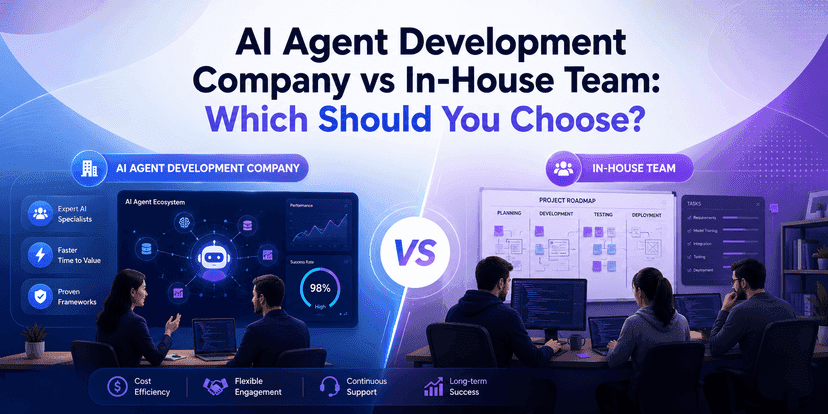
AI Agent Development Company vs In-House Team: Which Should You Choose?
 Manikandan
A customer asks for an order update. Your support team opens the CRM, checks the order system, reads past emails, prepares a response and updates the ticket.
The task takes eight minutes.
Now multiply it by 500 requests each day.
This is where an AI agent can help. It can understand the request, retrieve approved data, use business tools, prepare a response and escalate unusual cases to a person.
But a major decision comes before development begins:
Should you hire an AI agent development company or build an in-house AI development team?
For CEOs, the decision affects cost, speed and business risk. For CTOs, it affects architecture, security and long-term ownership. For technical architects, it affects integrations, observability, model choice and system reliability.
The wrong choice can lead to:
- A costly team that takes months to become productive
- A vendor-built prototype that cannot survive production
- An agent that performs well in demonstrations but fails on real data
- Security gaps caused by excessive tool permissions
- Rising model costs with no measurable business return
The right choice depends on your goals, existing talent, timeline, data and appetite for long-term AI ownership.
This guide compares both options. It explains the benefits, development process, risks, costs, success metrics and decision factors.
What Is AI Agent Development?
AI agent development is the process of building software that can understand a goal, reason about the next step, use approved tools and complete a task.
A basic chatbot usually returns an answer.
An AI agent can go further. It may:
- Search a company knowledge base
- Read a customer record
- Check order status
- Create a support ticket
- Update a CRM field
- Generate a report
- Schedule a meeting
- Request approval
- Notify an employee
- Escalate an exception
This does not mean an agent should have unlimited freedom.
Reliable AI agent solutions use defined tools, access rules, validation steps, audit logs and human approval for high-impact actions.
An enterprise agent is best understood as a controlled software worker. It can operate across several systems, but only within the boundaries set by the business.
What Does an AI Agent Development Company Do?
An AI agent development company designs, builds, tests and deploys agents for clients.
Its work often includes:
- Business-process discovery
- AI feasibility assessment
- Agent and workflow architecture
- Model selection
- Retrieval-augmented generation
- Prompt and tool design
- CRM, ERP and API integration
- Permission controls
- Agent evaluation
- Security testing
- Monitoring and cost tracking
- Production deployment
- Post-launch optimisation
A strong provider does not begin by asking, “Which agent framework should we use?”
It begins by asking:
What business outcome should improve, what actions must the system perform, and where must a human remain in control?
That difference matters. Many failed AI projects begin with technology rather than workflow design.
What Is an In-House AI Development Team?
An in-house AI development team is a group of employees responsible for building and maintaining the organisation’s AI systems.
Depending on the project, the team may include:
- AI or machine-learning engineers
- Backend developers
- Frontend or mobile developers
- Data engineers
- Cloud engineers
- Security specialists
- Product managers
- UX designers
- Quality engineers
- Domain experts
In-house development gives the business direct control over priorities, source code, infrastructure and institutional knowledge.
However, the business must recruit, manage and retain the skills needed to move from prototype to production.
Hiring one AI engineer is rarely enough. A useful agent also needs data access, backend services, integrations, security, testing, monitoring and product design.
Why Does This Decision Matter?
AI agents can touch sensitive systems and make operational decisions. That makes the delivery model more important than it may be for a simple website or internal dashboard.
The selected model affects:
- Time to market
- Initial and ongoing cost
- Access to specialist skills
- Technical ownership
- Data security
- Integration quality
- Model evaluation
- Operational reliability
- Knowledge retention
- Ability to scale
Enterprise adoption is growing, but measurable value is not automatic. In a 2025 PwC survey of 300 senior executives, 79% said their companies were adopting AI agents. Among adopters, 66% reported measurable productivity value. The same research highlighted trust, workforce readiness and responsible AI as major barriers.
The lesson is simple:
Building an agent is not the same as creating a trusted business system.
Why Should You Choose an AI Agent Development Company?
An external AI development company is often the better choice when:
- You need to launch quickly
- You lack internal AI specialists
- You need several skills for one project
- Your team has limited agent-production experience
- You want to validate the idea before hiring
- The project has a defined scope
- You need architecture and security guidance
- You require a proof of concept or MVP
- Your internal engineers are committed to core products
A company can bring a ready team instead of requiring you to recruit each role separately.
This is valuable when speed matters more than building a permanent AI department immediately.
Why Should You Build an In-House AI Team?
An in-house team may be the better option when:
- AI is central to your core product
- You expect continuous AI development
- You have enough work for a permanent team
- You already employ strong data and platform engineers
- Your data cannot leave a controlled environment
- You require deep control over models and infrastructure
- The organisation can support recruitment and retention
- AI knowledge must remain within the company
For example, a SaaS company whose main product depends on proprietary AI may need long-term internal capability.
A logistics company testing one route-planning agent may not.
When Is a Hybrid Model Better?
For many businesses, the best answer is neither full outsourcing nor complete in-house development.
A hybrid model can combine:
- Internal ownership of product goals and data
- External support for architecture and initial delivery
- Shared development during implementation
- Internal takeover after launch
- Ongoing specialist support for evaluation or security
This model can reduce early risk while helping the internal team build knowledge.
A practical hybrid structure may look like this:
The internal team owns:
- Business priorities
- Domain rules
- Data access
- Product decisions
- Security approval
- Long-term roadmap
Development partner owns or supports:
- Agent architecture
- Model integration
- Tool development
- Evaluation framework
- Deployment setup
- Initial monitoring
- Knowledge transfer
Benefits of Hiring an AI Agent Development Company
1. Faster Access to a Complete Team
Recruiting AI engineers, data specialists, cloud engineers and security professionals can take months.
A development company can provide these skills from the beginning.
This is useful when a business needs to validate an opportunity before a market window closes or before leadership approves a larger AI investment.
2. Shorter Time to First Working Version
An experienced team may already have reusable patterns for:
- Authentication
- Tool calling
- Agent memory
- Retrieval
- Human approval
- Logging
- Evaluation
- Model fallback
- Cost monitoring
These patterns should not be copied blindly. But they can reduce time spent solving common infrastructure problems.
3. Wider Technical Experience
A good AI software development company has often worked with several models, frameworks and deployment approaches.
It can compare:
- API-based models
- Open-source models
- Retrieval-augmented generation
- Fine-tuned models
- Single-agent systems
- Multi-agent systems
- Deterministic workflows
- Human-in-the-loop automation
This helps avoid unnecessary complexity.
A multi-agent system may sound advanced. Yet a simple workflow with one classifier and three API calls may be safer and cheaper.
4. Lower Initial Hiring Risk
Building an internal team creates a fixed cost before the business has proven the use case.
A project-based engagement allows the organisation to test:
- Technical feasibility
- Data quality
- User demand
- Workflow fit
- Model accuracy
- Expected return
The company can then decide whether to expand, pause or bring the capability in-house.
5. Production-Focused Delivery
Many internal experiments stop at the demonstration stage.
A production-ready agent needs more than a good response in a chat window. It needs:
- Access controls
- Error handling
- Trace logs
- Usage limits
- Approval flows
- Evaluation datasets
- Rollback procedures
- Cost alerts
- Incident handling
An experienced provider should include these elements in its AI agent development services.
6. Flexible Engagement
The business may need a full team during initial development but only part-time support after launch.
An external partner can often scale involvement up or down more easily than an internal department.
Benefits of Building an In-House AI Development Team
1. Deep Business Knowledge
Internal employees learn the company’s systems, customers, policies and exceptions over time.
This is valuable when workflows are highly specialised or change often.
2. Direct Control
An internal team gives leadership direct control over:
- Priorities
- Architecture
- Development practices
- Security decisions
- Infrastructure
- Release schedules
- Intellectual property
There is less dependence on vendor availability.
3. Long-Term Knowledge Retention
The design decisions, evaluation data and operational lessons remain within the organisation.
This matters when AI is a long-term strategic capability rather than a single project.
4. Faster Continuous Iteration
After the team is established, internal developers can respond quickly to user feedback and changing business needs.
They do not need to begin a new vendor engagement for every improvement.
5. Stronger Alignment With Core Products
When enterprise AI agents are embedded inside a company’s main product, an internal team can coordinate more closely with product, engineering, security and customer-success groups.
Benefits of a Hybrid Approach
A hybrid model offers three key advantages:
Speed Without Losing Ownership
The external team accelerates the first release. The internal team remains involved and prepares to own the system.
Specialist Help Without Permanent Overstaffing
The business can use an agent, security or evaluation experts when needed without employing every specialist full-time.
Structured Knowledge Transfer
Internal developers learn through real implementation rather than only through courses or isolated experiments.
Process: How to Choose the Right Delivery Model Step by Step
Step 1: Define the Business Outcome
Do not begin with:
We need an AI agent.
Begin with:
We need to reduce average support-handling time from eight minutes to four minutes without lowering customer satisfaction.
Define:
- Current workflow
- Current cost
- Current processing time
- Error rate
- Volume
- Desired outcome
- Risk level
- Required human involvement
A clear outcome makes vendor and internal proposals easier to compare.
Step 2: Map the Agent’s Actions
List every action the proposed agent must perform.
For example:
- Receive a customer request
- Identify intent
- Verify the customer
- Retrieve order data
- Check refund policy
- Decide whether the request is eligible
- Prepare a response
- Request human approval for refunds
- Update the support system
- Log the result
This map reveals the real complexity.
The difficult part is often not the model. It is identity, permissions, integrations and exceptions.
Step 3: Assess Your Internal Capability
Score your organisation from 1 to 5 in these areas:
Step 4: Estimate Total Cost, Not Only Development Cost
Compare the full cost of each option.
In-House Costs
Include:
- Recruitment
- Salaries
- Benefits
- Equipment
- Cloud infrastructure
- Model usage
- Training
- Management time
- Security support
- Staff turnover
- Ongoing maintenance
Development Company Costs
Include:
- Discovery
- Design
- Development
- Integrations
- Testing
- Cloud infrastructure
- Model usage
- Support contract
- Change requests
- Knowledge transfer
- Internal oversight
The cheapest proposal is not always the lowest-cost outcome.
A low-price prototype that must be rebuilt may cost more than a carefully designed first release.
Step 5: Evaluate Time to Value
Ask when the solution will begin producing measurable value.
Do not measure only the launch date.
A fast launch has little value when:
- Users do not trust the agent
- Integrations are incomplete
- Human review remains unchanged
- Accuracy is not measured
- The agent cannot handle exceptions
A useful timeline should include:
- Discovery
- Data access
- Prototype
- Evaluation
- Pilot
- Production launch
- Adoption
- Measurable business impact
Step 6: Review Data and Security Requirements
Identify:
- What data the agent can read
- What data it can change
- Which systems it can access
- Whether personal data is involved
- Where model requests are processed
- How long logs are retained
- Which actions require approval
- How access can be revoked
- How incidents will be investigated
High-risk agents need strict permissions and human checkpoints.
A customer-support agent that drafts replies has a different risk profile from an agent that approves payments.
Step 7: Compare Architecture Proposals
Whether the work is internal or outsourced, ask for a clear architecture.
It should explain:
- Model choice
- Tool layer
- Retrieval approach
- Data flow
- Identity and access
- Memory design
- Human approval
- Evaluation
- Monitoring
- Fallback behaviour
- Cost controls
Avoid proposals that rely on vague claims such as “advanced autonomous AI".
Ask what happens when the agent is wrong.
Step 8: Run a Limited Pilot
Start with one workflow, one team or one type of request.
A pilot should test:
- Accuracy
- Task completion
- User adoption
- Human-review burden
- Integration quality
- Response time
- Cost per task
- Security
- Failure recovery
Do not allow early success on a small demonstration set to justify full deployment.
Test real exceptions.
Step 9: Decide the Long-Term Ownership Model
After the pilot, choose one of four paths:
- Continue with the AI agent development company
- Build an internal team and transfer ownership
- Use a hybrid delivery model
- Stop because the value does not justify the cost
Stopping a weak use case is not failure. It prevents a larger waste of money and time.
What Are the Risks of Hiring an AI Agent Development Company?
Weak Domain Understanding
An external team may understand technology but not your policies, users or exceptions.
How to reduce the risk: Assign internal domain experts to the project. Require workflow workshops and documented business rules.
Vendor Dependency
The organisation may depend on the provider for every update.
How to reduce the risk: Require source-code access, documentation, infrastructure ownership and knowledge transfer.
Generic Agent Architecture
Some providers may reuse the same chatbot pattern for every client.
How to reduce the risk: Ask how the architecture changes based on your workflow, risk and data.
Hidden Model and Infrastructure Costs
Development fees may exclude ongoing model, search, storage and monitoring costs.
How to reduce the risk: Request projected cost per task at low, expected and high usage.
Prototype-Only Capability
A team may be good at demonstrations but weak at production systems.
How to reduce the risk: Ask for examples of monitoring, evaluation, security, incident handling and post-launch support.
What Are the Risks of an In-House AI Team?
Slow Recruitment
Specialised hiring may delay the project before development begins.
How to reduce the risk: Use a partner for the first release while recruiting selectively.
Skill Gaps
One machine-learning engineer cannot cover product design, backend engineering, security, cloud and quality assurance.
How to reduce the risk: Map required roles before hiring. Avoid treating AI as a one-person function.
Expensive Experimentation
Internal teams may spend months comparing tools without proving business value.
How to reduce the risk: Set a fixed pilot period and measurable exit criteria.
Technology Bias
A team may choose the framework it knows rather than the simplest solution.
How to reduce the risk: Require architecture reviews and comparisons of deterministic workflows, APIs and custom models.
Retention Risk
Key knowledge may leave when a specialist resigns.
How to reduce the risk: Use shared documentation, code reviews, runbooks and cross-training.
What Mistakes Should Both Models Avoid?
Starting With the Model
The model is only one part of the system.
Start with the workflow and business result.
Automating a Broken Process
AI will not fix unclear ownership or inconsistent policies.
Improve the process before automating it.
Giving the Agent Too Much Access
Use least-privilege permissions. Each tool should expose only the actions the agent needs.
Skipping Evaluation
A few successful test conversations do not prove reliability.
Build a repeatable evaluation set.
Ignoring Human Handoff
Design what happens when confidence is low or the request is sensitive.
Measuring Activity Instead of Value
The number of agent messages is not a business result.
Measure time, quality, cost, adoption and completed outcomes.
What Results Can AI Agents Deliver?
AI agents can improve productivity, but results vary by workflow, implementation quality and user adoption.
OpenAI’s 2025 enterprise report found that surveyed enterprise users reported saving roughly 40–60 minutes per day from AI use. The report also showed rapid growth in enterprise usage, although these figures cover broader enterprise AI rather than every agent deployment.
A 2025 field experiment involving 2,310 participants found that human-AI teams achieved 60% greater productivity per worker in the tested advertising workflow. The study also found mixed quality effects: AI-supported teams produced stronger text, while human-only teams produced stronger images. This shows why results must be measured by task rather than assumed across all work.
These results should be treated as reference points, not promises.
Your own benchmarks should come from a controlled pilot.
Which Metrics Should You Track?
Operational Metrics
- Average handling time
- Task-completion rate
- First-response time
- Processing volume
- Escalation rate
- Human-review time
- Error rate
- Rework rate
AI Quality Metrics
- Intent-classification accuracy
- Tool-selection accuracy
- Retrieval relevance
- Factual accuracy
- Policy-compliance rate
- Successful action rate
- Unsupported-answer rate
- Human-override rate
Financial Metrics
- Cost per completed task
- Labour hours saved
- Infrastructure cost
- Model cost
- Support cost
- Cost of rework
- Revenue influenced
- Payback period
User Metrics
- Adoption rate
- Employee satisfaction
- Customer satisfaction
- Task-abandonment rate
- Trust score
- Repeat usage
Risk Metrics
- Unauthorised action attempts
- Sensitive-data exposure
- Prompt-injection success rate
- Failed approval checks
- Incident frequency
- Time to detect and resolve failures
How Should You Compare the Two Options?
Use a weighted decision table.
Simple Decision Rule
Choose an AI agent development company when speed, specialist access and lower initial hiring risk matter most.
Choose an in-house AI development team when AI is core to your product, continuous development is expected and long-term control justifies the investment.
Choose a hybrid model when you need a fast start but want internal ownership over time.
Conclusion
The decision is not simply “outsourcing versus hiring".
It is a decision about speed, risk, control and long-term capability.
An AI agent development company can help you move quickly, access specialised skills and test a use case without building a full department.
An in-house team can provide deeper business alignment, direct control and long-term knowledge retention.
For many organisations, the strongest path is hybrid:
- Keep product goals, data governance and business rules internal.
- Use an experienced partner to accelerate architecture and initial development.
- Involve internal engineers from the beginning.
- Transfer ownership through documentation and shared delivery.
- Retain external specialists only where they continue to add value.
Do not choose based on trend, team size or the lowest quote.
Choose the model that can deliver a measurable business outcome safely and repeatedly.
Frequently Asked Questions
AI Agent Development Company vs In-House Team: Which Is Better?
An AI agent development company is usually better for faster delivery, specialist access and a defined project. An in-house team is better when AI is a long-term core capability and the company can support a permanent multidisciplinary team.
Should You Outsource AI Agent Development?
You should consider outsourcing when your organisation lacks production AI experience, needs to launch quickly or wants to validate a use case before hiring. Keep product ownership, data governance and business decisions internal.
What Is the Difference Between In-House and Outsourced AI Development?
In-house development uses employees who work directly for the organisation. Outsourced development uses an external specialist team. In-house teams offer more direct control, while outsourced teams often provide faster access to diverse skills.
What Are the Benefits of Hiring an AI Agent Development Company?
Key benefits include faster time to market, access to specialist skills, lower initial recruitment risk, flexible team capacity and experience with architecture, integrations, evaluation and deployment.
How Much Does an AI Agent Development Company Cost?
The cost depends on workflow complexity, integrations, data readiness, model choice, security and support. A focused proof of concept costs less than an enterprise agent connected to several sensitive systems. Request a breakdown of development cost, infrastructure cost and expected cost per completed task.
How Long Does Custom AI Agent Development Take?
A focused proof of concept may take a few weeks. A production agent involving several integrations, evaluation, security controls and human approvals may take several months. Discovery and data access often influence the timeline as much as coding.
Can an AI Development Company Work With Our Internal Team?
Yes. A hybrid model allows the external company to provide architecture and specialist delivery while the internal team supplies domain knowledge, system access and long-term ownership.
How Do We Choose the Right AI Software Development Company?
Review its production experience, case studies, architecture process, security approach, evaluation methods, source-code terms and knowledge-transfer plan. Avoid providers that discuss models but cannot explain permissions, failures, monitoring and human approval.
Need Help Choosing the Right AI Development Model?
InfiniAppsAI helps businesses evaluate, design and build secure custom AI agents for customer support, sales, operations and internal automation.
We can help you:
- Assess your use case
- Map the workflow
- Select the right architecture
- Build a proof of concept
- Integrate business systems
- Define security controls
- Create an evaluation plan
- Prepare for production deployment
Book a free AI agent consultation to find out whether an external, in-house or hybrid approach is right for your organisation.