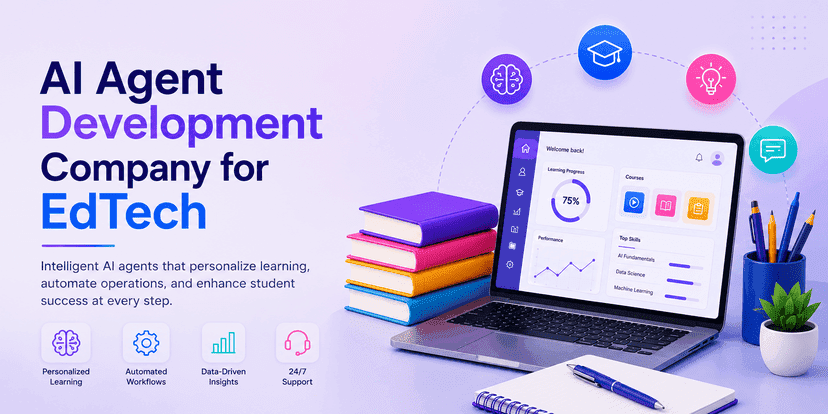
AI Agent Development Company for EdTech
 Karuna
A student emails a college at 11 PM. She needs to know if her financial aid form was received. No one answers. She waits three days for a reply. By then, the deadline has passed.
This happens every day, at every school, everywhere. Staff are busy. Inboxes are full. Students wait.
Now picture the same student. She emails at 11 PM. Within seconds, an AI agent checks her record, confirms the form was received, and tells her the next step.
No wait. No stress. No missed deadline.
That's the real gap in education today. Schools and universities don't lack care. They lack time. This guide explains how the right AI agent development company can close that gap — with AI tutors, student support agents, and smart tools built for how education actually works.
We'll cover what AI agents in education really are, the real benefits, how the build process works, common mistakes to avoid, and the results schools can expect. By the end, you'll know exactly what to look for in an AI agent development company for EdTech.
What is an AI agent in education?
An AI agent is software that can think, plan, and act on its own. It's not a simple chatbot that just answers questions. It can check a student record, update a course status, send a reminder, and follow up, without a staff member doing it by hand.
A basic chatbot replies. An AI agent finishes the task.
Why does education need AI agents now?
Schools and universities handle thousands of repeat questions every week. What's my grade? When is the deadline? How do I reset my password? Staff answer the same questions again and again. This eats up hours that could go toward real teaching and real student care.
An AI agent handles the repeat questions. Staff get their time back for the work that actually needs a human.
Why should you choose a specialised AI agent development company for EdTech?
A general software company can build a chatbot. But education has its own rules. Student data needs strong privacy protection. Learning tools need to adapt to each student's pace. Systems need to connect with school platforms like Moodle, Canvas, or a custom student portal.
A specialised AI agent development company understands these needs from day one. A generic dev shop often does not.
When should a school or EdTech company bring in an AI agent development company?
Bring one in when:
- Support staff are overwhelmed with repeat student questions
- You want to offer help outside school hours, not just 9-to-5
- You're building an EdTech product and want AI features that actually work, not just a chat widget bolted on
- Your current tools can't scale as your student base grows
Who actually needs AI agents in education?
Schools, colleges, universities, online course platforms, tutoring companies, and EdTech startups all fit. Any place where students ask repeat questions or need personal help at scale is a strong fit for an AI agent.
The Real Benefits of AI Agents for Education
1. Faster answers, any time of day Students don't only have questions during office hours. An AI agent answers at 2 AM just as well as 2 PM. No more waiting days for a simple answer.
2. Personal learning support at scale An AI virtual tutor can adjust to each student's pace. It can explain a concept three different ways if the first one doesn't click — something one teacher can't do for 40 students at once.
3. Less manual work for staff Registration questions, deadline reminders, and grade lookups — an AI teaching assistant handles these instantly. Staff time shifts to real teaching, real mentoring, and real problem-solving.
4. Better student retention Students who get fast, clear answers are less likely to give up out of frustration. A good AI learning assistant catches confusion early, before a student falls behind or drops out.
5. Lower cost per student supported As student numbers grow, support costs don't have to grow at the same rate. One well-built AI agent can support thousands of students at once.
6. Data-driven insight for schools Every AI agent interaction is a data point. Schools can see which topics confuse students most, which questions repeat the most, and where to improve — insight that's hard to get from a normal support inbox.
Step-by-Step: How AI Agent Development Works for Education
Step 1: Define the real problem first. Don't start with "We want an AI chatbot." Start with the actual pain: "Our admissions team spends 20 hours a week answering the same five questions." A clear problem leads to a much better AI agent.
Step 2: Map the student and staff workflows. A good AI agent development company studies how students actually ask for help and how staff actually respond today. This shapes the agent's design before any code is written.
Step 3: Choose the right AI architecture This includes the language model, the memory system, and the agent framework (like LangGraph or CrewAI). The right choice depends on how complex the tasks are — a simple FAQ bot needs less than a full AI virtual tutor.
Step 4: Connect the agent to real systems. The agent needs to talk to your student information system, learning management system (LMS), and any other school software. This step is often the hardest part of the build — and the most important for the agent to feel truly useful.
Step 5: Train the agent on real content. This includes course materials, school policies, FAQs, and past support conversations. This is what lets the agent give accurate, grounded answers instead of guesses.
Step 6: Add safety and privacy guardrails. Student data needs strong protection. The agent should have clear rules on what it can and can't do — especially around sensitive information like grades, health records, or family details.
Step 7: Test with real students and staff A short pilot with a real class or department shows how the agent performs with real questions, not just test cases. This step catches problems before a full rollout.
Step 8: Launch, monitor, and improve After launch, the agent needs ongoing monitoring. Student needs change every semester. The agent should keep learning and improving with real use.
Common Challenges in AI Agent Development for Education (and How to Avoid Them)
Challenge: Treating it like a simple chatbot project Many schools start with a basic FAQ bot and call it done. But a true AI agent should complete tasks, not just answer questions. Push for real task automation, not just Q&A.
Challenge: Weak data privacy planning Student data is sensitive and often protected by law (like FERPA in the US or similar rules elsewhere). Insist on clear answers about data storage, access control, and encryption before you sign with any vendor.
Challenge: Poor integration with existing school systems An AI agent that can't connect to your LMS or student database is only half useful. Ask any AI agent development company for their specific experience integrating with systems like yours.
Challenge: No plan for tone and empathy Education is personal. A cold, robotic agent can frustrate students more than no agent at all. The best AI teaching assistants are trained to sound warm and clear, not stiff and scripted.
Challenge: Skipping the pilot phase Rolling out to an entire university at once, without testing first, is risky. Start with one department or one course. Prove it works. Then scale.
Best practice: Treat your first AI agent as a small, controlled pilot. Test it with one group of students. Fix what doesn't work. Then expand school-wide.
Metrics and Results That Show AI Agents Are Working
Look for real, measurable outcomes — not vague claims.
- Response time — how fast students get an answer, especially outside office hours
- First-contact resolution rate — how many questions the agent solves without human help
- Staff hours saved per week — time freed up for real teaching and mentoring
- Student satisfaction score — do students feel genuinely helped, not just answered
- Drop-off/retention rate — does fast support reduce students giving up on a course
- Cost per student supported — how support cost changes as your student base grows
Schools and EdTech platforms using well-built AI agents commonly report a 30–50% drop in repeat support tickets within the first few months, along with faster response times and higher student satisfaction scores. Ask any AI agent development company to show real numbers from past education projects, not general industry averages.
Conclusion
Students don't need more emails sent into silence. They need fast, clear, personal answers — at 2 AM or 2 PM, it shouldn't matter.
The right AI agent development company for education understands this. It's not about adding a chatbot for show. It's about building an AI teaching assistant, AI virtual tutor, or AI student support agent that actually finishes the job — checking records, answering questions, and freeing up staff for the work only humans can do.
Schools that get this right in 2026 aren't the ones who added AI fastest. They're the ones who built it carefully — with real student workflows, real data protection, and a real pilot before a full rollout.
Frequently Asked Questions
What is the best AI agent development company for EdTech?
The best fit depends on your specific needs — school size, existing systems, and budget. Look for a company with real experience in education, not just general chatbot work, and ask for real case studies and a pilot before a full contract.
What does an AI agent development company for schools actually build?
They build AI systems that answer student questions, manage admissions enquiries, send reminders, support learning, and connect directly to school systems like LMS platforms and student databases — all without constant human input.
What does an AI agent development company for universities offer?
Universities typically need larger-scale systems: AI agents for admissions, financial aid support, course registration, academic advising support, and 24/7 student help across a much bigger student body.
How is custom AI agent development for education different from a generic chatbot?
A generic chatbot answers questions from a script. A custom AI agent understands context, connects to real school systems, and completes tasks — like updating a record or confirming a deadline — without a staff member stepping in.
Can AI agents integrate with our learning management system (LMS)?
Yes. A capable AI agent development company can connect agents to LMS platforms like Moodle, Canvas, or Blackboard, along with student information systems and other school software.
What are AI automation services for educational institutions?
These are services that use AI agents to handle repeat tasks — admissions questions, registration help, deadline reminders, and basic academic support — reducing manual work for staff.
How much does AI chatbot development for schools cost?
Costs vary by scope. A single-task agent (like an FAQ or admissions assistant) can start in the low thousands of dollars, while larger, multi-agent university systems cost significantly more, depending on integrations and scale.
What is an AI student support agent, and how does it help?
It's an AI agent focused on answering student questions and resolving issues — like account access, deadlines, or general enquiries — instantly, 24/7, without a student waiting for office hours.
Is student data safe with an AI agent?
It should be, if built correctly. Insist on clear answers about encryption, access controls, and compliance with education data privacy laws before choosing a vendor.
How long does it take to build an AI agent for a school or EdTech platform?
A single-task agent, like an FAQ or admissions assistant, can launch in a few weeks. Larger, multi-agent systems for a full university typically take a few months, depending on integration complexity.
Ready to Build an AI Agent That Actually Helps Your Students?
If your staff are buried in repeat questions, and your students are waiting too long for simple answers, it's time for a real solution — not another basic chatbot.
Book a free consultation with the Infiniapps.ai team, or request a custom quote to see what a well-built AI agent could look like for your school or EdTech platform.