AI SaaS Pricing Models: Subscription vs Usage vs Hybrid
 Karuna
Pricing an AI SaaS product looks easy until you try to put numbers on the pricing page.
Charge $49 a month?
Charge for every AI request?
Charge by tokens?
Give customers a monthly plan and bill extra when they use more?
All of those approaches can work.
They can also create completely different businesses.
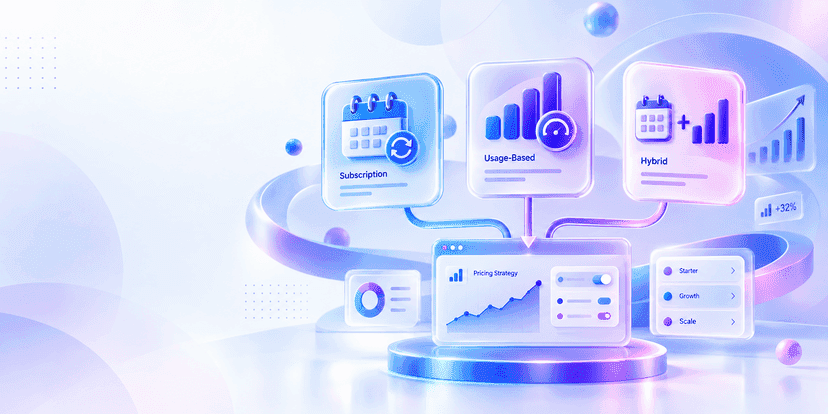
A subscription model gives customers a predictable bill and gives the SaaS company recurring revenue.
Usage-based pricing allows revenue to grow as customers use the product more.
A hybrid model combines both.
For traditional SaaS, choosing between these models was already important. For AI SaaS, it matters even more because the cost of serving a customer can rise every time they generate an image, analyse a document, run an agent, process tokens, or make an AI-powered request.
Stripe's 2026 guidance makes the same distinction: AI products often have marginal costs that increase with usage, which makes the choice of pricing metric closely connected to unit economics.
So the question is not:
“Which SaaS pricing model is most popular?”
The better question is:
“Which pricing model matches how our customers receive value and how our own costs increase?”
This guide explains subscription, usage-based, and hybrid SaaS pricing in practical terms and helps you decide which model fits your AI product.
What Is an AI SaaS Pricing Model?
An AI SaaS pricing model defines how customers are charged for using an AI-powered software product.
The pricing may be based on:
- Monthly or annual access
- Number of users
- API calls
- AI requests
- Tokens
- Documents processed
- Images generated
- Minutes of audio
- Tasks completed
- Storage or compute
- Business outcomes
The pricing model is different from the price itself.
For example:
Pricing model: Subscription
Price: $49 per month
Or:
Pricing model: Usage-based
Price: $0.02 per processed document
The model decides what customers pay for.
The price decides how much they pay.
That difference is important.
You can change a $49 plan to $59 fairly easily.
Changing the entire business from subscription pricing to metered usage is a much bigger decision.
Quick Answer: Subscription vs Usage-Based vs Hybrid
Here is the simplest comparison.

There is no universal winner.
The right model depends on your customers, product, AI costs, usage patterns, and how easily customers can understand the bill.
What Is Subscription-Based SaaS Pricing?
Subscription pricing charges customers a fixed recurring amount.
That may be:
$29/month
$99/month
$499/month
or an annual equivalent.
The customer normally receives a defined set of features or allowances within that plan.
A typical pricing page might look like this:
Starter — $29/month
For individuals and small teams.
Pro — $79/month
For growing businesses.
Business — $199/month
For teams that need advanced features.
The exact numbers are not important here.
What matters is that the customer knows what the software will cost before they start using it.
Why Subscription Pricing Works
People understand subscriptions.
They already pay monthly for software, streaming, cloud tools, productivity platforms, and business applications.
The model has another benefit for the SaaS company:
Revenue is easier to forecast.
If 1,000 customers pay $50 per month, the company begins the month with a clearer idea of recurring revenue than it would with purely variable billing.
That predictability can help with:
Hiring.
Cloud budgets.
Sales targets.
Product investment.
Cash planning.
For customers, the advantage is similar.
The finance team knows roughly what the bill should be.
When Subscription Pricing Works Well for AI SaaS
Subscription pricing can work well when usage does not vary dramatically between customers.
Imagine an AI meeting-notes product.
A typical customer might record:
15 meetings one month.
18 the next.
14 the month after that.
Usage changes, but not enough to completely change the economics.
A monthly plan may be easier than billing for every minute of transcription.
Subscription pricing can also work well when customers primarily pay for access to features, rather than raw computation.
Examples may include:
- AI writing tools
- AI productivity apps
- Business dashboards
- AI CRM features
- AI workflow tools
- Small-team collaboration products
The key question is whether your cost to serve one active customer remains reasonably predictable.
The Problem With Pure Subscription Pricing for AI
Imagine two customers buy the same $49 plan.
Customer A makes 50 AI requests.
Customer B makes 10,000.
Both pay $49.
Your revenue is identical.
Your infrastructure cost may not be.
That creates a problem.
As heavy users become more successful with the product, they can actually reduce your margin.
This is one reason AI SaaS companies have to watch usage much more carefully than many traditional software businesses.
The subscription looks profitable until customers begin using the AI feature heavily.
What Is Usage-Based SaaS Pricing?
Usage-based pricing charges customers according to what they actually consume.
It is sometimes called:
Consumption-based pricing
or
Pay-as-you-go pricing.
Instead of:
$99 per month
The customer might pay:
$0.01 per AI request
or:
$5 per 1,000 documents processed
or:
$0.20 per completed task
Stripe describes usage-based SaaS pricing as charging according to consumption rather than simply charging a flat fee for access. Common units include API calls, tokens and other measurable usage.
Common Usage Metrics for AI SaaS
The difficult part is not adding a meter.
It is deciding what should be measured.
Possible metrics include:
- Tokens consumed
- API calls
- AI messages
- Images generated
- Video minutes
- Audio minutes
- Documents processed
- Records analysed
- Automations executed
- Agent tasks completed
- Search requests
- Compute time
Some of these make sense to developers.
Not all of them make sense to customers.
That distinction matters.
Why Usage-Based Pricing Can Work Well
Imagine an AI data-processing platform.
Customer A processes 5,000 records.
Customer B processes 5 million.
Charging both customers the same monthly amount would probably not make sense.
With usage-based pricing:
More usage → More customer value → More revenue
Ideally, your revenue also increases as your infrastructure costs increase.
That creates a more natural relationship between consumption and price.
Usage-based pricing is particularly common in API and infrastructure products because consumption can be measured directly. AWS also describes metering as a core part of consumption-based SaaS, with billing tied to measurable customer usage.
Why Customers Like Usage-Based Pricing
A small customer can start small.
They do not need to pay for a large plan before they need it.
Imagine a startup testing an AI API.
Month one:
2,000 requests.
Month six:
500,000 requests.
A usage-based model lets its bill grow alongside adoption.
That can lower the barrier to trying the product.
The customer is not buying future capacity.
They are paying for what they actually use.
The Biggest Problem: Bill Shock
Usage pricing sounds fair until customers receive a bill they did not expect.
Imagine a business normally spends $200 per month.
Then one successful marketing campaign increases activity dramatically.
The next bill is $1,400.
The customer may have received more value.
But the reaction can still be:
“Why did our software bill increase seven times?”
That uncertainty matters, especially for larger companies where budgets are approved in advance.
Stripe highlights this as one of the core trade-offs of consumption pricing: customers can find their spending harder to predict, while vendors also have more variable revenue.
A good usage-based product therefore needs more than a billing meter.
It needs:
Usage dashboards.
Budget alerts.
Spending limits.
Forecasts.
Notifications.
Clear unit pricing.
Possibly hard caps.
Pricing design becomes part of the product experience.
What Is Hybrid SaaS Pricing?
Hybrid pricing combines a recurring base charge with a usage component.
For example:
Pro Plan — $99/month
Includes:
5 users
10,000 AI tasks
Advanced reporting
API access
Additional AI tasks:
$0.01 each
The subscription creates a predictable revenue floor.
The usage component allows revenue to grow when customers consume more resources.
Stripe describes this model as a base subscription combined with additional usage charges and notes that it can balance recurring revenue, customer budget predictability and monetisation of heavier usage.
Why Hybrid Pricing Is Attractive for AI SaaS
AI creates a difficult pricing problem.
Customers want:
Predictable bills.
Businesses want:
Predictable revenue.
But AI infrastructure costs may change with usage.
Hybrid pricing tries to satisfy all three.
The base subscription can cover:
- Product access
- User management
- Dashboard features
- Customer support
- Core infrastructure
- Basic AI allowance
Then metered billing covers additional consumption.
That creates a model such as:
Subscription = access
Usage = scale
This is already the direction reflected in Infiniapps.ai's own AI SaaS pricing material, which frames hybrid pricing as combining a recurring base plan with usage add-ons.
A Simple Hybrid Pricing Example
Imagine an AI customer-support platform.
Starter — $49/month
Includes:
1,000 AI-assisted conversations.
Growth — $149/month
Includes:
5,000 conversations.
Business — $499/month
Includes:
25,000 conversations.
After the included allowance:
$0.03 per additional conversation.
A small customer can stay within the package.
A growing customer naturally generates additional revenue.
The SaaS company does not have to push the customer into a completely different plan every time usage changes.
Subscription vs Usage-Based vs Hybrid: A Practical Example
Imagine three companies using the same AI document-processing product.
Customer A
Processes 500 documents per month.
Customer B
Processes 10,000.
Customer C
Processes 500,000.
Now compare the models.
Subscription
Everyone pays a fixed amount based on their plan.
Simple.
But if Customer C consumes significantly more AI resources, the vendor may lose margin.
Usage-Based
Each company pays according to documents processed.
Fairly aligned with consumption.
But Customer C's invoice may move substantially from month to month.
Hybrid
Everyone pays for a base package.
Heavy users pay additional charges once they exceed their included usage.
The model provides both a predictable starting point and room for expansion.
That is why choosing a model should begin with customer behaviour.
Not with a competitor's pricing page.
AI SaaS Changes the Pricing Conversation
Traditional SaaS economics often had relatively low incremental software cost.
Once the platform existed, another user might not dramatically increase operating cost.
AI can behave differently.
Every additional activity may involve:
Model inference.
Tokens.
Vector search.
GPU resources.
Speech processing.
Image generation.
Third-party model APIs.
Storage.
Agent tool calls.
That means the cost of an active customer may be meaningfully different from the cost of an inactive customer.
This is one reason AI companies need to understand usage at the customer level from the beginning.
Do not wait until revenue grows before measuring AI cost.
Your Pricing Metric Should Match Customer Value
This is probably the most important pricing principle in the article.
Do not automatically charge customers using the same metric your AI provider charges you.
Suppose your model provider charges by token.
Does your customer understand tokens?
Probably not.
Imagine telling an HR manager:
“Your plan includes 3 million tokens.”
That may mean very little.
Now compare:
“Your plan includes 2,000 candidate screenings.”
The second metric is connected to the work the customer understands.
A useful pricing metric should ideally be:
Measurable
You can count it reliably.
Understandable
Customers know what they are paying for.
Connected to value
Usage increases when customers receive more value.
Connected to cost
It does not allow infrastructure spending to increase without any corresponding revenue.
Stripe recommends choosing a usage metric that scales with the value customers receive and is understandable enough for customers to estimate their spending.
Cost Metric and Pricing Metric Do Not Have to Be the Same
Suppose your application pays an LLM provider by token.
Your customer could still pay per:
Document processed.
Lead qualified.
Support case resolved.
Report generated.
Workflow completed.
Behind the scenes:
Customer action → AI usage → Infrastructure cost
But the pricing page can show:
$0.20 per completed report
rather than:
$X per 100,000 tokens
The customer buys an outcome they understand.
Your engineering and finance teams still monitor the underlying token cost.
This separation can make AI SaaS pricing much easier to communicate.
When Should You Choose Subscription Pricing?
Subscriptions are worth considering when:
- Customer usage is relatively consistent.
- Infrastructure cost per customer is predictable.
- Buyers strongly prefer fixed budgets.
- Your product's value comes mainly from access and features.
- You want a simple self-service pricing page.
- Usage metering would add unnecessary complexity.
Imagine a small AI task-management product.
Most customers use roughly the same number of AI summaries and recommendations each month.
A subscription may be all you need.
Do not build a complicated metering system simply because the product contains AI.
When Should You Choose Usage-Based Pricing?
Usage-based pricing becomes more attractive when:
- Customer consumption varies significantly.
- Your cost increases directly with usage.
- Customers clearly understand the consumption metric.
- Small customers should be able to start cheaply.
- The product is API-first.
- Usage closely reflects customer value.
Think about:
AI APIs.
Data-processing services.
Transcription platforms.
Infrastructure products.
Large-scale document processing.
Customers often expect consumption pricing in those environments.
When Should You Choose Hybrid Pricing?
Hybrid pricing deserves serious consideration when:
- You need baseline recurring revenue.
- AI costs increase materially with usage.
- Customers still want predictable plans.
- Heavy customers should pay more.
- You want included usage in each plan.
- Expansion should happen naturally as customers grow.
For many AI SaaS businesses, this creates a practical middle ground.
But there is a catch.
Hybrid pricing needs to remain understandable.
If your invoice includes:
Base subscription.
User charges.
Token charges.
Storage charges.
Workflow charges.
API charges.
Premium model charges.
Data-processing fees.
Priority fees.
You may have created a pricing spreadsheet instead of a pricing model.
Keep the Usage Metric Simple
You may track twenty things internally.
The customer does not need to be billed for twenty things.
Imagine an AI agent platform.
Internally, you track:
Tokens.
Model calls.
Search queries.
Vector operations.
Storage.
Tool calls.
Compute.
Retries.
That data is useful for engineering.
But the customer-facing pricing could simply be:
1 AI task completed = 1 unit
You absorb the technical complexity and sell something understandable.
That is often better pricing design.
How to Calculate Whether a Pricing Model Is Sustainable
Start with the cost of serving one customer.
Suppose a customer pays:
$100/month
Their monthly variable costs are:
AI inference: $18
Other APIs: $7
Cloud infrastructure: $5
Variable support cost: $5
Total variable cost:
$35
The contribution before other fixed business expenses is:
$100 − $35 = $65
Now imagine heavy usage pushes the AI cost from $18 to $80.
The economics become:
Revenue: $100
Variable cost: $97
Remaining contribution: $3
That customer appears to be growing.
But the account is becoming less attractive financially.
Usage monitoring reveals the problem.
Your pricing model determines what you can do about it.
Do Not Price From Your AI Cost Alone
There is another mistake at the opposite end.
Suppose an AI workflow costs you $0.04 to run.
It saves the customer 20 minutes of employee time.
Should you sell it for $0.05?
Probably not.
Cost matters because it protects your margin.
Customer value matters because it determines what the product may actually be worth.
Good pricing sits somewhere between:
What does this cost us?
and
What is this worth to the customer?
That is where product positioning becomes important.
Should You Charge Per User?
Seat-based pricing still makes sense for many SaaS products.
For example:
$30 per user per month
works when each additional employee receives independent value from the product.
It becomes less natural when AI reduces the need for human seats.
Imagine an AI support agent that handles the workload previously shared by ten employees.
Charging only per human user may disconnect your revenue from the value the AI produces.
This is why some AI SaaS products are exploring usage, outcomes, capabilities, or combinations rather than relying entirely on seats.
Custom SaaS platform development
What About Outcome-Based Pricing?
There is another model gaining attention:
Pay for results.
For example:
Per meeting booked.
Per ticket resolved.
Per qualified lead.
Per document approved.
Per successful workflow.
Outcome pricing sounds attractive because the customer pays for value rather than software usage.
But defining the outcome can be difficult.
Did the AI cause the result?
What happens when a human finishes the process?
What counts as a successful resolution?
How are disputes handled?
Outcome pricing can work well when the result is measurable and attribution is clear.
It is not automatically better than subscription or hybrid pricing.
Monthly or Annual Subscription?
If you choose subscription or hybrid pricing, you still need to decide how billing periods work.
Monthly plans lower commitment.
Annual plans can improve revenue visibility and reduce monthly churn.
Many SaaS businesses offer both.
For example:
$50/month
or:
$500/year
The annual discount is effectively a trade.
The customer commits for longer.
The business receives stronger revenue certainty.
The exact discount should come from your economics rather than copying the percentage another SaaS company uses.
Should You Offer a Free Plan?
A free plan can help customers experience the product before buying.
But AI makes unlimited free tiers risky.
Every free AI request may still cost your business money.
Instead, you might provide:
Limited AI credits.
Limited tasks.
A time-based trial.
A smaller model.
Restricted features.
A usage cap.
The goal is to let people understand the product without creating an uncontrolled infrastructure bill.
Why Pricing Needs Engineering Support
Pricing is not only a marketing decision.
Usage-based and hybrid pricing require product infrastructure.
Your system may need to:
Identify the customer.
Track usage.
Aggregate events.
Apply plan limits.
Handle overages.
Show current consumption.
Send alerts.
Generate billing records.
Handle billing failures.
Deal with upgrades and downgrades.
Maintain audit records.
AWS's SaaS guidance also emphasises tenant-level activity and consumption tracking as the foundation for metering and consumption billing.
Your billing model therefore needs to be discussed while the SaaS architecture is being designed.
Not the week before launch.
What Should Customers See Inside the Product?
If customers can be charged according to usage, they should not have to guess what they have consumed.
A useful billing dashboard might show:
Current plan
Growth
Included AI tasks
10,000
Used
7,450
Remaining
2,550
Estimated bill
$149
Next billing date
October 1
And alerts such as
You've used 80% of your included AI tasks.
That visibility builds trust.
Hidden usage charges do the opposite.
Common SaaS Pricing Mistakes
Copying Competitors
Your competitor may have completely different infrastructure costs, customers and sales motions.
Use competitors for context.
Not as a pricing calculator.
Charging for a Metric Customers Do Not Understand
Tokens may matter to your engineering team.
They may mean nothing to an operations manager.
Translate infrastructure into value where possible.
Offering Unlimited AI Too Early
“Unlimited” sounds simple.
Your cloud bill may disagree.
Understand actual usage first.
Creating Too Many Plans
Starter.
Starter Plus.
Professional.
Professional Plus.
Team.
Growth.
Business.
Business Pro.
Enterprise.
If customers need a spreadsheet to choose, simplify.
Hiding Overage Charges
Unexpected bills damage trust.
Show usage before the customer receives the invoice.
Ignoring Heavy Users
Average usage can hide expensive accounts.
Look at usage distributions, not only averages.
Never Changing Pricing
The first pricing model is a hypothesis.
Customers change.
The product changes.
AI costs change.
The value you provide changes.
Your pricing should be reviewed as you learn.
That principle is also reflected in Infiniapps.ai's existing SaaS pricing material: test plans, monitor usage, collect feedback and refine the model as the product grows.
How to Choose the Right SaaS Pricing Model
Before choosing subscription, usage-based or hybrid, answer these questions.
1. What does the customer value?
What result are they actually paying for?
2. What drives your cost?
Users?
Tokens?
Compute?
Storage?
Transactions?
3. How much does usage vary?
Are customers similar or dramatically different?
4. Can customers predict the metric?
Do they know roughly how many documents, tasks or API calls they will use?
5. Does your buyer require budget certainty?
Enterprise finance teams may dislike completely variable bills.
6. Can you meter usage accurately?
If you cannot measure it reliably, you cannot bill for it reliably.
7. What happens when customers grow?
Does your revenue grow naturally too?
These answers usually make the best pricing model much easier to see.
A Simple Decision Framework
If your cost and customer usage are predictable:
Start with subscription.
If consumption varies heavily and directly drives both cost and value:
Consider usage-based pricing.
If you need predictable recurring revenue but also need heavy users to contribute more:
Consider hybrid pricing.
And if none of those descriptions fit perfectly, that is normal.
Pricing models can evolve.
Your First Pricing Model Does Not Have to Be Perfect
Founders sometimes treat pricing as a permanent decision.
It is not.
Your first goal is to create a model customers understand and your business can sustain.
Then watch what happens.
Which plan sells?
Which customers upgrade?
Who generates most usage?
Which accounts have poor margins?
Where do customers become confused?
Which limits feel artificial?
What does the sales team hear?
Pricing gets better when it is based on actual customer behaviour rather than guesses made before launch.
Which SaaS Pricing Model Is Best for AI Products?
There is no single best model.
But there is a useful way to think about it.
Subscription
Best when simplicity and predictability matter most.
Usage-Based
Best when consumption closely tracks value and cost.
Hybrid
Best when you need recurring revenue plus the ability to monetise heavier consumption.
For an AI SaaS product, hybrid pricing often deserves consideration because AI infrastructure costs can increase as customers use the product more.
But the best model is still the one your customers understand and your economics can support.
Why Consider InfiniappsAI for AI SaaS Development?
Pricing and product architecture are more connected than they first appear.
A subscription product needs plans and recurring billing.
A usage-based product needs reliable metering.
A hybrid product needs both.
AI SaaS products may also need:
- AI model integration
- Usage tracking
- Customer-level cost monitoring
- Billing integrations
- Plan limits
- Role-based access
- Cloud architecture
- Analytics
- AI usage dashboards
- Admin controls
Infiniapps.ai positions its work around AI SaaS development and has already developed pricing-focused material covering subscription, usage-based and hybrid approaches.
The best time to think about those requirements is while the product architecture is being planned.
Not after customers have already started paying.
Frequently Asked Questions
What are the main SaaS pricing models?
Common SaaS pricing models include subscription, per-user, usage-based, tiered, freemium, hybrid and outcome-based pricing. AI SaaS companies often combine multiple approaches.
What is subscription-based SaaS pricing?
Subscription pricing charges customers a fixed monthly or annual amount for access to the software or a defined package of features and usage.
What is usage-based pricing?
Usage-based pricing charges customers according to what they consume. Examples include API calls, AI tasks, documents processed, storage, messages or computation.
What is hybrid SaaS pricing?
Hybrid pricing combines a recurring subscription with variable usage charges. A customer might pay $99 per month for a base plan and additional fees when usage exceeds an included allowance.
Which pricing model is best for AI SaaS?
It depends on the product. Subscription works well for predictable usage, usage-based pricing fits variable consumption, and hybrid pricing can balance recurring revenue with AI usage costs.
Is usage-based pricing better than subscription pricing?
Not automatically. Usage-based pricing aligns revenue with consumption but can make bills less predictable. Subscription pricing is easier to understand but can create margin problems when customer usage varies significantly.
Why is hybrid pricing popular for AI SaaS?
Hybrid pricing allows a SaaS company to maintain recurring base revenue while charging more when customers consume additional AI resources. It can also give customers an understandable base plan.
Should AI SaaS charge customers per token?
Usually only when the customer understands tokens and expects that pricing model. For many business products, charging per task, document, conversation or another value-based unit may be easier to understand.
How do I choose a usage metric?
Choose something measurable, understandable and closely connected to customer value. It should ideally also correlate with the cost of providing the service.
Can SaaS pricing change after launch?
Yes. Pricing should be reviewed as you collect real information about customer usage, willingness to pay, infrastructure cost, conversion, retention and product value.
Planning an AI SaaS Product?
The pricing page is not something to design after the product is finished.
Your pricing model affects your billing architecture, usage tracking, product limits, customer dashboard, cloud costs and long-term unit economics.
Start by understanding three things:
How your customer receives value.
How your infrastructure cost grows.
How predictable the customer wants their bill to be.
From there, subscription, usage-based or hybrid pricing becomes a much easier decision.
If you are planning an AI SaaS platform, Infiniapps.ai can help you design the product architecture, AI integrations, usage tracking and billing workflows needed to support the pricing model you choose.