Rentia: Hostel Management App
 Manikandan
It is 8:30 on a Monday morning.
A new resident is waiting at reception. The warden is checking a spreadsheet for an empty bed. Finance is searching WhatsApp for a payment screenshot. A parent is calling about unpaid fees. One room has a broken AC. Another resident needs a gate pass.
Everyone is working.
But the hostel is still waiting.
This is the real problem that a hostel management app should solve.
The goal is not to replace a paper register with a digital form. It is not to put another dashboard in front of your team.
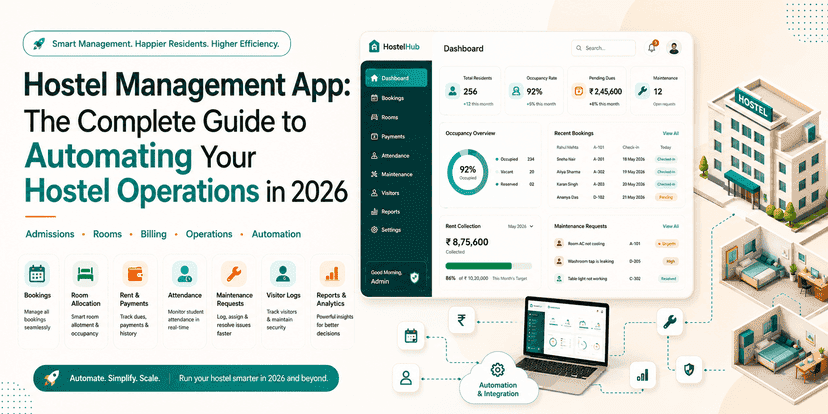
The goal is to connect admissions, rooms, residents, payments, attendance, visitors, maintenance, communication, and reporting into one operating system for the hostel.
Modern hospitality systems already bring reservations, room operations, billing, payments, housekeeping, and reporting into connected workflows rather than isolated processes.
In 2026, the next step is automation.
A well-designed hostel management system can:
- Assign rooms and beds.
- Track residents.
- Generate rent or fee dues.
- Reconcile payments.
- Send reminders.
- Manage visitors.
- Create maintenance tickets.
- Track attendance.
- Alert staff when action is needed.
- Give management live operational data.
- Use AI to assist staff with routine decisions.
For a CEO, this means better control.
For a CTO, it means fewer disconnected systems.
For a technical architect, it means creating a secure platform where data and workflows have clear ownership.
The key idea is simple: do not build a digital hostel register. Build an operational control layer for the entire hostel.
What Is a Hostel Management App?
A hostel management app is software used to manage the daily operations of a hostel, PG, student residence, staff accommodation, or co-living property.
It creates one place to manage the resident lifecycle:
Enquiry → Admission → Verification → Room Allocation → Stay → Payments → Services → Exit
A complete hostel management application may include the following:
- Resident profiles
- Admission records
- Room and bed inventory
- KYC documents
- Guardian details
- Fee and rent management
- Deposits
- Attendance
- Access records
- Visitor management
- Maintenance
- Complaints
- Notifications
- Reports
- Multi-property management
The best hostel management software does more than store this information.
It connects it.
For example, when a resident checks out, the system can automatically:
- Mark the bed as unavailable for inspection.
- Check pending dues.
- Create an exit inspection.
- Calculate the refundable deposit.
- Close access permissions.
- Update room inventory.
- Notify the operations team.
That is automation.
Why Is a Hostel Management System Important in 2026?
Because hostel operations become harder as the business grows.
A 30-bed hostel can survive with spreadsheets.
A 300-bed operation may struggle.
A 3,000-bed multi-location business can become dependent on people remembering what needs to happen next.
This creates four common problems:
Data gets fragmented. Resident details may sit in spreadsheets, payment tools, WhatsApp chats, paper files, and accounting systems.
Processes depend on people. One staff member knows how deposits are calculated. Another knows which rooms are under maintenance.
Management sees problems late. An owner may know occupancy, unpaid dues, or maintenance backlog only after asking several people.
The same work gets repeated. Teams enter the same resident, room, payment, and complaint data into multiple systems.
A connected hostel management solution changes the operating model.
Instead of asking:
“Who has the latest spreadsheet?”
The business can ask:
“What is happening right now?”
Who Needs Hostel Management Software?
Hostel management software becomes valuable when operational complexity begins growing faster than the team.
It is especially useful for:
- Student hostels
- College and university accommodation
- Working-professional hostels
- PG operators
- Co-living companies
- Staff accommodation
- Corporate housing
- Multi-property hostel chains
The stronger signal is not bed count.
It is workflow complexity.
If admissions, rooms, payments, complaints, access, maintenance, and resident communication require several teams or tools, a centralized platform can create value.
When Should You Build Custom Hostel Management Software?
An off-the-shelf product may be enough for a small property with standard needs.
Custom hostel management app development makes more sense when you need:
- Custom admission workflows
- Multiple property types
- Complex fee structures
- Parent or guardian portals
- ERP integration
- Accounting integration
- Biometric or smart-access integration
- Custom KYC workflows
- Multi-tenant architecture
- Advanced analytics
- AI automation
- Country-specific processes
- Strong data-security controls
- A branded resident experience
The question is not
“Can we buy hostel software?”
It is:
“Does our operating model fit inside standard software?”
If the answer is no, hostel management software development may become a strategic product investment rather than an IT expense.
Benefits
1. One Source of Truth for Hostel Operations
Imagine a resident named Riya.
She changes rooms.
Without a connected system, reception may update one spreadsheet while finance still uses the old room number.
Maintenance may send a technician to the wrong room.
The access system may still allow the old room.
A hostel management system links these events.
One room change can update every dependent workflow.
That reduces confusion and makes the system—not an employee's memory—the source of truth.
2. Faster Admissions and Room Allocation
Admission can include many tasks:
- Application
- Identity verification
- Document collection
- Payment
- Agreement
- Room selection
- Bed assignment
- Access setup
- Parent details
A hostel administration software platform can turn this into one guided workflow.
Instead of moving between tools, staff can follow one process.
The system can also prevent double allocation by checking room and bed availability before confirmation.
Hospitality reservation platforms use similar centralized models to create, update, cancel, and coordinate room reservations with related operational functions.
3. Better Rent and Fee Collection
Fee management is often where manual operations become expensive.
A hostel management app can automatically:
Generate due → Notify resident → Receive payment → Match payment → Update ledger → Issue receipt
It can also flag:
- Overdue payments
- Partial payments
- Failed transactions
- Refunds
- Deposits
- Adjustments
Modern hospitality billing platforms already automate parts of charge routing, payment posting, adjustments, and account management.
The larger benefit is visibility.
A CEO should be able to see the following:
Total due. Total collected. Total overdue. By property. Today.
4. More Controlled Maintenance
“AC not working.”
That message should not disappear inside a WhatsApp group.
A better workflow is the following:
Resident reports issue → Ticket created → Priority assigned → Technician assigned → SLA tracked → Resident notified → Work verified → Ticket closed
Management can then see:
- Open tickets
- Average resolution time
- Repeat failures
- Most problematic rooms
- Maintenance cost by property
Hospitality systems already use real-time room status and maintenance workflows to coordinate operational teams.
5. Better Resident Experience
Residents do not care how many systems your company uses.
They care whether things get done.
A resident app can provide:
- Digital onboarding
- Payment history
- Maintenance requests
- Visitor requests
- Notices
- Documents
- Room information
- Support
- Gate passes
- Move-out requests
The best technology becomes almost invisible.
The resident asks.
The workflow runs.
The problem gets solved.
6. Real-Time Management Visibility
A useful dashboard should answer operational questions without requiring a meeting.
For example:
- What is our occupancy today?
- Which rooms are vacant?
- How much rent is overdue?
- Which properties have high maintenance backlogs?
- How many residents are leaving next month?
- What is our average complaint resolution time?
- Which property has the highest operating cost per resident?
That is where hostel management system software becomes an executive decision tool rather than an administrative database.
7. AI Can Reduce Repetitive Work
AI should not be added because it looks impressive.
Use AI where judgment, language, or pattern detection creates value.
For example:
“Show me residents with unpaid rent for more than seven days who have not responded to the last two reminders.”
An AI-powered hostel management app could find the data, summarize it, and prepare the next actions.
But money transfers, KYC decisions, refunds, room eviction, or sensitive account changes may still need human approval.
Good automation knows when not to automate.
Process (Step-by-Step)
Step 1: Map the Real Hostel Workflow
Do not begin with features.
Begin with events.
Map what happens when:
- A resident joins.
- A payment fails.
- A room becomes vacant.
- A complaint is raised.
- A visitor arrives.
- A resident moves rooms.
- A resident leaves.
For every event, ask:
Who acts? What data is needed? What system changes? What happens next?
This becomes your automation map.
Step 2: Define Your Data Model
Your architecture should clearly define entities such as the following:
Resident → Property → Building → Floor → Room → Bed → Booking → Invoice → Payment → Complaint → Visitor → Access Event
Avoid storing the same truth in several places.
A room ID should mean the same thing across admissions, billing, maintenance, and reporting.
This sounds basic.
It is one of the biggest differences between software that scales and software that becomes harder to maintain every year.
Step 3: Define Roles and Permissions
A warden should not have the same access as a CFO.
A maintenance technician does not need resident bank information.
Typical roles may include:
- Super admin
- Property manager
- Warden
- Finance
- Security
- Maintenance
- Resident
- Parent
- Auditor
Sensitive resident and financial information should follow least-privilege access principles. NIST's Zero Trust Architecture recommends avoiding implicit trust based only on network location or ownership, while OWASP continues to identify broken authorization and authentication as major API risks.
Step 4: Build the Core Modules First
A strong hostel management system development roadmap usually starts with:
- Resident management
- Room and bed management
- Admissions
- Payments
- Maintenance
- Visitor management
- Notifications
- Reporting
Do not build 40 modules at once.
Build the smallest system that can run one complete resident journey.
Step 5: Connect External Systems
A hostel rarely operates alone.
Your system may need APIs for:
- Payment gateways
- Accounting
- ERP
- SMS
- Biometric devices
- Smart locks
- CCTV platforms
- Identity verification
- CRM
Treat each integration as a failure point.
Third-party API responses should be validated rather than automatically trusted; OWASP specifically calls out unsafe consumption of APIs as a security risk.
Step 6: Add Hostel Management Automation
Now automate repeatable workflows.
For example:
Rent automation
Invoice created
↓
Reminder sent
↓
Payment received
↓
Payment matched
↓
Receipt created
↓
Finance dashboard updated
Or:
Maintenance automation
Complaint received
↓
Category detected
↓
Priority assigned
↓
Technician notified
↓
Resident updated
↓
SLA monitored
This is where software begins removing work rather than just recording it.
Step 7: Add AI Where It Has a Clear Job
An AI hostel management system can help with:
- Resident support
- Complaint classification
- Document extraction
- FAQ answering
- Payment follow-up drafting
- Operations summaries
- Maintenance pattern analysis
- Natural-language reporting
But an AI agent should operate inside clear permissions.
For example:
Safe: “Summarize today's maintenance issues.”
Controlled: “Prepare reminders for unpaid residents.”
Approval required: “Refund ₹25,000.”
AI should increase speed without removing accountability.
Step 8: Pilot Before Full Rollout
Start with one property.
Measure the baseline.
Run the new system alongside critical processes for a limited period.
Find:
- Missing workflows
- Data errors
- Permission issues
- User confusion
- Integration failures
Then fix them before adding more properties.
Step 9: Measure and Improve
A hostel management application is never truly “finished.”
Processes change.
Policies change.
Residents behave differently.
Management needs new reports.
Design the platform so workflows, rules, and integrations can evolve without rebuilding the entire system.
Challenges
Challenge 1: Automating a Broken Process
A bad process does not become good because it is digital.
It becomes a faster bad process.
Before writing code, remove unnecessary approvals, duplicate entry, and unclear ownership.
Challenge 2: Building Too Many Features
Teams often start hostel management software development with a giant feature list.
That increases cost and slows learning.
Instead, ask:
What are the five workflows consuming the most staff time today?
Automate those first.
Challenge 3: Weak Security Around Resident Data
Hostels may hold highly sensitive information.
That can include IDs, addresses, phone numbers, family details, payment information, and access records.
Do not design security as one admin password around one database.
Use:
- Role-based access
- Encryption
- Audit logs
- Strong authentication
- Data minimization
- Secret management
- Environment separation
- API authorization
- Backup controls
Authorization must be checked at both object and function levels, not only at login. OWASP lists both broken object-level and function-level authorization among major API security risks.
Challenge 4: Overusing AI
AI should not decide everything.
A good rule is:
Automate low-risk, repeatable actions. Assist medium-risk decisions. Require humans for high-impact decisions.
Keep audit trails for important AI actions.
Challenge 5: Ignoring Staff Adoption
The best architecture fails if a warden needs 14 clicks to close a maintenance ticket.
Design around the staff member doing the work.
Mobile-first flows often matter more than beautiful executive dashboards.
Metrics / Results
Do not judge a hostel management solution by how many features it has.
Judge it by what changes after launch.
A practical 90-day measurement plan might look like this:

These are planning targets, not universal industry benchmarks. Your baseline should determine your target.
For CEOs, measure:
- Occupancy
- Collection rate
- Revenue per bed
- Operating cost per resident
- Maintenance backlog
- Resident retention
For CTOs, measure:
- Uptime
- API error rate
- Integration success
- Deployment frequency
- Incident rate
- Recovery time
For architects, measure the following:
- Data consistency
- Permission violations
- Workflow failure rate
- Event-processing delay
- Audit coverage
- Automation completion rate
A good hostel management app should improve both business outcomes and system reliability.
Conclusion
A hostel management app is not valuable because it puts hostel records on a screen.
Its value comes from connecting the work.
Admissions affect rooms.
Rooms affect billing.
Billing affects collections.
Residents create service requests.
Service requests affect operations.
Operations create data.
That data should help management make better decisions.
The strongest hostel management system therefore acts as a shared operating layer across the business.
And in 2026, AI creates another opportunity.
Not to replace every human.
But to remove repetitive work, surface useful context, and help teams take the right action faster.
Build the workflow first. Add automation second. Add AI where it creates measurable value.
That is how a hostel management application becomes infrastructure instead of just another app.
FAQs
1. What is AI hostel management software?
AI hostel management software combines normal hostel operations with AI features. It may automate support, classify complaints, summarize data, extract information from documents, recommend actions, or answer staff questions using hostel data.
2. What is an AI-powered hostel management app?
An AI-powered hostel management app is a resident or staff application that uses AI to understand requests, analyze context, recommend actions, or automate workflows instead of relying only on fixed menus and rules.
3. What hostel operations can be automated?
Common hostel management automation areas include admissions, room allocation, payment reminders, receipt generation, maintenance routing, visitor approvals, notifications, reporting, and resident support.
4. How does an AI hostel management system work?
An AI hostel management system connects AI models with hostel data and approved tools. The AI understands a request, retrieves relevant data, chooses an allowed action, and either executes it or asks a human for approval.
5. Is hostel management software secure?
It can be, but security depends on architecture. Strong systems should use encryption, role-based access, audit logs, secure APIs, authentication, backups, and strict controls around sensitive resident information.
6. How long does hostel management app development take?
A focused MVP may take a few months. A multi-property platform with payments, access control, complex integrations, analytics, and AI can take longer. Scope should be based on priority workflows rather than feature count.
7. Should I buy software or build a custom hostel management system?
Buy when your workflows are standard.
Consider custom development when your business has unique processes, integrations, security requirements, multiple properties, or plans to turn technology into a competitive advantage.
8. What integrations should a hostel management application support?
Typical integrations include payment gateways, accounting software, ERP systems, SMS, email, WhatsApp, identity verification, biometric attendance, smart locks, and analytics platforms.
9. Can one hostel management system manage multiple properties?
Yes. A well-designed multi-property system can provide property-level operations while giving central management consolidated occupancy, payments, maintenance, resident, and performance data.
10. What should CEOs and CTOs prioritize during hostel management system development?
Prioritize the resident lifecycle, reliable data, secure access, workflow automation, integrations, reporting, and measurable business outcomes. Avoid starting with AI features before the core operational system is stable.
Your hostel may not need more software.
It may need fewer disconnected workflows.
If you are planning hostel management app development, modernizing an existing hostel management system, or exploring AI-driven hostel operations automation, start with an architecture and workflow discovery session.
We can help you map your operations, define the right modules, design secure integrations, identify practical AI use cases, and build a scalable hostel management platform around your actual business.
Ready to automate your hostel operations?
Book a discovery consultation and turn your hostel workflow into one connected operating system.