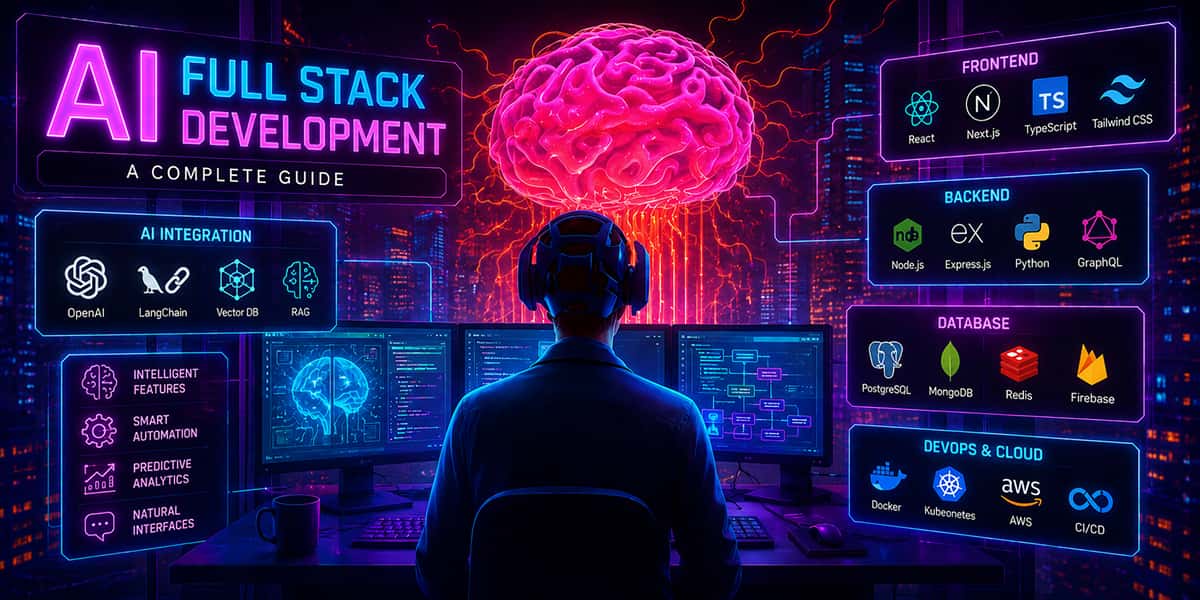
What Is AI Full Stack Development? The Complete Guide
 Naveen KT
AI is changing software development.
Today, companies want more than websites and apps. They want smart products that can answer questions, create content, automate tasks, and help users make better decisions.
This shift has created a new role called the AI Full Stack Developer.
An AI full-stack developer builds the entire application, and full-stack developers work on the frontend, backend, databases, cloud services, and AI systems.
In simple words:
An AI Full Stack Developer builds complete software applications powered by artificial intelligence.
What Is AI Full Stack Development?
AI Full Stack Development is the process of building complete AI-powered applications.
It combines:
- Frontend development
- Backend development
- Database management
- API development
- Cloud deployment
- AI model integration
- Vector databases
- AI agents and automation
An AI full-stack developer can build both the application and the AI features that power it.
Examples include:
- AI chatbots
- AI content generators
- AI customer support systems
- AI search engines
- AI coding assistants
- AI recommendation systems
Why AI Full Stack Development Matters
The Problem
Many companies want to add AI to their products.
For example:
- AI chatbots
- AI search
- AI copilots
- AI content generation
- AI agents
The challenge is that building AI applications often requires many specialists.
A company may need:
- Frontend developers
- Backend developers
- Data engineers
- Machine learning engineers
- Cloud engineers
This increases costs and slows development.
The Solution
AI full-stack developers can handle most of these tasks.
They understand both software development and AI integration.
This helps companies:
- Build products faster
- Reduce development costs
- Launch AI features quickly
- Improve customer experience
That is why AI full-stack development has become one of the fastest-growing areas in technology.
What Does an AI Full Stack Developer Do?
An AI full-stack developer works across the entire application stack.
Frontend Development
The frontend is what users see and interact with.
Popular front-end technologies include the following:
- React
- Next.js
- Vue.js
- HTML
- CSS
- JavaScript
- TypeScript
Examples of frontend AI features:
- Chat interfaces
- AI dashboards
- AI content generators
- AI search pages
The goal is to create simple and responsive user experiences.
Backend Development
The backend handles application logic and data processing.
Common backend technologies include:
- Python
- FastAPI
- Django
- Flask
- Node.js
- Express.js
Backend responsibilities include:
- Authentication
- API development
- Business logic
- Data processing
- AI request handling
The backend connects users with AI services.
AI Model Integration
This is where AI full-stack development becomes different from traditional full stack development.
Developers connect AI models to applications.
Popular AI models include:
- GPT-4o
- Claude
- Gemini
- Llama
- Mistral
These models can:
- Answer questions
- Generate content
- Summarize documents
- Translate languages
- Analyze data
Instead of building models from scratch, most developers integrate existing AI models through APIs.
Database Management
Every AI application needs a place to store information.
Common databases include:

Vector databases are important because they help AI systems search and retrieve information.
This process is often called Retrieval-Augmented Generation (RAG).
Cloud Deployment
AI applications need reliable infrastructure.
Popular cloud platforms include:
- Amazon Web Services (AWS)
- Microsoft Azure
- Google Cloud Platform
Cloud services help with:
- Hosting applications
- Managing databases
- Running AI workloads
- Scaling traffic
Without cloud deployment, AI applications cannot handle large numbers of users.
AI Full Stack Development Architecture
Most AI applications follow a similar architecture.
Layer 1: User Interface
Users interact through:
- Websites
- Mobile apps
- Dashboards
- Chat interfaces
Layer 2: Frontend
The frontend sends requests to the backend.
Common tools:
- React
- Next.js
- Vue
Layer 3: Backend
The backend manages:
- APIs
- Authentication
- User requests
- Business logic
Layer 4: AI Layer
This layer handles:
- Prompt processing
- AI responses
- Recommendations
- Predictions
Layer 5: Data Layer
Stores:
- User information
- Documents
- Chat history
- Embeddings
Layer 6: Cloud Infrastructure
Handles:
- Deployment
- Monitoring
- Security
- Scalability
This architecture is used in most modern AI products.
AI Full Stack Development Tech Stack
The right tools make development easier.
Here is a common AI full-stack technology stack.

Choosing the right stack depends on project requirements.
Essential Skills for AI Full Stack Development
Programming Skills
Learn:
- Python
- JavaScript
- TypeScript
Python is the most important language because most AI tools are built around it.
Frontend Skills
Learn:
- React
- Next.js
- HTML
- CSS
These skills help you build modern user interfaces.
Backend Skills
Learn:
- FastAPI
- Django
- APIs
- Authentication
Backend skills connect applications with AI services.
AI Skills
Understand:
- Prompt Engineering
- RAG
- Embeddings
- LLMs
- AI Agents
You do not need to become a research scientist.
You only need enough knowledge to build useful products.
Cloud Skills
Learn:
- Docker
- AWS
- Azure
- Google Cloud
These skills help you deploy and scale applications.
AI Full Stack Developer Roadmap (2026)
Many beginners feel confused when they start learning full-stack AI development.
The good news is that you do not need to learn everything at once.
Follow this roadmap step by step.
Phase 1: Learn Frontend Development
Start with the basics.
Learn:
- HTML
- CSS
- JavaScript
Then move to:
- React
- Next.js
- Tailwind CSS
Your goal is simple.
Build websites that users can interact with.
Phase 2: Learn Backend Development
Once you understand the frontend, learn how applications work behind the scenes.
Focus on:
- Python
- Node.js
- APIs
- Authentication
- Databases
Build simple APIs and connect them to your frontend projects.
Phase 3: Learn Databases
Every application stores data.
Learn:
- PostgreSQL
- MySQL
- MongoDB
Understand:
- CRUD operations
- Database design
- Queries
- Relationships
Phase 4: Learn AI Fundamentals
You do not need a PhD in AI.
Learn practical concepts:
- Machine Learning basics
- Neural Networks
- Large Language Models (LLMs)
- Prompt Engineering
- Embeddings
Understand how modern AI applications work.
Phase 5: Learn AI APIs
Most companies use existing AI models.
Learn how to work with:
- OpenAI API
- Claude API
- Gemini API
- Llama Models
Practice sending prompts and processing responses.
Phase 6: Learn Vector Databases
Modern AI systems need memory.
Learn:
- Pinecone
- Weaviate
- ChromaDB
Understand:
- Embeddings
- Similarity Search
- Semantic Search
Phase 7: Learn RAG Systems
RAG stands for Retrieval-Augmented Generation.
Many enterprise AI systems use RAG.
Benefits include:
- Better accuracy
- Less hallucination
- Access to company data
RAG is one of the most important skills in AI full-stack development.
Phase 8: Learn Cloud Deployment
Deploy your projects online.
Learn:
- AWS
- Azure
- Google Cloud
Also understand:
- Docker
- CI/CD
- Kubernetes basics
Phase 9: Build Real Projects
Projects help you learn faster than courses.
Focus on solving real problems.
The more projects you build, the easier it becomes to get hired.
7 Real AI Full Stack Projects to Build
Projects help you stand out from other developers.
Here are some of the best projects for beginners and intermediate developers.
1. AI Customer Support Chatbot
Features:
- Live chat
- Knowledge base search
- AI responses
Skills learned:
- OpenAI API
- RAG
- Vector databases
2. AI Resume Builder
Features:
- Resume generation
- ATS optimization
- Skill recommendations
Skills learned:
- Prompt engineering
- Form handling
- AI content generation
3. AI Content Generator
Features:
- Blog creation
- SEO suggestions
- Content outlines
Skills learned:
- LLM integration
- User prompts
- Content workflows
4. AI Document Search Tool
Features:
- Upload PDFs
- Ask questions
- Get instant answers
Skills learned:
- RAG
- Vector search
- Embeddings
5. AI Coding Assistant
Features:
- Code explanations
- Bug detection
- Code generation
Skills learned:
- AI APIs
- Developer tools
- Context handling
6. AI Sales Assistant
Features:
- Lead analysis
- Sales recommendations
- Email generation
Skills learned:
- CRM integration
- AI workflows
- Automation
7. AI Interview Preparation Tool
Features:
- Mock interviews
- Skill evaluation
- Feedback generation
Skills learned:
- Conversational AI
- Prompt design
- User experience
AI Full Stack Developer vs AI Engineer
Many people confuse these roles.
They are related but not identical.

AI Full Stack Developer
Focuses on building complete AI products.
Works on:
- Frontend
- Backend
- Databases
- APIs
- AI integration
AI Engineer
Focuses on AI systems.
Works on:
- Model training
- Data pipelines
- Machine learning
- Fine-tuning
Common Mistakes Beginners Make
Learning AI Full Stack Development can feel overwhelming.
Avoid these mistakes.
Mistake 1: Learning Too Many Tools at Once
Many beginners try to learn the following:
- React
- Python
- AI
- Cloud
- DevOps
all at the same time.
This causes confusion.
Better Approach
Learn one skill at a time.
Build projects after each step.
Mistake 2: Focusing Only on AI
AI alone is not enough.
Many developers ignore:
- Frontend development
- Backend development
- Databases
Companies hire people who can build complete products.
Mistake 3: Skipping Real Projects
Watching tutorials is not enough.
Employers want proof.
Build real applications.
Deploy them online.
Show your work.
Mistake 4: Ignoring User Problems
Many AI projects are impressive but not useful.
Always ask:
"What problem am I solving?"
The best AI applications solve real business problems.
Mistake 5: Not Learning RAG
Many enterprise AI systems use retrieval-augmented generation.
Without RAG:
- Accuracy drops
- Hallucinations increase
- User trust decreases
RAG is a must-have skill.
Mistake 6: Avoiding Deployment
Some developers never deploy their projects.
This is a mistake.
Learn:
- Docker
- AWS
- Vercel
- Render
Deployment shows employers that you can build production-ready applications.
Mistake 7: Chasing Every New AI Trend
New tools appear every week.
Do not chase every trend.
Focus on fundamentals:
- Programming
- Databases
- APIs
- AI integration
- Deployment
Strong fundamentals last longer than trends.
Future of AI Full Stack Development
AI Full Stack Development is still growing.
Many experts believe it will become one of the most valuable technology skills over the next decade.
Companies want developers who can build complete AI-powered products. They do not want separate teams for every small feature.
This shift is creating strong demand for AI full-stack developers.
Key Trends Shaping the Future
1. AI Agents
AI agents can perform tasks with little human input.
Examples include:
- Customer support agents
- Sales agents
- Research agents
- Coding assistants
Many future applications will use AI agents instead of simple chatbots.
2. Multi-Agent Systems
Instead of one AI model, multiple agents will work together.
For example:
- One agent gathers information
- One agent analyzes data
- One agent creates reports
This approach improves accuracy and efficiency.
3. Enterprise AI Applications
Businesses are investing heavily in AI.
Common use cases include:
- Internal knowledge search
- Workflow automation
- Employee assistants
- Customer service systems
AI full-stack developers will play a major role in building these solutions.
4. AI Copilots
AI copilots help users perform tasks faster.
Examples include:
- GitHub Copilot
- Microsoft Copilot
- Customer support copilots
- Marketing copilots
Many software products now include AI copilots as a core feature.
5. AI Search Experiences
Traditional search is changing.
Users now ask questions directly.
Platforms such as:
- ChatGPT
- Google AI Overviews
- Perplexity
- Gemini
Provide direct answers instead of simple links.
Developers who understand AI search systems will have a strong advantage.
6. Real-Time AI Applications
Future applications will provide instant responses.
Examples include:
- Live translations
- Voice assistants
- AI meeting assistants
- Real-time recommendations
These experiences require strong full-stack and AI skills.
Why Businesses Are Hiring AI Full Stack Developers
Many companies face a common problem.
They want AI features but do not have large engineering teams.
An AI full stack developer can:
- Build the frontend
- Develop APIs
- Integrate AI models
- Deploy applications
- Maintain systems
This reduces costs and speeds up development.
As a result, startups and enterprises are actively hiring full-stack AI talent.
Frequently Asked Questions (FAQs)
1. What is AI Full Stack Development?
AI Full Stack Development is the process of building complete software applications that include frontend development, backend systems, databases, cloud infrastructure, and artificial intelligence features such as chatbots, AI search, recommendation engines, and content generation tools.
2. What does an AI full-stack developer do?
An AI full-stack developer builds and manages the entire application stack. This includes user interfaces, APIs, databases, cloud deployment, and AI model integration.
3. Is AI full-stack development a good career in 2026?
Yes, AI full stack development is one of the fastest-growing technology careers. Businesses across many industries are investing in AI-powered applications and need professionals who can build complete solutions.
4. What skills are required for AI full-stack development?
Important skills include:
- Python
- JavaScript
- React
- Next.js
- FastAPI
- Databases
- Cloud platforms
- Prompt engineering
- RAG systems
- AI model integration
5. Do I need machine learning knowledge?
Basic machine learning knowledge is helpful. However, many AI full-stack developers focus on integrating AI models rather than training models from scratch.
6. What programming language should I learn first?
Most beginners start with JavaScript for frontend development and Python for AI development.
Together, these two languages cover most AI full-stack development needs.
7. What projects should beginners build?
Good beginner projects include:
- AI chatbots
- AI content generators
- Resume builders
- Document search tools
- AI coding assistants
Projects help you gain practical experience.
8. What is the difference between an AI full-stack developer and an AI engineer?
AI full-stack developers build complete applications, while AI engineers focus more on machine learning models, data pipelines, and advanced AI systems.
9. What tools are commonly used in AI full-stack development?
Popular tools include:
- React
- Next.js
- FastAPI
- PostgreSQL
- Pinecone
- OpenAI API
- Claude API
- Docker
- AWS
10. What is the future of AI full-stack development?
The future includes:
- AI agents
- Multi-agent systems
- Enterprise AI platforms
- AI copilots
- Real-time AI applications
Demand for AI full-stack developers is expected to grow significantly.
Conclusion
AI Full Stack Development is changing how modern software is built.
Instead of creating applications that only display information, developers can now build intelligent products that understand, generate, analyse, and automate.
This field combines the best parts of software engineering and artificial intelligence.
By learning frontend development, backend systems, databases, cloud technologies, and AI integration, you can build complete AI-powered applications from start to finish.
The demand for these skills continues to rise.
Companies need developers who can move quickly, solve real problems, and deliver AI-powered experiences that users love.
Whether you are a student, software developer, freelancer, or business owner, learning AI full-stack development can open new opportunities and help you stay competitive in the AI era.
Ready to Start Your AI Full Stack Journey?
Start with the basics.
Learn:
- HTML, CSS, and JavaScript
- React and Next.js
- Python and APIs
- Databases and cloud deployment
- AI model integration
- RAG systems and AI agents
Build real projects. Solve real problems.
Keep learning.
The future of software development is AI-powered, and AI full-stack development is one of the best ways to be part of it.