AI Full Stack Development vs Traditional Full Stack: Key Differences
 Naveen KT
Today, companies are looking for professionals who can build applications powered by artificial intelligence (AI).
This shift has created a new role called the AI Full Stack Developer.
But what is the difference between AI full-stack development and traditional full-stack development?
Which approach is better?
Which one should businesses choose?
And which career path offers better opportunities?
This guide explains everything in simple terms.
AI Full Stack Development vs Traditional Full Stack

Simple Summary: Traditional full-stack developers build applications. AI full-stack developers build intelligent applications that can learn, generate content, automate tasks, and provide predictions.
What Is Traditional Full Stack Development?
Traditional full-stack development involves building both the frontend and backend of an application.
A traditional full-stack developer works on the following:
- User interfaces
- APIs
- Databases
- Server logic
- Authentication
- Application deployment
Common Technologies
Frontend
- HTML
- CSS
- JavaScript
- React
- Angular
- Vue.js
Backend
- Node.js
- Python
- Java
- PHP
- .NET
Databases
- MySQL
- PostgreSQL
- MongoDB
Example
An eCommerce website built using:
- React frontend
- Node.js backend
- MySQL database
The application follows predefined rules and logic.
It performs tasks exactly as programmed.
What Is AI Full Stack Development?
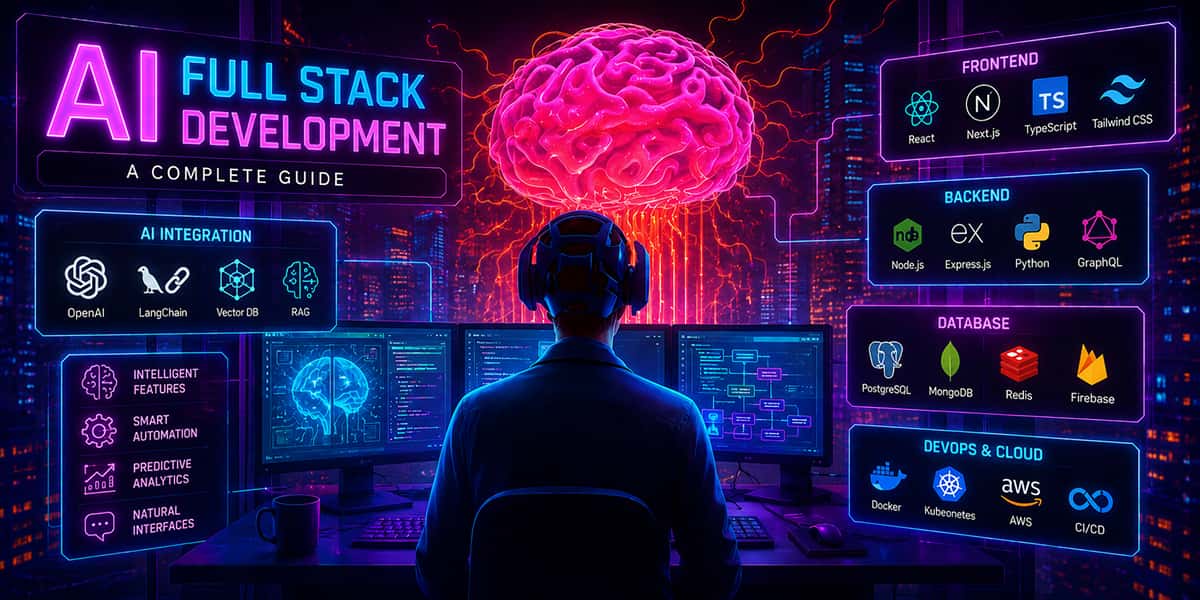
AI full stack development combines traditional development with artificial intelligence technologies.
The developer builds both the
- The software application
- The AI intelligence layer
The AI layer allows applications to:
- Generate content
- Answer questions
- Make recommendations
- Predict outcomes
- Automate workflows
- Understand human language
Common Technologies
Frontend
- React
- Next.js
- Vue.js
Backend
- Node.js
- Python
- FastAPI
- Django
AI Technologies
- OpenAI GPT
- Claude
- Gemini
- Llama
- LangChain
- Vector Databases
- RAG Systems
Databases
- PostgreSQL
- Pinecone
- Weaviate
- ChromaDB
Example
An AI customer support platform can:
- Understand customer questions
- Generate responses
- Search company documents
- Escalate complex issues
without requiring fixed responses for every scenario.
Key Difference #1: Purpose
Traditional Full Stack Development
The goal is to build functional applications.
Examples:
- Banking apps
- Ecommerce stores
- CRM systems
- Booking platforms
The application follows rules written by developers.
AI Full Stack Development
The goal is to create intelligent systems.
Examples:
- AI chatbots
- AI assistants
- Recommendation engines
- AI search platforms
These systems can adapt and generate new responses.
Traditional applications execute instructions.
AI applications generate outcomes.
Key Difference #2: Development Approach
Traditional Approach
Developers write logic for every feature.
Example:
If the user clicks "Buy Now":
- Add item to cart
- Calculate price
- Process payment
Everything is predefined.
AI Approach
Developers provide context and prompts.
The AI decides the best response.
Example:
The customer asks:
"Which laptop is best for video editing?"
AI analyses:
- Product catalog
- Customer needs
- Product reviews
Then generates a custom recommendation.
Result
AI systems offer more flexibility.
Key Difference #3: Technology Stack
Traditional Full Stack Stack
Frontend
- React
- Angular
- Vue
Backend
- Node.js
- Java
- PHP
Database
- MySQL
- PostgreSQL
AI Full Stack Stack
Frontend
- React
- Next.js
Backend
- Python
- FastAPI
AI Layer
- GPT
- Claude
- Gemini
- LangChain
Vector Database
- Pinecone
- Weaviate
- ChromaDB
Result
An AI full stack requires additional AI infrastructure.
Key Difference #4: User Experience
Traditional Applications
Users navigate menus and forms.
Examples:
- Search filters
- Dropdowns
- Static dashboards
AI Applications
Users communicate naturally.
Examples:
- Chat interfaces
- Voice assistants
- AI copilots
Why This Matters
Users prefer asking questions instead of clicking through multiple pages.
AI creates a simpler experience.
Key Difference #5: Data Processing
Traditional Development
Uses structured data.
Examples:
- Customer records
- Orders
- Product details
AI Development
Uses both structured and unstructured data.
Examples:
- PDFs
- Emails
- Documents
- Images
- Audio
Advantage
AI can understand information that traditional systems cannot easily process.
Key Difference #6: Decision Making
Traditional Systems
Follow fixed rules.
Example:
If order value exceeds $100, provide free shipping.
AI Systems
Analyse patterns and context.
Example:
Recommend products based on:
- User behavior
- Purchase history
- Similar customer actions
Benefit
AI provides smarter recommendations.
Key Difference #7: Automation Level
Traditional Automation
Rule-based workflows.
Examples:
- Email triggers
- Scheduled reports
AI Automation
Intelligent automation.
Examples:
- Content creation
- Ticket classification
- Customer support
- Lead qualification
Result
AI significantly reduces manual work.
Key Difference #8: Development Speed
AI coding tools are changing software development.
Popular tools include:
- GitHub Copilot
- Cursor AI
- Claude Code
- ChatGPT
Traditional Development
Most code is written manually.
AI Full Stack Development
Developers use AI-assisted coding.
Benefits:
- Faster prototyping
- Faster debugging
- Faster testing
Many teams report development speed improvements of 30%–60%.
Key Difference #9: Cost
Traditional Projects
Lower startup costs.
Main expenses:
- Developers
- Infrastructure
- Maintenance
AI Projects
Additional costs include:
- AI APIs
- Model hosting
- Vector databases
- Training datasets
Important Note
AI projects often cost more initially but can reduce operational expenses through automation.
Key Difference #10: Scalability
Traditional Systems
Scale servers and databases.
AI Systems
Scale:
- Models
- Inference requests
- Vector databases
- AI pipelines
Challenge
AI applications require more computing resources.
Key Difference #11: Security Considerations
Traditional Security
Focus areas:
- Authentication
- Authorization
- Encryption
AI Security
Additional concerns:
- Prompt injection
- Model misuse
- Data leakage
- Hallucinations
Best Practice
Organisations should implement AI governance and monitoring.
Skills Required for Traditional Full Stack Development
Developers should learn:
- HTML
- CSS
- JavaScript
- React
- Node.js
- APIs
- Databases
- Cloud deployment
These skills remain valuable.
Skills Required for AI Full Stack Development
Developers should learn:
- Python
- React
- APIs
- LLMs
- Prompt Engineering
- RAG
- Vector Databases
- LangChain
- AI Agents
- Model Evaluation
Recommended Learning Path
- Learn traditional full-stack development.
- Learn Python.
- Learn AI fundamentals.
- Build AI applications.
- Learn deployment and monitoring.
When Should Businesses Choose Traditional Full Stack Development?
Choose traditional full-stack development if:
- AI is not required.
- Workflows are predictable.
- Budget is limited.
- Data is structured.
- Business processes are rule-based.
Examples
- Accounting software
- Internal portals
- Inventory systems
- Basic e-commerce stores
When Should Businesses Choose AI Full Stack Development?
Choose AI full-stack development if:
- Customer support needs automation.
- Large document collections exist.
- Personalisation is important.
- Content generation is required.
- Decision support is needed.
Examples
- AI chatbots
- AI copilots
- Healthcare assistants
- Knowledge management systems
- Intelligent search engines
Future of AI Full Stack Development
The future points toward intelligent applications.
Industry trends include:
- AI agents
- Autonomous workflows
- Personalized user experiences
- Conversational interfaces
- AI-native software products
Many experts believe AI capabilities will become a standard part of modern applications.
This does not replace traditional development.
Instead, AI expands what developers can build.
Frequently Asked Questions (FAQ)
1. What is the main difference between AI full-stack development and traditional full stack development?
Traditional full-stack development focuses on building functional applications. AI full stack development adds intelligence using AI models, machine learning, and generative AI.
2. Is AI full-stack development replacing traditional full-stack development?
No, traditional full-stack development remains essential. AI full stack development builds on top of those foundations.
3. Which is better for beginners?
Start with traditional full-stack development. Then learn AI technologies.
4. Is Python necessary for AI full-stack development?
In most cases, yes. Python is widely used for AI frameworks and model integration.
5. Are AI full-stack developers in demand?
Yes. Organisations increasingly need developers who can build AI-powered applications.
6. Does AI full-stack development cost more?
Usually yes. AI APIs, infrastructure, and model hosting add costs.
7. What industries use AI full-stack development?
Healthcare, finance, ecommerce, education, SaaS, manufacturing, and customer support.
8. Can AI applications work without machine learning?
Some AI applications use large language models through APIs instead of custom machine learning models.
9. What tools are commonly used in AI full-stack development?
Popular tools include GPT, Claude, Gemini, LangChain, Pinecone, FastAPI, React, and Python.
Conclusion
The comparison between AI Full Stack Development vs Traditional Full Stack is not about choosing one over the other.
Traditional full-stack development provides the foundation for modern software.
AI full-stack development adds intelligence, automation, personalisation, and advanced decision-making capabilities.
For businesses, the right choice depends on goals, budget, and user needs.
For developers, learning traditional full-stack skills first and then adding AI expertise creates the strongest career advantage.
As AI becomes a core part of digital products, professionals who understand both worlds will be best positioned for future success.
Ready to Build AI-Powered Applications?
Whether you are a startup, enterprise, or software team, combining traditional development with AI capabilities can help you deliver smarter user experiences, automate workflows, and gain a competitive advantage.
Need expert guidance on AI full-stack development? Contact our team today to explore custom AI solutions tailored to your business goals.