AI Full Stack Development Cost: What It Really Takes to Build in 2026
 Naveen KT
“How much will it cost to build our AI product?”
It sounds like a simple question.
In 2026, it is not.
A traditional web application may need a frontend, backend, database, APIs, cloud hosting, and security.
An AI-powered product needs all of those things plus an intelligence layer.
That layer may include:
- Large language models
- Retrieval-augmented generation (RAG)
- Vector databases
- AI agents
- Model routing
- Prompt management
- Evaluation systems
- Guardrails
- Monitoring
- Human approval workflows
- AI-specific security controls
This is why comparing AI full-stack development cost with ordinary full-stack development cost can be misleading.
A team may build an impressive AI demo in a week.
Building a system that can safely serve customers, access business data, make decisions, recover from errors, control token spend, and scale to thousands of users is a very different job.
The short answer is this:
A practical AI full-stack project in 2026 can range from roughly $15,000 for a focused proof of concept to $250,000+ for a production-grade enterprise platform. Complex regulated or multi-agent systems can cost significantly more.
These are planning ranges, not fixed industry prices. The real AI development cost depends on scope, data, integrations, security, traffic, AI architecture, and how much reliability the business requires.
This guide explains what you are actually paying for.
You will learn:
- What AI full-stack development includes
- What drives AI application development cost
- Practical 2026 budget ranges
- How model usage affects ongoing cost
- What a good development process looks like
- Where AI projects become expensive
- Which metrics CEOs and CTOs should track
- How to reduce cost without creating technical debt
What is AI full-stack development?
AI full-stack development means building the complete application around an AI capability.
It is not only connecting a chatbot to an API.
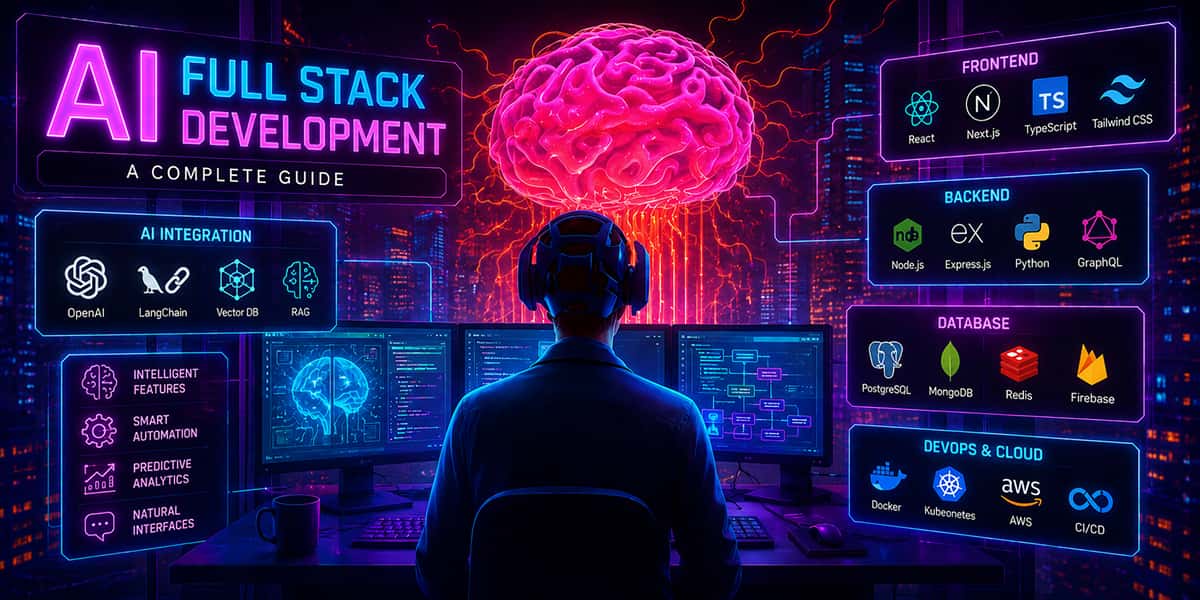
A full-stack AI product can include:
Frontend
- Web application
- Mobile application
- Dashboards
- Chat or voice interfaces
- Admin portals
Backend
- Business logic
- APIs
- Authentication
- Payments
- User management
- Workflow engines
- Integrations
Data layer
- SQL or NoSQL databases
- Vector databases
- Document stores
- Data pipelines
- Analytics
AI layer
- LLM APIs
- AI agents
- Embedding models
- RAG pipelines
- Classification models
- Vision or speech models
- Model routing
Production layer
- Cloud infrastructure
- CI/CD
- Logging
- Model monitoring
- AI evaluations
- Security
- Cost controls
- Observability
That combination is what makes full-stack AI development different from adding one AI feature to an existing product.
Why does AI full-stack development cost more than a basic web application?
Because AI introduces uncertainty.
Traditional software usually follows rules written by developers.
For example:
If payment succeeds, mark the order as paid.
AI systems can behave differently.
A model may:
- Misread the request
- Generate a wrong answer
- Use the wrong tool
- Retrieve weak data
- Produce unsupported claims
- Expose information it should not expose
- Consume more tokens than expected
This creates work that does not exist in ordinary software projects.
Teams need testing, evaluation, guardrails, logging, permission controls, fallback logic, and human review.
OWASP's GenAI security guidance highlights risks such as prompt injection and excessive agency. These issues become especially important when AI agents can access tools or business systems.
NIST also recommends managing generative AI risk across the full AI lifecycle rather than treating risk as a final security check.
That extra engineering affects the AI software development cost.
Why should CEOs and CTOs care about the full cost instead of the prototype cost?
Because prototypes hide expensive questions.
Imagine this scenario.
A company spends two weeks building an AI sales assistant.
The demo works.
Leadership approves production.
Then the team discovers that the assistant must:
- Connect to Salesforce
- Read contract data
- Respect user permissions
- Avoid exposing customer information
- Log every action
- Handle failed APIs
- Work with 20,000 customers
- Meet a response-time target
- Support human approval before certain actions
- Track model spend
The expensive part was never the chat box.
The expensive part was making it trustworthy.
For serious products, AI development pricing should be based on the production architecture, not the demo.
Who needs AI full-stack development services?
AI full-stack development services are useful when AI is part of the actual product or business workflow.
Common examples include:
- AI SaaS products
- Customer support agents
- Sales assistants
- Internal knowledge assistants
- Document automation systems
- AI-powered ERP workflows
- Healthcare platforms
- Fintech applications
- Logistics applications
- Recommendation products
- Voice agents
- AI analytics dashboards
- Intelligent mobile apps
You may not need a full AI stack if you only want a simple content-generation feature.
You probably do need one if AI must interact with users, data, APIs, business rules, or other systems.
When should you hire an AI full-stack development company?
Consider an AI full-stack development company when your project crosses several technical layers.
For example:
User uploads a document → AI understands it → business rules are applied → data is checked → CRM is updated → manager approval is requested → action is logged.
That is no longer an isolated AI feature.
It is a full business system.
A strong team should understand both software engineering and AI engineering.
That matters because the best AI model cannot fix a weak backend, broken permissions, bad data, or poor product design.
Benefits
1. One architecture instead of disconnected AI experiments
Many companies start with separate experiments.
One team builds a chatbot.
Another builds document extraction.
Another tests an AI agent.
Soon, every tool has its own model, database, authentication method, and logging system.
Costs rise.
A unified AI full-stack architecture can share:
- Authentication
- APIs
- Model gateways
- Vector databases
- Evaluation systems
- Logging
- Security rules
- Cloud infrastructure
That can reduce duplicate engineering.
2. Faster product iteration
AI-assisted engineering can speed up parts of development.
GitHub reported that 72.6% of developers in its research who used Copilot code review said it improved their effectiveness. GitHub also reported strong growth in AI-related development activity, although it warns that these observations do not prove AI caused all productivity gains.
The important lesson is not:
“AI replaces the engineering team.”
It is:
“AI can remove low-value coding work so engineers can spend more time on architecture, validation, security, and product decisions.”
Google's DORA research makes a similar point: successful AI adoption is a systems problem, not simply a tooling problem.
3. Lower cost per workflow at scale
Suppose employees manually review thousands of customer documents each month.
An AI-powered application may:
- Extract the document.
- Classify it.
- Check required fields.
- Compare it with internal data.
- Flag unusual cases.
- Send only exceptions to employees.
The business does not need AI to replace every person.
It needs AI to remove repetitive work.
That is often where the business case becomes strong.
4. Better control over AI operating costs
A good architecture can route simple tasks to cheaper models and difficult tasks to stronger models.
This matters because model prices vary widely.
For example, OpenAI's published standard API pricing currently lists GPT-5.6 Luna at $0.20 per million input tokens and $1.20 per million output tokens, while GPT-5.6 Sol is priced at $5 per million input tokens and $30 per million output tokens.
Consider 100,000 requests per month.
Assume each request uses:
- 2,000 input tokens
- 500 output tokens
That equals:
- 200 million input tokens
- 50 million output tokens
At the published Luna rates, the model portion would be about $100 per month.
At the published Sol rates, the same token volume would be about $2,500 per month.
Same application.
Same number of requests.
Very different operating cost.
This is why architecture matters as much as coding.
Process (Step-by-Step)
Step 1: Define the business outcome
Do not start with:
“We need an AI agent.”
Start with:
“We need to reduce invoice review time from 15 minutes to 3 minutes.”
Or:
“We need 60% of support requests resolved without a human.”
A measurable goal makes the project easier to scope and price.
Step 2: Map the workflow.
Document:
- Users
- Inputs
- Decisions
- Data sources
- Systems
- AI actions
- Human approvals
- Outputs
This step often reveals that the AI model is only one part of the system.
Step 3: Decide what AI actually needs to do
Ask:
- Generate text?
- Extract data?
- Search company knowledge?
- Classify documents?
- Analyse images?
- Use external tools?
- Execute workflows?
- Make recommendations?
- Take actions?
Each capability changes the AI app development cost.
Step 4: Choose the AI architecture
A typical project may use one of four approaches.
API-based AI
Use an existing foundation model through an API.
Usually the fastest route.
RAG
Connect the model to your business knowledge.
Adds document processing, embeddings, search, retrieval, and evaluation work.
Fine-tuning
Customise model behaviour using training examples.
Useful in specific cases but not always needed.
Self-hosted models
Run models on your own infrastructure.
May improve control but creates GPU, deployment, scaling, and MLOps work.
An experienced team should choose the simplest architecture that meets the business need.
More AI is not always better.
Step 5: Build the product foundation
The team develops:
- UX
- Frontend
- Backend
- Database
- Authentication
- APIs
- Roles
- Permissions
- Integrations
This is where normal full-stack development costs overlap with AI development.
Step 6: Build the AI layer
Now the application gets intelligence.
This may include:
- Prompts
- Tool calling
- RAG
- Agents
- Model routing
- Memory
- Embeddings
- Context management
- Output validation
A good implementation also limits what the model can access.
Step 7: Add evaluations and guardrails.
Do not test an AI system only by opening the app and asking a few questions.
Create repeatable tests.
Check:
- Answer accuracy
- Retrieval quality
- Hallucinations
- Tool selection
- Sensitive data exposure
- Prompt injection
- Permission boundaries
- Latency
- Token consumption
NIST's Generative AI Profile recommends managing and measuring AI risk throughout the lifecycle.
OWASP also recommends controls around input validation, permissions, data access, and agent capabilities.
Step 8: Deploy and observe
Production AI needs visibility.
Track:
- Which model answered
- Tokens used
- Cost
- Latency
- Retrieved sources
- Tools called
- Errors
- User feedback
- Failed workflows
Without this data, improving the product becomes guesswork.
Step 9: Optimise after real usage
Real users will expose cases your development team never predicted.
That is normal.
Use production data to improve:
- Prompts
- Retrieval
- UX
- Tool permissions
- Model selection
- Cost
- Response time
- Failure handling
AI applications should be treated as living systems.
Challenges
Challenge 1: Pricing the project around screens instead of complexity
Ten screens do not mean a small AI application.
A single screen connected to:
- Five enterprise systems
- Sensitive customer records
- Agentic workflows
- Real-time data
may be far harder than a 30-screen CRUD application.
Best practice: Price the workflow and architecture, not the number of pages.
Challenge 2: Using the strongest model for every request
This can make an otherwise affordable system expensive.
Use model routing.
For example:
- Simple classification → small model
- Basic extraction → small model
- Complex reasoning → larger model
- High-risk decision → stronger model + human review
Google Cloud and AWS also offer multiple model tiers and pricing models, including batch options that may reduce inference cost for suitable workloads.
Challenge 3: Ignoring security until launch
AI creates new attack paths.
Prompt injection is one example.
Another is excessive agency: giving an agent permission to perform actions it does not truly need. OWASP identifies both as important risks for LLM applications.
Use:
- Least-privilege permissions
- Approval gates
- Input validation
- Output validation
- Data isolation
- Audit logs
- Rate limits
- Tool allowlists
Challenge 4: Overbuilding the first version
A company wants:
- Voice
- AI agents
- RAG
- Fine-tuning
- Autonomous actions
- Predictive analytics
- 20 integrations
Before one user has touched the product.
That is expensive.
Build the smallest workflow that proves value.
Then expand.
Challenge 5: Thinking AI-generated code means free development
AI can write code.
But code generation is not the same as software ownership.
Someone still needs to decide:
- Is the architecture right?
- Is the code secure?
- Are edge cases handled?
- Can we maintain it?
- Can it scale?
- Do we have tests?
- What happens when the model fails?
GitHub's research on advanced AI users describes developers increasingly acting as orchestrators and verifiers rather than only code producers.
That is a better way to think about AI-assisted development.
Metrics / Results
What does AI full-stack development cost in 2026?
For planning purposes, a useful framework is:

These figures are planning estimates rather than universal market rates.
A quotation should be based on actual engineering effort.
Why such a large range?
Because AI product development costs change dramatically based on:
- Number of workflows
- Number of integrations
- Data quality
- AI model selection
- Security requirements
- Platform count
- User volume
- Compliance
- Agent autonomy
- Evaluation requirements
- Availability targets
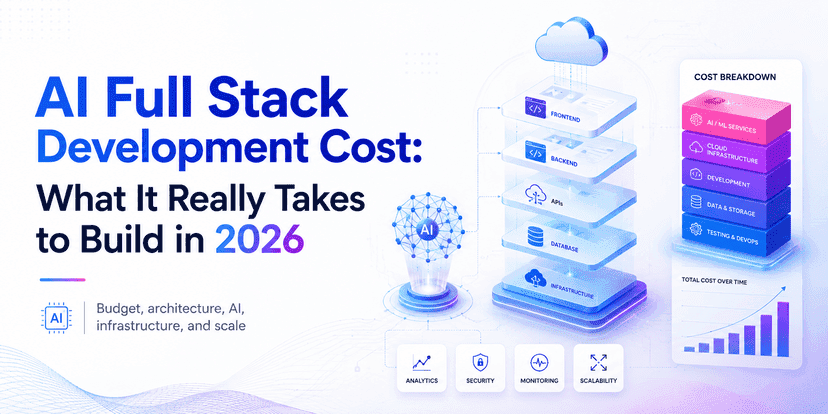
AI application development cost breakdown
A production budget often includes:
Product discovery and architecture: 5–10%
UI/UX and frontend: 15–20%
Backend and integrations: 20–30%
AI engineering: 15–25%
Data and RAG systems: 10–20%
Testing, evaluations, and security: 10–20%
DevOps and deployment: 5–10%
These percentages overlap in some projects because teams work in parallel.
They should be used for planning, not as fixed billing rules.
Why does labour still drive most AI software development costs?
AI APIs can appear surprisingly cheap.
Engineering is not.
U.S. Bureau of Labour Statistics data shows median weekly earnings of about $2,015 for full-time workers in computer and mathematical occupations in 2025.
That figure is employee pay, not the cost of hiring a development company.
A delivery team also includes:
- Architecture
- Product management
- QA
- DevOps
- Security
- Design
- Management overhead
- Infrastructure
- Support
This explains why a model API costing hundreds of dollars per month can still sit inside a six-figure software project.
What metrics should you track after launch?
A CTO should not ask only:
“Is the AI accurate?”
Track business and technical metrics together.
Business metrics
- Cost per completed workflow
- Human hours saved
- Automation rate
- Conversion rate
- Revenue per user
- Support deflection
- Time to resolution
AI metrics
- Accuracy
- Hallucination rate
- Retrieval precision
- Tool-call success rate
- Escalation rate
- Human override rate
Engineering metrics
- Response latency
- Failure rate
- API reliability
- Tokens per request
- Infrastructure cost
- Model cost per transaction
A successful AI product does not simply generate impressive answers.
It creates measurable business value at an acceptable cost.
Conclusion
The biggest mistake in estimating AI full-stack development cost is pricing the model instead of pricing the system.
The model is only one component.
A real AI-powered product needs:
- Product strategy
- UX
- Frontend engineering
- Backend engineering
- Data architecture
- AI integration
- Security
- Evaluations
- Deployment
- Monitoring
- Continuous optimisation
A simple proof of concept may cost tens of thousands of dollars.
A production AI platform may require a six-figure investment.
That does not mean AI development must be expensive.
It means the architecture must match the value of the problem.
Start small.
Measure results.
Use the cheapest model that meets the task.
Keep humans in high-risk decisions.
Design permissions before agents.
Build observability before scale.
And choose your AI full-stack development services based on production engineering ability—not on how quickly someone can produce a chatbot demo.
FAQs
1. How much does AI full-stack development cost in 2026?
A focused proof of concept may require roughly $15,000–$40,000, while a serious MVP may fall around $40,000–$100,000. Production applications commonly require larger budgets, and complex enterprise platforms can exceed $250,000.
These are planning ranges. Actual AI full-stack development pricing depends on architecture, data, integrations, security, traffic, and compliance.
2. What affects AI full-stack development cost in 2026?
The main factors are:
- Product complexity
- Number of AI workflows
- Model choice
- RAG requirements
- Number of integrations
- Security
- Data preparation
- User volume
- Platform requirements
- Testing
- Compliance
- Agent autonomy
The AI API itself is often only a small part of the total project cost.
3. How much does it cost to build an AI application?
A simple AI feature may cost far less than a complete AI product.
A production AI application needs frontend, backend, data systems, model integration, security, testing, and monitoring.
For that reason, AI application development cost should be estimated from the complete system rather than the model API alone.
4. What is the cost to build an AI-powered full-stack application?
A commercial AI-powered full-stack application may fall anywhere from $40,000 to several hundred thousand dollars, depending on the workflow.
An AI customer-support product with one data source is very different from an autonomous enterprise agent connected to ERP, CRM, payments, and internal documents.
5. How much does it cost to develop AI software?
The AI software development cost includes both initial development and ongoing operation.
Initial costs may include:
- Design
- Engineering
- AI integration
- Data work
- Testing
- Deployment
Ongoing costs may include:
- Model usage
- Cloud hosting
- Vector databases
- Monitoring
- Maintenance
- Support
6. What should an AI application development cost breakdown include?
A good estimate should show separate costs for:
- Discovery
- UX
- Frontend
- Backend
- Data
- AI
- Integrations
- Security
- QA
- DevOps
- Monitoring
- Post-launch support
Be cautious if an AI full-stack development company gives one price without explaining what is included.
7. Is AI app development cheaper in 2026?
AI-assisted coding can reduce effort in parts of software development, but production AI creates new work in areas such as evaluation, model monitoring, security, data pipelines, and AI governance.
So the answer is not simply "yes".
AI can make teams faster while making the overall product architecture more sophisticated.
8. What is the best way to estimate AI software development cost in 2026?
Start with the workflow.
Define:
- The business problem.
- The users.
- The data.
- The AI decisions.
- The systems being connected.
- The required accuracy.
- The security level.
- Expected usage.
Then create a technical architecture and estimate the engineering effort.
That approach produces a far more useful AI development pricing estimate than pricing by screens or features alone.
Planning an AI Product? Get the Architecture and Cost Right Before You Build
The most expensive AI mistake is not choosing the wrong model.
It is building the wrong architecture around it.
InfiniAppsAI helps businesses design and build production-ready AI-powered applications across frontend, backend, cloud, data, and AI.
Our AI software development services can help you with:
- AI product strategy
- Full-stack AI development
- AI web application development
- AI-powered application development
- AI agent development
- RAG systems
- Enterprise integrations
- Cloud architecture
- AI security
- Production deployment
Have an AI application in mind?
Book a free consultation and get a practical architecture, scope, and AI development cost estimate before committing to development.