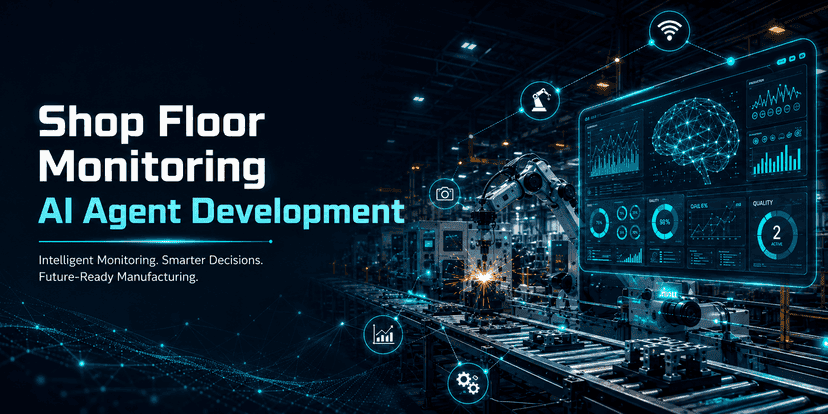
Shop Floor Monitoring AI Agent Development
 Sasikumar
What Is a Shop Floor Monitoring AI Agent?
A shop floor monitoring AI agent is an intelligent software system that watches production data, detects problems, explains what may be causing them, and helps operators take action.
Unlike a normal dashboard, an AI agent does more than display machine data.
It can collect signals from machines, PLCs, sensors, SCADA, MES, ERP, quality systems, and Industrial IoT platforms. It can then analyze those signals in real time.
For example, the agent may detect that a machine is running slower than normal. It can check recent vibration data, production history, maintenance records, and quality results. It can then alert the operator and suggest the most likely cause.
In more advanced systems, the agent can start an approved workflow automatically.
This makes shop floor monitoring more active, not just visual.
Simple definition: A shop floor monitoring AI agent turns factory data into real-time insights, alerts, recommendations, and controlled actions.
Why Traditional Shop Floor Monitoring Is No Longer Enough
Factories have monitored machines for decades.
Most plants already use some form of the following:
- SCADA
- PLC monitoring
- MES dashboards
- Historian systems
- Andon boards
- Excel reports
- Manual production sheets
- Maintenance logs
- Quality dashboards
These tools remain important.
An AI agent does not need to replace them.
The problem is that traditional monitoring often shows what happened, but it may not explain why it happened or what should happen next.
For example, a production dashboard may show the following:
Line 2 OEE: 61%
That tells the supervisor there is a problem.
But many questions remain.
Why did OEE fall?
Was it caused by downtime?
Was the machine running slower?
Did quality rejection increase?
Did material arrive late?
Did the previous shift change a machine setting?
Is the same problem happening on another line?
A human supervisor must often open several systems to find the answer.
This is where an AI agent for manufacturing floor monitoring can add value.
The agent can connect information from different systems and investigate the issue.
It may respond,
Line 2 output dropped after 9:40 AM. Machine M12 showed increasing vibration for 32 minutes before three short stops. The same pattern appeared before the previous bearing failure. Maintenance inspection is recommended.
That is a major shift.
The system moves from
Data → Dashboard → Human Analysis
to:
Data → AI Analysis → Recommendation → Human or Automated Action
Why Manufacturers Are Investing in Smarter Monitoring
Smart manufacturing investment is already moving toward connected data, automation, and AI.
Deloitte's 2025 Smart Manufacturing Survey covered 600 manufacturing executives. Ninety-two percent said smart manufacturing will be a major driver of competitiveness during the next three years. Respondents also reported average improvements of 10% to 20% in production output and 10% to 15% in unlocked capacity from smart manufacturing initiatives.
The same research shows the data foundation is still being built.
At facility or network level:
- 57% reported using cloud computing
- 57% reported using data analytics
- 46% reported using Industrial IoT
- 29% reported using AI or machine learning
- 24% reported using generative AI
Another 38% were piloting generative AI.
This matters because shop floor AI depends on connected factory data.
AI cannot fix poor machine connectivity.
It cannot understand equipment without context.
It cannot produce reliable production insights if machine tags, downtime codes, work orders, and production records are inconsistent.
Deloitte also reported that nearly 70% of manufacturers identified data problems such as quality, validation, and contextualization as major barriers to AI adoption.
The first step toward intelligent manufacturing is therefore not always a new AI model.
It is often better factory data.
How Does a Shop Floor Monitoring AI Agent Work?
A practical architecture has three main intelligence layers:
- Perception
- Reasoning
- Action
Around them are data, security, governance, and monitoring systems.
1. Perception Layer
The perception layer gives the agent visibility into the factory.
It may collect data from:
- PLCs
- CNC machines
- Robots
- Industrial sensors
- SCADA
- MES
- Historians
- Quality systems
- Energy meters
- Computer vision cameras
- ERP
- CMMS
- Warehouse systems
- Maintenance records
Common protocols may include OPC UA, MQTT, REST APIs, database connections, and industrial gateways.
Microsoft's current Azure IoT Operations architecture, for example, supports MQTT and OPC UA and is designed to process and normalize industrial data at the edge before sending selected data to the cloud.
The AI agent does not need every raw signal.
It needs the right signals with the right business context.
2. Reasoning Engine
The reasoning layer asks:
What does this data mean?
Different AI models may work together here.
These can include:
- Time-series anomaly detection
- Predictive models
- Classification models
- Computer vision
- Optimization algorithms
- Large language models
- Rules engines
- Retrieval systems
A language model alone should not control the factory.
Instead, it can work with deterministic systems and specialist models.
For example:
Sensor model: Detect unusual vibration.
Production model: Detect output loss.
Rules engine: Check safety limits.
AI agent: Combine these signals and explain the likely issue.
This approach gives the agent context.
3. Action Module
The action layer decides what happens next.
Actions should be controlled by risk.
Low-risk actions
The agent may automatically:
- Send an alert
- Create a dashboard event
- Generate a shift summary
- Open an analysis report
- Recommend an inspection
Medium-risk actions
The agent may:
- Create a maintenance work order
- Assign a technician
- Escalate a downtime incident
- Recommend production rescheduling
These may require confirmation.
High-risk actions
Actions that could affect machine safety or physical processes need much tighter controls.
Human approval and industrial safety systems should remain part of the control path.
NIST's AI Risk Management Framework recommends early safety planning, testing, continuous monitoring, and mechanisms for human intervention when AI systems behave outside expected conditions.
Shop Floor AI Agent Architecture
A simplified architecture may look like this:

Security and audit logging should surround the full architecture.
Data visualization description: Architecture diagram
For the blog design, create a horizontal architecture graphic.
The left side should show machines, robots, PLCs, cameras, and sensors.
The center should show an industrial data platform feeding an AI agent with three blocks:
Perception → Reasoning → Action
The right side should show MES, ERP, CMMS, maintenance teams, supervisors, and dashboards.
Use arrows to show that actions and feedback can move back into the agent.
What Can a Shop Floor Monitoring AI Agent Do?
The value comes from combining several monitoring functions.
Real-Time Production Monitoring
A real-time production monitoring AI system can watch the following:
- Production count
- Cycle time
- Takt time
- Machine state
- Downtime
- Changeovers
- Scrap
- Rework
- OEE
- WIP
- Energy use
- Quality performance
Instead of waiting for an end-of-shift report, supervisors can see problems while they are still happening.
The agent can also prioritize issues.
Ten alerts may exist.
Only two may affect the production target.
The agent can tell the supervisor which ones matter most.
Anomaly Detection
Anomaly detection helps identify behavior that does not match normal operation.
Examples include:
- Rising motor temperature
- Unusual vibration
- Falling machine speed
- Longer cycle times
- High compressed air use
- Unexpected energy consumption
- Repeated micro-stops
AWS IoT SiteWise, for example, provides industrial anomaly detection based on equipment time-series data and supports predictive maintenance use cases.
An AI agent can take this further by combining an anomaly with other data.
Instead of saying
Vibration anomaly detected
it may say:
Vibration increased after the tooling change. Cycle time also increased by 8%. Similar behavior appeared before two previous spindle maintenance events.
That gives the operator context.
Predictive Maintenance Alerts
Predictive maintenance tries to identify equipment problems before a breakdown occurs.
The agent may analyze:
- Temperature
- Vibration
- Pressure
- Current
- Runtime
- Historical faults
- Maintenance history
- Operator notes
- Spare parts history
Machine complexity is also making maintenance more difficult.
McKinsey notes that modern industrial assets combine more sensors, software, and complex control systems. Plants often contain equipment from different generations and vendors, which makes maintenance knowledge harder to manage.
An intelligent agent can help connect machine signals with maintenance knowledge.
For example:
Pump P-104 has shown a rising vibration trend for four shifts. The pattern is close to the condition seen before the previous coupling failure. Inspect alignment during the next planned stop.
That does not mean AI should make every maintenance decision.
It means the agent can help technicians find problems faster.
Automated Root-Cause Analysis
Finding a fault is only part of the problem.
Plants also need to know what caused it.
Traditional root-cause analysis may require checking:
- Shift reports
- Alarm history
- Machine parameters
- Downtime records
- Maintenance reports
- Batch details
- Operator comments
- Quality data
A shop floor analytics automation agent can search these sources together.
It can build a timeline.
For example:
10:07: Material batch changed.
10:14: Line speed increased.
10:19: Temperature began rising.
10:28: Quality rejection exceeded limit.
This does not prove cause.
But it gives engineers a much faster starting point.
Intelligent Production Alerts
Normal alarms are rule-based.
For example:
Temperature > 90°C → Alert
AI agents can add context.
Suppose temperature reaches 88°C.
That is below the alarm limit.
However, the normal temperature for this machine may be 72°C.
The agent may also see that current consumption is increasing.
It can raise an early warning.
This can help the team act before the standard alarm fires.
Equipment Optimization
AI agents can also look for losses that are not failures.
Examples include:
- Slow cycle times
- Long idle periods
- Frequent minor stops
- High energy use
- Poor machine balance
- Production bottlenecks
- Repeated changeover delays
The agent may compare:
Machine A vs. Machine B
or:
Current shift vs. best shift
It can then identify the biggest performance gap.
Automatic Shift Reports
Shift reporting is a good early AI-agent use case because the risk is low.
The agent can generate a report containing:
- Planned quantity
- Actual quantity
- OEE
- Downtime
- Top losses
- Quality issues
- Open maintenance problems
- Important alarms
- Recommended actions
The supervisor can review the report before sharing it.
This reduces manual reporting work without giving the AI direct machine control.
Shop Floor AI Agents vs. Traditional Dashboards

The key difference is not visualization.
It is reasoning.
Can AI Agents Replace SCADA or MES?
Usually, no.
A shop floor monitoring AI agent should normally work with existing industrial systems.
SCADA remains important for process visibility and control.
MES remains important for production execution.
PLC systems remain responsible for deterministic machine control.
The AI agent should act as an intelligence layer.
A typical structure is the following:
PLC → SCADA → MES/Data Platform → AI Agent
The AI agent may also connect with ERP and maintenance systems.
This design avoids rebuilding systems that already work.
MES Integration for Shop Floor AI
MES integration is one of the most important parts of the architecture.
The agent may need:
- Work order
- Product
- Operation
- Machine
- Shift
- Operator
- Quantity
- Downtime
- Scrap
- Rework
- Production target
This helps the agent understand the business meaning of machine signals.
A temperature value alone means little.
A temperature value linked to:
Machine → Operation → Product → Batch → Shift
has much more value.
Microsoft's current manufacturing architecture guidance also positions MES, factory digital twins, sensors, PLC data, and enterprise IT data as parts of an intelligent factory environment.
Industrial IoT and AI Agents
Industrial IoT provides much of the data needed by shop floor agents.
IIoT platforms can collect and organize:
- Sensor data
- Machine state
- Equipment events
- Historian data
- Alarms
- Energy data
AWS IoT SiteWise, for example, is designed to collect, organize, monitor, and analyze industrial equipment data at scale. It supports both cloud and edge operations.
The AI agent can sit above this data layer.
Think of IIoT as the nervous system.
The AI agent becomes part of the decision layer.
Digital Twins and Shop Floor AI
A digital twin is a digital representation of a physical system.
It may represent:
- One machine
- One production line
- A process
- A full plant
The twin can include live operating data.
AWS describes IoT TwinMaker as a way to build operational digital twins using sensor, video, and business application data.
An AI agent can query the digital twin.
This creates powerful use cases.
A plant manager could ask the following:
Why is Line 4 under target today?
The agent may review the digital twin, MES data, downtime history, and machine state.
It can then explain the main constraint.
Edge AI vs. Cloud AI for Manufacturing
This is a major development decision.
Edge AI
AI runs close to the machine.
Best for:
- Low latency
- Limited internet access
- Sensitive OT data
- Computer vision
- Immediate detection
- Local resilience
Cloud AI
AI runs in the cloud.
Best for:
- Large-scale analytics
- Multi-site comparison
- Large AI models
- Central reporting
- Model training
- Enterprise integration
Hybrid Architecture
For many factories, hybrid is the best model.
Use the edge for fast detection.
Use the cloud for deeper reasoning and cross-site learning.
Microsoft's Azure IoT Operations follows this type of edge-to-cloud approach by processing and normalizing industrial data at the edge and integrating it with cloud services.
A possible architecture is the following:
Machine → Edge Detection → Cloud Agent → Recommendation
Safety-critical machine control should remain within approved industrial control architecture.
Data Requirements for Shop Floor Monitoring AI
AI quality depends on data quality.
Before development, check whether you have:
Machine data
- Tag values
- Alarms
- Machine states
- Sensor readings
Production data
- Job
- Product
- Quantity
- Cycle time
- Shift
Quality data
- Inspection result
- Scrap
- Rework
- Defect type
Maintenance data
- Failure history
- Work orders
- Parts changed
- Technician notes
Business context
- Product
- Customer order
- Priority
- Production schedule
You do not need perfect data to begin.
But you need enough reliable data for one defined problem.
Model Selection
Not every problem requires generative AI.
Use the right model for the task.

A strong agent may combine several of these.
Safety and Reliability
Manufacturing AI is different from a marketing chatbot.
Wrong actions can affect:
- Equipment
- Production
- Employees
- Product quality
- Safety
AI agents therefore need control boundaries.
Important controls include:
- Role-based access
- Tool permissions
- Human approval
- Audit logs
- Action limits
- Emergency stop outside AI
- Model monitoring
- Fallback rules
Industrial cybersecurity also matters.
ISA/IEC 62443 is a major standards family for industrial automation and control system security. It uses a life cycle and risk-based approach for improving the security, reliability, integrity, and safety of industrial control systems.
AI should be added into your OT security model, not placed around it.
How to Develop a Shop Floor Monitoring AI Agent
A practical development process has seven phases.
Phase 1: Select One Problem
Do not start with:
“We want an AI factory.”
Start with one measurable problem.
For example:
- Unplanned downtime
- Slow cycle time
- High scrap
- Long fault diagnosis
- Manual reporting
Phase 2: Establish the Baseline
Measure the current result.
Examples:
- OEE: 64%
- Downtime: 14 hours/week
- Mean repair time: 95 minutes
- Scrap: 4.8%
Without a baseline, ROI is difficult to prove.
Phase 3: Connect the Data
Connect only the sources required for the selected problem.
For predictive maintenance, this may include the following:
Sensor + historian + CMMS
For production performance:
PLC + MES + downtime
Phase 4: Build the Intelligence
Create:
- Detection models
- Business rules
- AI reasoning
- Retrieval
- Tool connections
Validate each component separately.
Phase 5: Add the Operator Interface
Operators need simple outputs.
Do not give them another complex dashboard.
Use clear messages.
For example:
Problem: M22 cycle time increased.
Impact: 310 units may be lost this shift.
Likely Cause: Cooling pressure dropped after 10:20 AM.
Action: Inspect cooling circuit.
Phase 6: Pilot on One Line
Start small.
Measure results.
Capture feedback.
Check false alerts.
Do not scale before the pilot proves value.
Phase 7: Scale
After proving value:
- Add more machines
- Add more production lines
- Add more use cases
- Standardize the architecture
- Create governance
- Introduce multi-agent workflows
What Does Shop Floor AI Agent Development Cost?
There is no universal price.
Cost depends on:
- Number of machines
- Number of factories
- Existing MES
- SCADA availability
- Data quality
- Sensor coverage
- Required AI models
- Edge hardware
- Cloud services
- Integration complexity
- Security needs
- User interfaces
A plant that already has clean MES and historian data can usually start faster than a plant that still depends heavily on manual records.
A better cost model is the following:
Infrastructure + Data Integration + AI Development + OT Integration + Security + Support
Ask vendors to separate these costs.
This makes proposals easier to compare.
How Long Does ROI Take?
There is no fixed ROI timeline for a shop floor AI project.
The biggest factor is the use case.
A simple shift-reporting agent may show value quickly.
Predictive maintenance may require enough failure history to validate predictions.
A multi-plant autonomous optimization system can take much longer.
For planning purposes, organizations can think in three stages:
Stage 1: Pilot value
Can one line solve one measurable problem?
Stage 2: Operational value
Can the solution produce a repeatable improvement?
Stage 3: Enterprise value
Can the same architecture scale across lines or plants?
ROI should be measured against a business KPI, not the number of AI features built.
Shop Floor AI KPIs
Track both manufacturing and AI KPIs.
Manufacturing KPIs
- OEE
- Throughput
- Cycle time
- Downtime
- MTTR
- MTBF
- Scrap
- Rework
- Energy per unit
- Schedule adherence
AI KPIs
- Alert accuracy
- False alert rate
- Missed anomaly rate
- Recommendation acceptance
- Action success rate
- Response latency
- Human escalation rate
Measuring ROI
A simple model is
Annual Value = Downtime Savings + Productivity Gain + Quality Savings + Maintenance Savings
Then:
ROI = (Annual Value − Annual Solution Cost) ÷ Solution Cost × 100
Do not include savings that cannot be measured.
Use actual plant data.
Data visualization description: ROI comparison chart
Create a bar chart with four categories:
- Downtime loss before AI
- Downtime loss after AI
- Scrap cost before AI
- Scrap cost after AI
Beside it, show three KPI cards:
Downtime reduction
Throughput improvement
Payback period
Populate the final design with verified customer or plant data rather than generic numbers.
Change Management for Operators
Technical success does not guarantee adoption.
Operators may ask:
Is AI monitoring me?
Will it replace my job?
Why should I trust the alert?
These are reasonable questions.
Deloitte found that 35% of respondents in its smart manufacturing research identified helping workers adapt to the factory of the future as a major human-capital concern.
A good rollout should:
- Involve operators during design.
- Explain what data the agent uses.
- Show why an alert was generated.
- Allow feedback.
- Measure incorrect recommendations.
- Keep human control where appropriate.
The best early agent is often a copilot, not an autonomous controller.
Vendor and Technology Landscape
There are several paths for development.
Siemens
Siemens is investing heavily in Industrial AI and industrial copilots.
Its industrial AI strategy focuses on connecting and contextualizing shop floor data and using AI to support real-world industrial decisions.
Microsoft
Microsoft's manufacturing ecosystem combines Azure IoT Operations, AI, edge services, digital twins, and factory data.
Microsoft now explicitly describes AI agents as part of factory optimization scenarios.
AWS
AWS offers industrial services such as the following:
- AWS IoT SiteWise
- AWS IoT TwinMaker
- Amazon SageMaker
- Amazon Bedrock
These can support equipment data, digital twins, ML, and generative AI workloads.
Other Industrial Platforms
Depending on your plant ecosystem, solutions may also include platforms and products from
- Rockwell Automation
- Schneider Electric
- AVEVA
- PTC
- NVIDIA
- Hexagon
- Sight Machine
The correct platform depends on existing plant systems.
Open-Source AI Agent Frameworks
Manufacturers building custom agents may also use software frameworks for agent orchestration.
Common categories include:
- Agent workflow frameworks
- Retrieval systems
- Vector databases
- ML libraries
- Streaming platforms
- Industrial protocol libraries
The important point is not which framework is most popular.
The important point is whether it supports:
- Controlled tool calls
- Logging
- Retry logic
- State management
- Human approval
- Model flexibility
- Security
Industrial reliability matters more than demo speed.
Build vs. Buy
Should you build an AI agent or purchase a platform?
Use this framework.

A hybrid approach is also common.
You may buy the industrial data layer and build the AI agent on top.
What Are the Biggest Integration Challenges?
The main problem is often not AI.
It is integration.
Common challenges include:
- Old machines
- Vendor-specific protocols
- Missing sensors
- Poor downtime codes
- Unstructured maintenance records
- Different plant standards
- Network separation between OT and IT
- Cybersecurity restrictions
- Inconsistent asset names
- Weak MES data
Start with a data audit.
Do this before model development.
Future of Intelligent Manufacturing Agents
Shop floor AI is moving toward more autonomous systems.
Deloitte reported in 2025 that only 6% of surveyed manufacturers were already using agentic AI, but 24% expected to use it within two years.
The future is likely to involve several specialized agents.
Multi-Agent Manufacturing Systems
Instead of one large AI agent, a plant may use the following:
Maintenance Agent
Detects equipment risks.
Quality Agent
Tracks defects.
Production Agent
Monitors throughput.
Energy Agent
Finds energy waste.
Planning Agent
Checks schedules.
Supervisor Agent
Coordinates the others.
The agents can share information.
For example:
Production Agent:
Line 3 output may fall below target.
Maintenance Agent:
Machine 3A needs inspection.
Planning Agent:
Move Order 458 to Line 5.
Supervisor Agent:
Recommend Line 5 transfer and maintenance inspection during the next planned stop.
A human supervisor can then approve the plan.
Human-AI Collaboration on the Factory Floor
The goal should not be to remove people from every decision.
Manufacturing contains knowledge that is difficult to capture in a database.
Operators know:
- Machine sounds
- Material behavior
- Common failure patterns
- Workarounds
- Process history
AI adds another strength.
It can review huge amounts of data quickly.
The stronger model is
Human Experience + Machine Data + AI Reasoning
This creates a manufacturing copilot.
Frequently Asked Questions
What is a shop floor monitoring AI agent?
A shop floor monitoring AI agent is software that monitors machine and production data, finds abnormal conditions, analyzes possible causes, and gives operators recommendations or approved automated actions.
Can AI monitor factory production in real time?
Yes. AI can process real-time data from PLCs, sensors, MES, SCADA, historians, IIoT platforms, and other factory systems.
Can an AI agent predict machine failure?
AI can identify patterns linked with possible failures when enough reliable equipment data is available. Predictive models can use vibration, temperature, pressure, runtime, and historical maintenance data.
Does a shop floor AI agent replace MES?
Usually not. The AI agent normally connects with MES and uses MES data as business context.
Does AI replace SCADA?
No. SCADA remains important for industrial monitoring and control. AI agents normally add analysis and decision support above existing control systems.
Can an AI agent automatically control machines?
Technically, some automated actions are possible. However, physical machine actions should follow strict industrial safety, cybersecurity, authorization, and human-control requirements.
What data is required?
Common data sources include sensors, PLCs, SCADA, MES, historians, CMMS, quality systems, ERP, and operator records.
Should manufacturing AI run at the edge or in the cloud?
Many factories use a hybrid model. Fast detection can run at the edge while large-scale analytics and deeper AI reasoning run in the cloud.
What is the best first shop floor AI use case?
Start with a measurable problem with usable data. Good examples include downtime analysis, automated shift reporting, anomaly detection, and maintenance alerts.
How can manufacturers calculate ROI?
Measure changes in business KPIs such as downtime, throughput, scrap, maintenance cost, and labor effort. Compare the financial value with development and operating costs.
Conclusion
Shop floor monitoring is changing.
Factories already collect large amounts of information.
The next challenge is turning that information into faster decisions.
A shop floor monitoring AI agent can help connect machine signals, production records, maintenance information, quality data, and business context.
It can detect unusual behavior.
It can explain production losses.
It can generate predictive alerts.
It can help maintenance teams.
It can automate reporting.
And, where controls allow it, it can start approved workflows.
But successful shop floor monitoring AI agent development begins with the factory problem, not with the AI model.
Start with a clear KPI.
Build the right data foundation.
Connect existing OT and IT systems.
Keep safety and security outside the model's discretion.
Pilot the agent on a controlled production area.
Then measure whether downtime, throughput, quality, maintenance performance, or operator efficiency actually improves.
This approach turns AI from a factory experiment into a production capability.
At Infiniapps.ai, we develop AI agent solutions that connect with business and operational systems, analyze real-time data, automate workflows, and support production-ready enterprise use cases.
For manufacturers exploring intelligent factory operations, the right first question is not:
“How much AI can we add?”
It is:
“Which shop floor decision can we make faster and better with the data we already have?”
That is where a practical AI agent project should begin.