Who's Responsible When Your AI Agent Makes a Mistake?
 Sasikumar
At 8:47 on a Monday morning, Maya gets a call from the finance team.
There is a problem.
Her company recently launched an AI procurement agent.
The agent was designed to monitor inventory, identify shortages, prepare purchase orders, and send approved orders to suppliers.
For six weeks, it worked well.
Then one morning, the agent reads an outdated inventory record.
It concludes that a critical component is almost out of stock.
The agent creates a large purchase order.
The workflow allows purchases below a certain threshold to move forward automatically.
The order is sent.
But the company already has enough inventory.
Now Maya has one question:
“Who is responsible for this mistake?”
Is it the employee who enabled the AI agent?
The developer who built it?
The company that provided the LLM?
The manager who approved the automation?
The person responsible for the inventory data?
Or the business that decided an AI agent could place orders without human review?
This question is becoming far more important in 2026.
Businesses are moving beyond AI chatbots that only generate text.
Modern AI agents can search databases, call APIs, update CRMs, send emails, approve workflows, generate reports, make recommendations, and trigger real business actions.
When an AI chatbot gives a bad answer, someone may be annoyed.
When an AI agent takes the wrong action, the result can affect money, customers, employees, operations, safety, or compliance.
That is why every business deploying AI agents needs an AI governance framework.
And the first rule is simple:
The AI agent should never be the final owner of responsibility.
Responsibility must remain with people and organisations.
What Is AI Agent Governance?
AI agent governance is the set of policies, roles, controls, approvals, monitoring systems, and accountability rules used to manage how AI agents make decisions and take actions.
It answers questions such as:
- What is the agent allowed to do?
- What data can it access?
- Who approved the agent?
- Which actions require human approval?
- Who owns the business outcome?
- How are mistakes detected?
- What happens after an incident?
- When should the AI agent be stopped?
AI governance is not only about compliance.
It is about control.
A company may have an AI agent that is technically accurate 98% of the time.
But if the remaining 2% can transfer money, delete customer records, or make employment decisions, that 2% may carry serious risk.
NIST's AI Risk Management Framework treats AI governance as a continuous part of managing AI risk. Its framework is organised around four functions:
Govern → Map → Measure → Manage.
That idea is especially important for AI agents because their behaviour can change based on data, context, tools, and user instructions.
Why AI Agent Responsibility Is Different From Normal Software
Traditional software usually follows fixed instructions.
Imagine a payroll system.
A developer writes:
If employee salary = $5,000, transfer $5,000.
The result is predictable.
An AI agent works differently.
It may:
- Receive a goal.
- Interpret the request.
- Decide which tools to use.
- Retrieve information.
- Reason about possible actions.
- Select an action.
- Call an API.
- Observe the result.
- Decide what to do next.
This creates a longer chain of responsibility.
A mistake can come from:
- The user's instruction
- Poor business rules
- Wrong data
- Failed retrieval
- A model error
- Incorrect tool selection
- Excessive permissions
- Missing approval controls
- Weak testing
- Poor monitoring
That means asking:
“Who made the mistake?”
is usually too simple.
The better question is:
“Which control should have prevented the mistake, and who owned that control?”
The Story Continues: What Actually Went Wrong With Maya's AI Agent?
The technical team investigates.
They find five problems.
Problem 1: The Inventory Data Was Old
The warehouse system had not synchronised correctly.
Problem 2: The AI Agent Trusted the Data
There was no freshness check.
Problem 3: The Agent Had Purchase Permissions
It could create and submit orders.
Problem 4: The Approval Threshold Was Too High
Management had allowed the agent to send some orders automatically.
Problem 5: Nobody Was Monitoring Unusual Orders
There was no alert when purchasing volume was much higher than normal.
Now the answer becomes clearer.
The mistake did not belong to one person.
It came from several governance failures.
This is why businesses need shared accountability without creating vague accountability.
If everybody is responsible, nobody is responsible.
Each part of the AI system needs a clear owner.
Who Is Responsible When an AI Agent Makes a Mistake?
There is no universal legal answer.
Legal liability depends on the country, industry, contracts, product, facts, and type of harm.
But from an AI governance perspective, responsibility should be divided across clear roles.
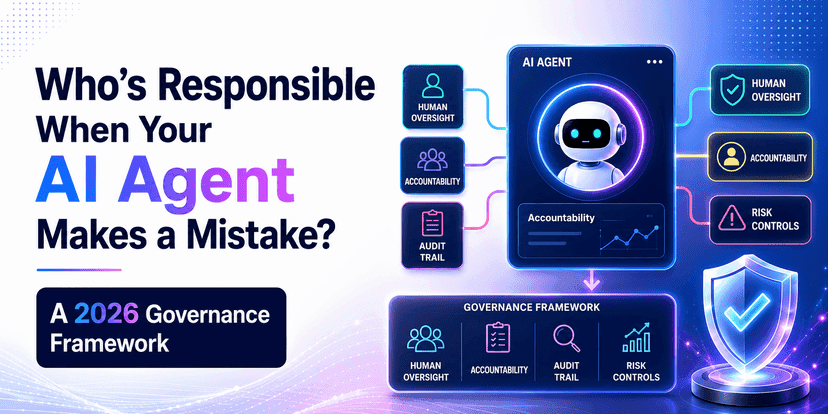
A practical model looks like this:

One company may combine several of these roles.
The important thing is that the roles exist.
1. The Business Owner Owns the Business Decision
Return to Maya's procurement agent.
Who decided that an AI system should be allowed to purchase goods automatically?
That is not an LLM decision.
It is a business decision.
The business owner should define:
- The problem the agent solves
- What success means
- Acceptable risk
- Maximum financial exposure
- Which actions require human review
- When automation should stop
For example:
An AI procurement agent may be allowed to:
- Search inventory
- Compare suppliers
- Prepare purchase orders
But orders above $5,000 may require a manager.
The business sets that boundary.
2. The AI Product Owner Owns the Agent's Scope
Every production AI agent should have a named owner.
Not:
“The AI team.”
A person or clearly identified function.
The AI product owner should know:
- Why the agent exists
- Which users can access it
- Which tools it uses
- Which data sources it reads
- Which actions it can perform
- Which models it uses
- What its failure limits are
- What metrics are monitored
This person does not personally cause every AI failure.
But they own the process for making sure the system remains within its intended scope.
NIST recommends documenting the intended purpose, users, deployment context, expected benefits, and possible negative impacts of AI systems as part of risk mapping.
3. The Development Team Owns Technical Guardrails
Developers should not be expected to decide the company's risk tolerance.
But they are responsible for implementing the agreed technical controls correctly.
These may include:
- Input validation
- Output validation
- API permissions
- Rate limits
- Retry controls
- RAG filtering
- Tenant isolation
- Human approval
- Logging
- Fallback behaviour
Imagine an AI agent generates:
refund_customer($25,000)
The backend should not simply execute that instruction because the model requested it.
The application should check:
- Does this user have refund permission?
- Is $25,000 within the permitted limit?
- Is manager approval required?
- Does the customer belong to this account?
- Is the transaction suspicious?
The LLM proposes.
The software controls execution.
This is an important principle in production-ready AI full stack application development.
4. The Model Provider Owns the Model Layer
Businesses may build agents using models from providers such as OpenAI, Anthropic, Google, or other vendors.
The model provider is responsible for the model and service according to its applicable commitments, documentation, and contracts.
But using an external model does not automatically transfer all responsibility to the model provider.
Imagine Maya's company gives an AI agent full purchasing authority.
The model provider did not decide that.
The company did.
This distinction becomes increasingly important as regulation separates different actors in the AI value chain.
The EU AI Act, for example, distinguishes roles such as providers and deployers, with different obligations depending on what each party does. The European Commission's current transparency guidance explicitly sets different expectations for providers and deployers of certain AI systems.
For businesses, the lesson is simple:
Buying an AI model does not outsource your governance.
5. The Data Owner Owns Data Quality and Access
What caused Maya's procurement problem?
Partly, bad data.
AI systems rely heavily on the information they receive.
If the inventory database is wrong, the agent may reason correctly from incorrect information.
This is sometimes described as:
Garbage in → confident AI decision out.
Businesses need owners for important AI data sources.
The data owner should define:
- Where data comes from
- How current it must be
- Who can access it
- How quality is checked
- Which data should not be used
- How incorrect records are corrected
For high-impact workflows, add freshness checks.
Example:
Do not create a purchase order if inventory data is more than 30 minutes old.
That one rule could have prevented Maya's incident.
6. Human Approvers Own High-Risk Decisions
Human-in-the-loop does not mean:
“A human is somewhere in the company.”
The human needs a clear role.
Imagine an AI lending assistant recommending rejecting an application.
A human reviewer sees only:
RECOMMENDATION: REJECT
and clicks Approve.
Technically there was human oversight.
Practically, there may have been very little meaningful oversight.
A good approval interface should show:
- What the AI recommends
- Why
- Key supporting information
- Confidence or uncertainty where useful
- Important risk flags
- What action will happen
- Whether the action can be reversed
Humans should have enough information and authority to challenge the AI.
7. Security Teams Own Access and Tool Risk
An AI agent becomes far more dangerous when it can use tools.
Consider the difference.
AI Assistant
Can answer:
“Which customers have overdue invoices?”
AI Agent
Can answer that question and send collection emails automatically.
The second system needs much stronger controls.
Security teams should review:
- Authentication
- Authorisation
- Secrets
- API credentials
- Tool permissions
- Tenant boundaries
- Sensitive data
- Prompt injection
- External content
- Audit logs
The safest model is usually:
Give the agent the minimum permissions required for its job.
Not:
“Give it broad access now and restrict it later.”
AI Agent Responsibility Matrix
A useful governance tool is a responsibility matrix.
For example:

This removes ambiguity after an incident.
Instead of asking:
“Whose fault was this?”
Teams can ask:
“Which control failed?”
A Practical 2026 AI Agent Governance Framework
Businesses do not need to start with a 150-page AI policy.
Start with a practical framework.
Layer 1 — Define the Agent
Every AI agent should have an agent card.
Document:
Agent Name
Procurement Agent
Business Purpose
Reduce manual purchase-order preparation.
Owner
Head of Procurement.
Approved Users
Procurement team.
Data Sources
Inventory database and supplier system.
Tools
- Search inventory
- Get supplier pricing
- Create purchase order
Prohibited Actions
- Create a new supplier
- Modify supplier banking details
- Delete transactions
Maximum Autonomous Action
Orders below the approved limit.
Human Approval
Required above threshold.
Monitoring
Daily transaction review and anomaly alerts.
If nobody can produce this information, the agent is probably not ready for production.
Layer 2 — Classify the Risk
Not every AI agent needs the same controls.
Use a simple four-level model.
Level 1 — Low Risk
Examples:
- Summarise meeting notes
- Rewrite emails
- Draft internal content
Potential control:
Basic logging and user review.
Level 2 — Moderate Risk
Examples:
- Customer support recommendations
- Internal knowledge search
- Sales lead scoring
Controls:
- Approved data
- Evaluation
- Logging
- Human review for some outputs
Level 3 — High Risk
Examples:
- Financial recommendations
- Healthcare support
- Employee screening
- Automated refunds
- Contract analysis
Controls:
- Strong evaluation
- Access controls
- Human approval
- Audit logs
- Formal risk review
Level 4 — Critical
Examples:
- Large financial transactions
- Safety-critical operations
- High-impact autonomous decisions
- Critical infrastructure actions
Default approach:
Do not allow unrestricted autonomous execution.
Use strict controls and expert review appropriate to the use case.
Layer 3 — Set Autonomy Levels
The key governance question is not:
“Do we use AI agents?”
It is:
“How much autonomy should this agent have?”
Use an autonomy ladder.
Level 0 — Inform
The AI only provides information.
Example:
“Here are three overdue invoices.”
Level 1 — Recommend
The AI suggests an action.
“I recommend contacting these customers.”
Level 2 — Prepare
The AI prepares the work.
“I drafted three reminder emails.”
Level 3 — Act With Approval
“Approve these emails before sending?”
Level 4 — Act Automatically Within Limits
The agent sends routine reminders below a defined risk threshold.
Level 5 — Broad Autonomous Action
The agent acts across multiple systems with little human review.
For most businesses, Level 5 should be rare.
Do not give the agent more autonomy than the business problem requires.
Layer 4 — Define Human Approval Gates
Not every action needs approval.
But certain triggers should automatically require a person.
Examples include:
Financial Threshold
Any transaction above $5,000.
Customer Impact
Account suspension or cancellation.
Legal Impact
Contract changes.
Employee Impact
Hiring, firing, or disciplinary recommendations.
Healthcare Impact
Important patient-specific clinical actions.
Low Confidence
The agent cannot find reliable supporting information.
New Situation
The workflow is outside tested scenarios.
The goal is not to approve everything manually.
The goal is to put people at the points where mistakes matter most.
Layer 5 — Keep an AI Audit Trail
Imagine Maya asks:
“Why did the AI purchase these components?”
The company should be able to reconstruct the event.
A useful audit trail may include:
- User request
- Agent goal
- Model version
- Prompt version
- Data retrieved
- Tools called
- API inputs
- API outputs
- Approval events
- Final action
- Time
- User identity
- Errors
Without logs, investigating AI incidents becomes guesswork.
ISO/IEC 42001 emphasises structured management of AI systems and supports goals such as traceability, transparency, reliability, and continued improvement.
Layer 6 — Test Before Giving the Agent More Power
Maya's company tested whether the procurement agent could create orders.
They did not test:
“What happens when inventory data is wrong?”
That is an important difference.
AI testing should include:
Normal Scenarios
Does the agent complete the task correctly?
Edge Cases
What happens with missing information?
Adversarial Cases
Can users manipulate the agent?
Permission Tests
Can the agent access restricted information?
Tool Failure
What happens if an external API stops responding?
Bad Data
What happens if information is outdated?
High-Impact Scenarios
Can the agent accidentally perform a costly action?
NIST's AI RMF recommends testing AI systems before deployment and regularly while they are operating.
Layer 7 — Monitor the Agent After Launch
Passing a test on Friday does not mean the agent will behave perfectly six months later.
Things change.
- Models change.
- Prompts change.
- Data changes.
- APIs change.
- Business rules change.
- Users find unexpected ways to use the system.
Monitor:
- Task success rate
- Human override rate
- Failed tool calls
- Hallucinations
- Retrieval quality
- Policy violations
- Unexpected actions
- Cost
- Latency
- User complaints
Governance is an ongoing process.
NIST describes AI risk management as continuous throughout the AI lifecycle, while ISO/IEC 42001 uses an ongoing management-system approach for maintaining and improving AI governance.
Layer 8 — Create an AI Incident Response Process
Eventually, an AI system will make a mistake.
The goal is not to pretend mistakes can be eliminated completely.
The goal is to know what happens next.
Imagine Maya discovers the incorrect purchase order.
A mature organisation should have a process.
Step 1: Stop Harm
Pause the agent or affected action.
Step 2: Preserve Evidence
Save logs, model outputs, retrieved data, and API records.
Step 3: Determine Impact
Ask:
- Who was affected?
- Was money lost?
- Was sensitive data exposed?
- Did a customer experience harm?
Step 4: Identify the Failure
Was it:
- Model failure?
- Data failure?
- Integration failure?
- Permission failure?
- Human approval failure?
- Policy failure?
Step 5: Fix the Control
Do not only fix the individual output.
Fix the system.
Step 6: Re-Evaluate
Run relevant evaluation tests again.
Step 7: Restart Carefully
Return permissions gradually if necessary.
AI Governance in 2026: Regulation Is Catching Up
Businesses should also understand that AI governance is moving from voluntary best practice toward formal regulatory obligations in some markets.
The EU AI Act became broadly applicable on August 2, 2026, with some requirements applying on different timelines. Transparency obligations for certain AI systems also began applying on August 2, 2026.
For example, certain interactive AI systems must make it clear when people are interacting with AI rather than a human. The rules also include transparency requirements for some AI-generated or manipulated content.
The Commission also distinguishes between responsibilities for AI providers and deployers, showing why businesses need to understand their position in the AI value chain.
For general-purpose AI model providers, obligations relating to documentation and information for downstream providers have applied since August 2, 2025.
This does not mean every business using an AI agent has the same obligations.
It means governance should include a basic question:
“Which laws and industry requirements apply to this use case and our role?”
For legal conclusions, organisations should obtain qualified advice for their actual jurisdiction and use case.
NIST AI RMF vs ISO 42001: Which Framework Should Businesses Use?
Businesses often ask whether they should use NIST AI RMF or ISO/IEC 42001.
They serve different but complementary purposes.

NIST explicitly describes the AI RMF as voluntary and designed to help organisations manage risks across the design, development, deployment, and use of AI systems.
ISO/IEC 42001 defines requirements for establishing, maintaining, and continually improving an AI management system.
Businesses do not necessarily need to choose only one.
A company can use NIST concepts to manage AI risks while using ISO/IEC 42001 to structure broader organisational governance.
The 2026 AI Agent Governance Checklist
Before deploying an AI agent, answer these questions.
Ownership
- Who owns the business outcome?
- Who owns the AI agent?
- Who owns each data source?
Scope
- What is the agent allowed to do?
- What is it prohibited from doing?
Data
- Which data can it access?
- How is data quality checked?
- Are access permissions applied during retrieval?
Autonomy
- Can it only recommend?
- Can it prepare actions?
- Can it execute actions?
Human Oversight
- Which decisions require approval?
- Who is authorised to approve?
Security
- What tools can the agent access?
- How are API credentials protected?
- Are permissions based on least privilege?
Testing
- Has the agent been tested on normal, edge, failure, and adversarial scenarios?
Evaluation
- What quality level must it meet before launch?
Monitoring
- Are actions, failures, costs, and unusual behaviour tracked?
Incident Response
- Can the agent be stopped quickly?
- Can past actions be reconstructed?
Compliance
- Which laws, regulations, industry rules, and contracts apply?
If several answers are:
“We're not sure.”
The agent is probably not ready for autonomous production use.
The Most Important Governance Rule: Match Control to Impact
You do not need a board meeting every time an AI agent summarises an email.
Governance should be proportional to risk.
A useful rule is:
The greater the potential impact of an AI action, the stronger the controls should be.
For example:

This lets businesses use AI without turning governance into a barrier to innovation.
Frequently Asked Questions
Who is responsible when an AI agent makes a mistake?
Responsibility depends on the system, organisation, contracts, jurisdiction, and type of harm. From a governance perspective, responsibility should be assigned across business owners, AI product owners, developers, data owners, security teams, human approvers, and other relevant parties rather than assigned to the AI itself.
Can an AI agent be legally responsible?
AI systems generally should not be treated as the organisation's accountability mechanism. Legal responsibility depends on applicable law and the roles of the people and organisations involved. Businesses should maintain clear human and organisational ownership.
Is the AI developer responsible for every mistake?
No. Developers are responsible for their part of the system, such as implementing agreed technical controls. Business decisions, data quality, model services, approvals, and operational use may belong to different parties.
Is the LLM provider responsible if its model makes a mistake?
It depends on the circumstances and applicable agreements and laws. Businesses deploying the model still need to govern how it is used, what data it receives, what permissions it has, and whether its outputs can trigger actions.
What is human-in-the-loop AI governance?
Human-in-the-loop governance requires a person to review or approve certain AI recommendations or actions before they take effect.
Should every AI agent action require human approval?
No. Low-risk and well-tested actions may be automated. Higher-impact actions should normally have stronger controls based on the organization's risk assessment.
What is an AI agent audit trail?
An AI audit trail records key information about what the agent did, including prompts, retrieved data, tool calls, model versions, approvals, actions, and errors.
What is an AI governance framework?
An AI governance framework defines the roles, policies, processes, controls, evaluations, monitoring, and escalation procedures used to manage AI systems safely and responsibly.
What is NIST AI RMF?
The NIST AI Risk Management Framework is a voluntary framework designed to help organisations manage AI risks. Its core functions are govern, map, measure, and manage.
What is ISO/IEC 42001?
ISO/IEC 42001 is an international AI management-system standard that provides requirements for establishing, implementing, maintaining, and continually improving organisational AI governance.
Does the EU AI Act apply to AI agents?
It can, depending on the AI system, use case, role of the organisation, and other factors. The EU AI Act uses a risk-based approach and sets different obligations for different actors and systems. Businesses operating in or serving relevant EU markets should assess their specific obligations.
Final Thoughts: AI Can Take the Action, but Humans Still Own the Decision
Maya's procurement agent did not wake up on Monday and decided to waste company money.
It operated inside a system humans designed.
Humans selected the model.
Humans connected the data.
Humans gave it tools.
Humans defined the purchase threshold.
Humans decided when approval was required.
And humans decided how closely the system should be monitored.
That is the most important lesson in AI agent governance.
AI agents can be given authority. They should not be given accountability.
Accountability should remain visible.
A strong governance model tells you:
Who owns the business outcome? → Who owns the agent? → Who owns the data? → Who owns the controls? → Who approves high-risk actions? → Who monitors the system → Who responds when something goes wrong.
You do not need to stop using AI agents because they can make mistakes.
People make mistakes too.
Software fails.
Data becomes outdated.
APIs break.
The goal of governance is not perfect AI.
The goal is to make sure one AI mistake does not become an uncontrolled business failure.
Start with small permissions.
Define clear owners.
Add human approval where impact is high.
Keep logs.
Test failure scenarios.
Monitor production.
And increase autonomy only when the evidence shows that the system is ready.
That is how businesses can move from experimenting with AI agents to using them responsibly at scale.
Build Governed AI Applications With InfiniappsAI
Building an AI agent is only one part of the challenge.
Production AI applications also need backend controls, secure APIs, role-based permissions, RAG security, human approval workflows, testing, monitoring, and clear operational limits.
Infinijith helps businesses build AI-powered applications with the technical architecture required for real production use.
If you are planning the system behind your AI agent, read our AI full-stack architecture guide.
You can also explore our guide to building a production-ready AI full-stack application for LLM integration, RAG, security, testing, deployment, and monitoring.
For companies planning a broader generative AI product, our full-stack application development services can support frontend, backend, APIs, AI integration, databases, cloud infrastructure, and production deployment.
Planning an AI agent that will interact with customers, business data, or internal systems? Talk to Infinijith about the architecture, permissions, approval controls, monitoring, and governance your application needs.
This article provides general technology and governance information and is not legal advice. AI legal obligations and liability vary by jurisdiction, industry, system, contracts, and specific facts.