CrewAI vs AutoGen vs LangGraph: Choosing the Right Framework in 2026
 Sasikumar
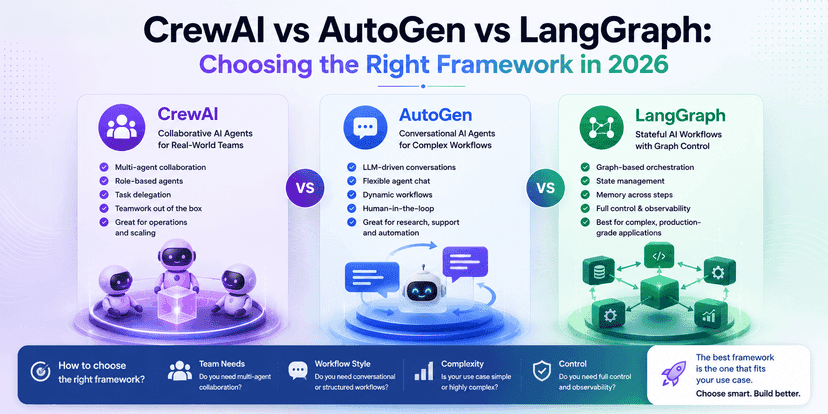
Choosing between CrewAI, AutoGen, and LangGraph depends on your project goals. CrewAI is ideal for role-based multi-agent collaboration, AutoGen excels at conversational AI workflows, and LangGraph is best for production-grade, stateful AI agents with complex orchestration. This guide compares their architecture, strengths, limitations, and ideal use cases to help you choose the right framework in 2026.
CrewAI vs AutoGen vs LangGraph: Choosing the Right Framework in 2026
Artificial intelligence has moved beyond simple chatbots. Businesses are now building intelligent systems that can plan, reason, collaborate, and complete complex workflows with little human intervention.
These systems are known as AI agents.
As AI agents become more capable, developers need frameworks that make it easier to build, manage, and scale them. Three frameworks have emerged as leading choices:
- CrewAI
- Microsoft AutoGen
- LangGraph
Each framework has its own philosophy, architecture, strengths, and ideal use cases.
Choosing the wrong framework can lead to unnecessary complexity, slower development, or challenges when scaling to production.
Choosing the right one can help your team build reliable, maintainable, and enterprise-ready AI applications much faster.
If you're looking for a simple recommendation:
- Choose CrewAI if you want multiple AI agents working together through clearly defined roles and responsibilities.
- Choose AutoGen if your application relies on conversations between agents or humans.
- Choose LangGraph if you need complex workflows, persistent memory, branching logic, and production-ready orchestration.
Each framework solves a different problem, so the best choice depends on your project's requirements rather than a single "winner".
Why Choosing the Right AI Agent Framework Matters
Many teams make the mistake of selecting an AI framework simply because it is popular.
Instead, the framework should match the problem you're trying to solve.
Imagine building a house.
You wouldn't use the same tools to build the following:
- a small apartment,
- a hospital,
- and a skyscraper.
Each project requires different tools.
AI agent frameworks work the same way.
For example:
Customer Support Bot
Requirements:
- Answer customer questions
- Escalate complex issues
- Use company knowledge
CrewAI may be an excellent choice because each agent can take responsibility for a specific task.
AI Research Assistant
Requirements:
- Search the web
- Summarize findings
- Debate ideas
- Refine answers
AutoGen performs well because multiple agents can naturally collaborate through conversation.
Enterprise Banking Workflow
Requirements:
- Maintain state
- Call APIs
- Handle approvals
- Retry failures
- Log activities
- Support human approval
LangGraph is often a better fit because it is designed for stateful, production-grade workflows.
Choosing the framework based on your workflow leads to better performance, easier maintenance, and lower long-term costs.
What Is an AI Agent Framework?
An AI agent framework provides the building blocks needed to create intelligent software agents.
Instead of writing every capability from scratch, the framework supplies reusable components for common tasks.
Typical capabilities include the following:
- Planning
- Memory
- Tool calling
- Agent communication
- Task delegation
- Workflow orchestration
- Error handling
- Human approval
- State management
- Observability
Think of it as an operating system for AI agents.
Without a framework, developers must build all of these capabilities themselves.
With a framework, they can focus on solving business problems.
Understanding the Three Frameworks
Before comparing them, let's understand what each framework is designed to do.
What Is CrewAI?
CrewAI is an open-source framework that allows multiple AI agents to work together as a team.
Each agent has:
- a role,
- a goal,
- specialized knowledge,
- and clearly defined responsibilities.
Instead of one AI trying to solve everything, work is divided among specialised agents.
Imagine a software company.
Rather than one employee doing every job, you have:
- Project Manager
- Business Analyst
- Software Developer
- QA Engineer
- DevOps Engineer
Each person contributes based on their expertise.
CrewAI follows the same principle.
Example
A content creation workflow:
Marketing Manager Agent │ ▼ Keyword Research Agent │ ▼ SEO Writer Agent │ ▼ Editor Agent │ ▼ Proofreading Agent │ ▼ Publish Agent
Every agent focuses on one responsibility.
Strengths of CrewAI
- Easy to understand
- Fast development
- Excellent role separation
- Great for business automation
- Strong multi-agent collaboration
- Minimal setup
Best Use Cases
- Content generation
- Marketing automation
- HR automation
- Sales workflows
- Customer support
- Internal business assistants
- Simple enterprise automation
What Is AutoGen?
AutoGen is Microsoft's open-source framework for building AI systems where agents communicate naturally through conversations.
Instead of assigning fixed responsibilities, AutoGen allows agents to exchange messages until they solve a problem.
Think of it as a meeting between experts.
Each expert contributes ideas until the best solution is found.
Example
Customer:
"I need an AI solution for invoice processing."
↓
Planner Agent
↓
Developer Agent
↓
Reviewer Agent
↓
Tester Agent
↓
Final Answer
Instead of executing tasks one after another, agents discuss, refine, and improve the solution together.
Strengths of AutoGen
- Natural conversations
- Dynamic collaboration
- Human-in-the-loop support
- Flexible workflows
- Easy experimentation
- Excellent for research
Best Use Cases
- AI research
- Code generation
- Knowledge assistants
- Educational tools
- Brainstorming systems
- Interactive copilots
What Is LangGraph?
LangGraph is an orchestration framework built on top of the LangChain ecosystem.
Unlike CrewAI or AutoGen, LangGraph models workflows as a graph of connected nodes.
Each node performs a task, while edges determine what happens next based on the current state.
This makes LangGraph particularly well suited for complex, stateful applications where workflows can branch, pause, resume, or involve human approvals.
Example Workflow
User Request │ ▼ Planner Node │ ▼ Retrieve Knowledge │ ▼ Reasoning Node │ ▼ Tool Calling │ ▼ Human Approval │ ▼ Final Response
Instead of following a single linear path, LangGraph allows workflows to adapt dynamically based on context and previous steps.
Strengths of LangGraph
- Stateful execution
- Graph-based orchestration
- Production-ready architecture
- Built-in checkpointing
- Advanced memory handling
- Human approval workflows
- Fine-grained control over execution
Best Use Cases
- Enterprise AI systems
- Financial workflows
- Healthcare applications
- Multi-step approval processes
- AI copilots
- Long-running agents
- Complex production automation
Framework Architecture Comparison
Each framework follows a different architectural approach.
Understanding these differences is the first step in choosing the right one.
CrewAI Architecture
CrewAI organises AI agents like employees inside a company.
Every agent has:
- A role
- A goal
- Assigned tools
- Responsibilities
- Memory (optional)
Example:
Customer Support Request │ ▼ Support Manager Agent │ ┌────────┴─────────┐ ▼ ▼ Billing Agent Technical Agent │ ▼ Response Generator │ ▼ Customer
Each agent performs a specific responsibility.
This architecture is simple and easy to maintain.
AutoGen Architecture
AutoGen treats agents as participants in a conversation.
Rather than assigning sequential work, agents communicate until they solve the task.
Example:
User ↓ Planner Agent ↔ Developer Agent ↔ Reviewer Agent ↔ Human ↓ Final Response
This architecture works exceptionally well for brainstorming and collaborative reasoning.
LangGraph Architecture
LangGraph organises workflows as connected nodes.
Each node performs a specific action while maintaining workflow state.
Example:
User Request │ ▼ Planning Node │ ▼ Knowledge Retrieval │ ▼ Reasoning Node │ ▼ Tool Calling │ ▼ Approval Node │ ▼ Final Response
Unlike the other frameworks, LangGraph supports branching, retries, checkpoints, and long-running workflows.
CrewAI
Most developers can become productive within a few days.
It has:
- Simple abstractions
- Minimal configuration
- Clear documentation
- Easy debugging
AutoGen
Developers need to understand:
- Agent conversations
- Conversation control
- Multi-agent messaging
- Conversation loops
The learning curve is moderate.
LangGraph
Developers should understand:
- State machines
- Graph execution
- Workflow orchestration
- LangChain concepts
- Checkpointing
Although more challenging initially, it offers greater flexibility for complex systems.
Workflow Comparison
How does work move through each framework?
CrewAI Workflow
Sequential collaboration.
Task ↓ Manager Agent ↓ Research Agent ↓ Writer Agent ↓ Reviewer Agent ↓ Completed
Simple.
Predictable.
Easy to monitor.
AutoGen Workflow
Conversation-driven.
Task ↓ Agent A ↔ Agent B ↔ Agent C ↓ Consensus ↓ Completed
Excellent for collaborative reasoning.
LangGraph Workflow
Graph execution.
Task ↓ Planning ↓ Decision ↓ Tool Call ↓ Retry? ↓ Approval? ↓ Complete
Every workflow can branch based on previous results.
Memory Management Comparison
Memory is one of the biggest differences.
CrewAI
Supports:
- Agent memory
- Shared memory
- Task context
Suitable for:
- Medium-sized projects
- Internal automation
AutoGen
Supports:
- Conversation history
- Chat memory
- Context passing
Ideal for:
- Interactive conversations
- AI copilots
LangGraph
Provides advanced memory capabilities.
Supports:
- Persistent memory
- Checkpointing
- Long-term memory
- Short-term memory
- Conversation state
- Workflow state
Ideal for enterprise applications where workflows may span minutes, hours, or days.
Multi-Agent Collaboration
How well do agents collaborate?
CrewAI
Designed specifically for teamwork.
Example:
Marketing Team ↓ SEO Agent ↓ Content Agent ↓ Editor Agent ↓ Publisher Agent
Each agent has a clearly defined role.
AutoGen
Collaboration happens through discussion.
Example:
Planner
↓
Developer
↓
Reviewer
↓
Tester
↓
Final Answer
Agents continuously improve each other's work.
LangGraph
Collaboration occurs through workflow orchestration.
Each agent becomes one node within the graph.
This offers greater control over execution order.
Tool Calling Comparison
Modern AI agents must use tools.
Examples include:
- Search APIs
- Databases
- CRMs
- Payment systems
- File storage
- Vector databases

The difference lies in orchestration.
CrewAI assigns tools to specific agents.
AutoGen lets conversational agents invoke tools during discussions.
LangGraph integrates tool calls directly into workflow nodes, making retries and error handling easier.
State Management
State management is crucial for production systems.
Suppose a loan approval process includes:
- Identity verification
- Credit check
- Risk assessment
- Manager approval
- Final approval
If the system crashes midway, where should it resume?
CrewAI
Basic state support.
Restarting complex workflows may require additional logic.
AutoGen
Conversation history can restore some context, but state management is limited for long-running workflows.
LangGraph
State management is one of LangGraph's strongest features.
It supports:
- Resume after failure
- Workflow checkpointing
- Persistent execution
- Human approval pauses
- Recovery after interruptions
This makes it particularly suitable for enterprise workflows.
Human-in-the-Loop Comparison
Many business processes require human approval.
Examples include:
- Loan approvals
- Insurance claims
- Medical diagnoses
- Financial transactions
CrewAI
Supports human review between tasks.
AutoGen
Humans can actively participate in conversations with agents.
This makes it excellent for collaborative decision-making.
LangGraph
Provides workflow-based human approvals.
Example:
AI Decision ↓ Human Review ↓ Approve ↓ Continue Workflow
This is ideal for regulated industries.
Real-World Use Cases
CrewAI Use Cases
CrewAI shines when multiple AI agents need to collaborate through clearly defined roles.
1. Content Marketing Automation
Example workflow:
Marketing Manager │ ▼ Keyword Research Agent │ ▼ SEO Writer │ ▼ Editor │ ▼ Publisher
Suitable for:
- Blog writing
- SEO content creation
- Social media management
- Email marketing
- Content planning
2. Sales Automation
Example:
- Lead Qualification Agent
- CRM Update Agent
- Proposal Writer
- Follow-up Email Agent
- Meeting Scheduler
Every agent performs one business responsibility.
3. HR Automation
CrewAI works well for the following:
- Resume screening
- Interview scheduling
- Employee onboarding
- Policy assistants
- Internal HR support
4. Customer Support
Example:
Support Manager
↓
Technical Support Agent
↓
Billing Agent
↓
Knowledge Base Agent
↓
Customer Response
Each agent specialises in solving one type of problem.
Best Industries for CrewAI
- SaaS
- Marketing
- HR
- Customer Support
- Sales
- Education
- Small & Medium Businesses
- Internal Enterprise Automation
AutoGen Use Cases
AutoGen performs best when multiple AI agents need to collaborate through conversations.
1. AI Research Assistant
Example:
Research Agent
↓
Search Agent
↓
Reviewer
↓
Fact Checker
↓
Summary Generator
Each agent contributes through discussion before producing the final answer.
2. Software Development Assistant
Example:
Planner
↓
Developer
↓
Code Reviewer
↓
Security Reviewer
↓
QA Tester
↓
Final Code
Excellent for software engineering teams.
3. AI Coding Copilot
AutoGen can power:
- Code generation
- Bug fixing
- Code explanation
- Documentation generation
- Unit testing
4. Brainstorming Systems
Ideal for:
- Product ideation
- Startup planning
- Business strategy
- Research collaboration
- Technical design discussions
Best Industries for AutoGen
- Software Development
- AI Research
- Universities
- Consulting
- Product Teams
- Innovation Labs
- Technology Companies
LangGraph Use Cases
LangGraph is designed for production-grade AI applications with complex workflows.
1. Banking
Example:
Customer Request
↓
Identity Verification
↓
Credit Score Check
↓
Fraud Detection
↓
Risk Assessment
↓
Human Approval
↓
Loan Processing
This workflow requires:
- State persistence
- Human approval
- Multiple API calls
- Workflow recovery
LangGraph is an excellent fit.
2. Insurance Claims
Example:
Claim Submitted
↓
Document Verification
↓
Fraud Detection
↓
Damage Assessment
↓
Policy Validation
↓
Manager Approval
↓
Payment
Every step is connected through a graph.
3. Healthcare
Example:
Patient Request
↓
Retrieve Medical History
↓
Analyze Symptoms
↓
Recommend Specialist
↓
Doctor Approval
↓
Appointment
Healthcare requires stateful workflows and human oversight.
4. Enterprise AI Copilot
Large organisations often build internal AI assistants.
Example:
Employee Question
↓
Search Documentation
↓
Retrieve Policies
↓
Access Internal APIs
↓
Generate Response
↓
Human Approval (Optional)
Best Industries for LangGraph
- Banking
- Insurance
- Healthcare
- Manufacturing
- Government
- Logistics
- Enterprise SaaS
- Telecommunications
Decision Matrix
The following matrix can help you select the most suitable framework.

Which Framework Should You Choose?
Choose CrewAI if you need it.
✅ Multiple role-based AI agents
✅ Business automation
✅ Marketing workflows
✅ HR workflows
✅ Sales automation
✅ Customer support
✅ Simple learning curve
Choose AutoGen If You Need
✅ Collaborative AI conversations
✅ AI research
✅ Code generation
✅ Interactive copilots
✅ Human-AI collaboration
✅ Brainstorming systems
Choose LangGraph If You Need
✅ Enterprise AI
✅ Banking applications
✅ Insurance systems
✅ Healthcare workflows
✅ Long-running agents
✅ Stateful workflows
✅ Human approvals
✅ Production reliability
Framework Comparison Summary

Frequently Asked Questions (FAQs)
Is CrewAI better than LangGraph?
Not necessarily. CrewAI is excellent for role-based collaboration and rapid development, while LangGraph is better suited to complex, stateful, enterprise workflows.
Is AutoGen suitable for production applications?
Yes. AutoGen can support production use cases, particularly conversational and collaborative AI systems, provided it is designed with appropriate monitoring, security, and operational controls.
Which framework is easiest to learn?
CrewAI generally has the shortest learning curve, making it a strong option for teams new to AI agent development.
Which framework is best for enterprise applications?
LangGraph is often preferred for enterprise environments because of its workflow orchestration, state management, checkpointing, and production-orientated design.
Can these frameworks work with different LLMs?
Yes. CrewAI, AutoGen, and LangGraph can integrate with multiple large language models, depending on your implementation and provider support.
Which framework is best for startups?
It depends on the use case:
- CrewAI: Rapid business automation and role-based agents.
- AutoGen: Research assistants and collaborative AI.
- LangGraph: Products that require scalable, production-ready workflows from the outset.
Conclusion
As AI agents become central to modern software, selecting the right framework is a strategic decision.
- Choose CrewAI for role-based collaboration and business automation.
- Choose AutoGen for conversational AI and collaborative reasoning.
- Choose LangGraph for enterprise-grade, stateful workflows and production reliability.
Evaluate your workflow, scalability needs, and operational requirements before making a decision. A thoughtful choice today will make your AI applications more maintainable, secure, and adaptable in the years ahead.
Build Enterprise-Ready AI Agents with the Right Framework
Whether you're developing intelligent business automation, multi-agent collaboration systems, AI copilots, or enterprise-grade workflows, selecting the right framework is the foundation of a successful AI solution.
Our AI engineering team helps organisations design, develop, and deploy scalable AI agent applications using CrewAI, AutoGen, LangGraph, OpenAI Agents SDK, and other leading technologies.
Our AI agent development services include the following:
- Custom AI Agent Development
- Multi-Agent System Design
- Enterprise AI Workflow Automation
- AI Copilot Development
- RAG & Knowledge Retrieval Solutions
- AI Agent Integration with ERP, CRM, and APIs
- AI Strategy Consulting
- Ongoing Optimization and Support
Ready to build intelligent AI agents for your business? Contact our team to discuss your requirements and create secure, scalable, and production-ready AI solutions tailored to your goals.