AI Agent Development Company for Travel
 Sasikumar
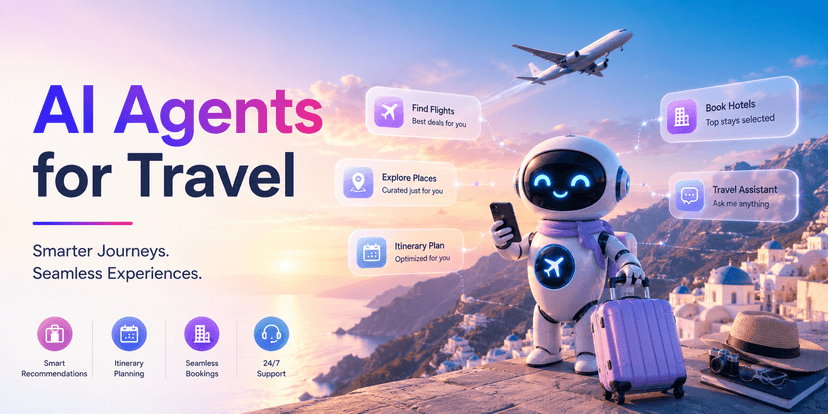
AI agents are changing how people plan and experience travel. They help travellers find destinations, compare prices, book flights and hotels, create personalized itineraries, provide real-time travel updates, and offer 24/7 support. For travel businesses, AI agents reduce operational costs, improve customer satisfaction, automate repetitive tasks, and increase booking conversions. This guide explains how AI agents work, their benefits, use cases, key features, and why they are becoming essential for the travel industry in 2026.
AI agents for travel are intelligent software systems that automate travel-related tasks such as itinerary planning, flight and hotel booking, customer support, travel recommendations, expense management, and real-time travel assistance. Unlike traditional chatbots, AI agents can understand traveler preferences, make decisions, interact with external systems, and complete multi-step travel workflows with minimal human intervention.
AI Agents for Travel: Transforming Trip Planning, Booking & Customer Experience in 2026
Travel has changed dramatically over the past decade.
Today's travellers expect instant responses, personalised recommendations, flexible booking options, and real-time updates throughout their journey. They no longer want to spend hours comparing flights, checking hotel reviews, or manually planning every detail of a trip.
At the same time, travel companies face increasing pressure to deliver exceptional customer experiences while managing rising operational costs, handling high booking volumes, and supporting customers around the clock.
This is where AI agent developments are making a significant impact.
Unlike traditional travel software, AI agents don't simply answer questions. They can understand customer intent, compare travel options, create personalised itineraries, monitor price changes, automate bookings, send travel reminders, and even help travellers during unexpected situations such as flight delays or cancellations.
From airlines and hotels to travel agencies and online booking platforms, organisations are using AI agents to improve efficiency, reduce costs, and provide faster, smarter, and more personalised travel experiences.
If you're looking for a simple explanation:
AI agents for travel are intelligent digital assistants that help travellers and travel companies automate planning, booking, customer support, itinerary management, and real-time travel assistance.
They can:
- Recommend destinations
- Compare flight prices
- Book hotels
- Build travel itineraries
- Send travel reminders
- Monitor flight status
- Suggest local attractions
- Handle customer support
- Manage cancellations and rebooking
- Provide 24/7 travel assistance
The result is a faster, more personalised, and stress-free travel experience for customers while improving efficiency and reducing costs for travel businesses.
Why the Travel Industry Needs AI Agents
The travel industry has become more competitive than ever.
Customers expect every interaction to be the following:
- Fast
- Personalized
- Accurate
- Available anytime
- Easy to use
However, traditional travel systems often struggle with these expectations.
Common Challenges in Travel
Travel companies face many daily operational challenges, including:
- Responding to thousands of customer enquiries.
- Managing booking changes and cancellations.
- Comparing prices across airlines and hotels.
- Providing multilingual customer support.
- Creating personalised travel packages.
- Handling seasonal booking spikes.
- Sending reminders and travel updates.
- Managing customer preferences across multiple channels.
These tasks consume significant time and resources when handled manually.
AI agents help solve these challenges by automating routine processes while allowing human teams to focus on more complex customer needs.
Traditional Travel Process vs AI-Powered Travel
Traditional Process
Imagine planning a vacation.
You might:
- Visit multiple airline websites.
- Compare hotel prices.
- Read hundreds of reviews.
- Search for attractions.
- Build an itinerary manually.
- Check visa requirements.
- Monitor flight prices.
- Contact customer support for changes.
This process can take several hours—or even days.
AI Agent-Powered Process
Now imagine asking:
"Plan a 5-day family trip to Bali in October with a budget of $2,000."
An AI travel agent can:
- Recommend destinations.
- Compare flights.
- Suggest hotels.
- Build a day-by-day itinerary.
- Recommend restaurants.
- Book activities.
- Monitor price drops.
- Send reminders.
- Update plans if flights change.
Instead of spending hours planning, travellers receive a personalised itinerary in minutes.
What Are AI Agents for Travel?
AI agents are intelligent software programs designed to understand goals, make decisions, interact with digital systems, and complete travel-related tasks autonomously.
Unlike basic chatbots that respond with predefined answers, AI agents can reason through multi-step requests, access external systems, and adapt to changing conditions.
Think of them as digital travel consultants available 24/7.
They don't just answer questions—they help complete the entire travel journey.
How AI Agents Work in Travel
AI agents combine several technologies to deliver intelligent travel assistance.
These include:
- Large Language Models (LLMs)
- Natural Language Processing (NLP)
- Machine Learning (ML)
- APIs
- Travel booking systems
- Maps and navigation services
- Payment gateways
- CRM platforms
- Weather and flight data services
Example Workflow

The AI agent continuously monitors the trip and can react to changes, such as delays or cancellations.
Core Components of an AI Travel Agent
A modern AI travel agent typically includes several specialised capabilities.
1. Natural Language Understanding
The AI understands requests written or spoken in everyday language.
Example:
"Find me the cheapest direct flight from Chennai to Singapore next Friday."
The AI interprets:
- Departure city
- Destination
- Travel date
- Preference for direct flights
- Budget sensitivity
2. Recommendation Engine
Based on user preferences, travel history, and real-time data, the AI suggests:
- Destinations
- Flights
- Hotels
- Activities
- Restaurants
- Local transportation
- Travel insurance
Recommendations become more relevant over time as the AI learns user preferences.
3. Booking Automation
Instead of redirecting users to multiple websites, AI agents can automate:
- Flight bookings
- Hotel reservations
- Car rentals
- Tour packages
- Activity tickets
- Insurance purchases
This simplifies the booking process and reduces friction.
4. Real-Time Monitoring
Travel plans can change unexpectedly.
AI agents monitor:
- Flight delays
- Gate changes
- Weather disruptions
- Traffic conditions
- Hotel availability
- Price changes
When an issue arises, the AI can notify the traveller and suggest alternatives.
5. Personalized Assistance
Every traveller has different needs.
AI agents can personalise recommendations based on:
- Budget
- Preferred airlines
- Favorite hotel chains
- Dietary requirements
- Accessibility needs
- Travel history
- Family size
- Business or leisure travel
This creates a more relevant and enjoyable travel experience.
Types of AI Agents Used in Travel
Different AI agents handle different parts of the travel journey.
Travel Planning Agent
Helps users:
- Choose destinations
- Compare options
- Create itineraries
- Recommend attractions
- Estimate budgets
Booking Agent
Automates:
- Flight bookings
- Hotel reservations
- Tour bookings
- Transportation
- Payment processing
Customer Support Agent
Provides:
- 24/7 assistance
- Booking updates
- Cancellation support
- Refund information
- Travel guidance
- Frequently asked questions
Itinerary Management Agent
Keeps travellers organised by managing:
- Daily schedules
- Reservation details
- Activity reminders
- Check-in notifications
- Calendar synchronization
Travel Safety Agent
Monitors:
- Weather alerts
- Local travel advisories
- Emergency contacts
- Health guidelines
- Visa and entry requirements
Helping travellers stay informed and prepared throughout their journey.
Benefits for Travelers
AI agents offer clear advantages that make travel planning and the overall journey easier.
Save Time
Instead of searching across multiple websites, travellers receive personalised options in one place.
Personalized Recommendations
Suggestions are tailored to each traveller's interests, budget, and past trips.
Better Booking Decisions
AI compares flights, hotels, and activities to recommend options that provide the best value.
24/7 Assistance
Travellers can get help at any time, regardless of time zone.
Real-Time Updates
Important notifications—such as flight delays, gate changes, or weather alerts—are delivered instantly.
Reduced Travel Stress
From planning to returning home, AI agents simplify the travel experience and help travellers adapt to unexpected changes.
Benefits of AI Agents for Travel Businesses
Travel businesses face growing customer expectations while trying to reduce costs and improve operational efficiency.
AI agents help solve both challenges.
1. 24/7 Customer Support
Travel never stops.
Customers book flights at midnight, change hotel reservations during weekends, and request support while traveling across different time zones.
Hiring human agents for round-the-clock support is expensive.
AI agents can answer questions, modify bookings, recommend alternatives, and resolve common issues at any time.
Example
A traveller in London books a flight to Singapore at 2:00 AM.
The AI agent can:
- Search flights
- Compare fares
- Book tickets
- Send confirmation
- Recommend hotels
No human intervention is required.
2. Faster Booking Process
Traditional booking often involves multiple steps.
Customers usually compare several websites before making a decision.
AI agents simplify the process.
Instead of asking users to search manually, they can simply ask:
"Book a 4-day honeymoon trip to Bali under $2,500."
The AI agent will:
- Compare airlines
- Compare hotels
- Suggest packages
- Recommend activities
- Complete the booking
This significantly reduces booking time and improves conversion rates.
3. Lower Operational Costs
Many repetitive tasks can be automated.
Examples include:
- Booking confirmations
- Flight reminders
- Hotel recommendations
- Travel document reminders
- Customer FAQs
- Refund status updates
- Itinerary generation
Automation reduces manual workload, allowing support teams to focus on complex customer needs.
4. Higher Customer Satisfaction
Travellers value:
- Quick responses
- Personalized experiences
- Accurate recommendations
- Proactive notifications
AI agents deliver all of these consistently.
Satisfied customers are more likely to:
- Book again
- Leave positive reviews
- Recommend the service to others
5. Increased Booking Revenue
AI agents help increase revenue through intelligent recommendations.
For example:
A customer books a flight.
The AI agent can also recommend:
- Hotels
- Airport transfers
- Travel insurance
- Local tours
- Car rentals
- Restaurant reservations
This increases average booking value through relevant upselling and cross-selling.
Key Features of AI Agents for Travel
Modern AI travel agents offer much more than chat support.
Here are the most valuable capabilities.
Intelligent Trip Planning
AI agents create personalised travel plans based on:
- Budget
- Destination
- Travel dates
- Group size
- Interests
- Preferred activities
Instead of presenting hundreds of options, the AI curates a tailored itinerary.
Flight Search & Booking
AI agents can:
- Compare airlines
- Monitor prices
- Recommend optimal travel times
- Suggest alternate airports
- Book tickets
- Notify travelers of fare changes
Hotel Recommendations
AI agents evaluate:
- Location
- Ratings
- Amenities
- Price
- Reviews
- Traveler preferences
They recommend accommodations that best match the traveller's needs.
Dynamic Itinerary Creation
Example itinerary:
Day 1: Arrival, Hotel Check-in, City Tour. Day 2: Beach Activities Local Food Tour Day 3 Adventure Sports Day 4 Shopping Day 5 Departure
The itinerary can automatically adjust if plans change.
Real-Time Travel Alerts
AI agents monitor:
- Flight delays
- Weather conditions
- Gate changes
- Traffic
- Hotel availability
- Local disruptions
Travellers receive proactive updates instead of discovering problems at the airport.
Multilingual Assistance
International travellers speak different languages.
AI agents can provide support in multiple languages, helping businesses serve a global audience without hiring multilingual teams.
Smart Expense Management
For business travellers, AI agents can:
- Track travel expenses
- Categorize receipts
- Generate reports
- Submit reimbursements
- Monitor travel budgets
Real-World Use Cases
AI agents support every segment of the travel industry.
AI Agents for Airlines
Airlines manage millions of passenger interactions every day.
AI agents help automate:
- Flight bookings
- Seat upgrades
- Boarding reminders
- Flight status notifications
- Baggage tracking
- Loyalty program assistance
- Rebooking during delays
Example
If a flight is cancelled:
The AI agent can:
- Find alternative flights
- Compare available seats
- Rebook automatically
- Notify the traveler
- Update the itinerary
This reduces frustration and speeds up resolution.
AI Agents for Hotels
Hotels can improve guest experiences with AI-powered assistance.
AI agents help with:
- Room reservations
- Digital check-in
- Room upgrades
- Restaurant bookings
- Local recommendations
- Guest support
- Late checkout requests
Example
A guest messages:
"I need a sea-view room with early check-in."
The AI agent checks availability and processes the request without requiring front desk intervention.
AI Agents for Online Travel Agencies
Online travel platforms handle vast numbers of searches and bookings.
AI agents can:
- Compare prices across providers
- Recommend destinations
- Create vacation packages
- Assist with bookings
- Provide personalized offers
- Send travel reminders
This creates a smoother customer experience.
AI Agents for Travel Agencies
Traditional travel agencies also benefit from AI.
Instead of spending hours preparing travel packages, agents can use AI to:
- Generate itineraries
- Compare pricing
- Estimate budgets
- Recommend destinations
- Prepare travel proposals
This allows consultants to focus on building customer relationships.
AI Agents for Corporate Travel
Businesses frequently manage employee travel.
AI agents can automate:
- Flight approvals
- Hotel bookings
- Travel policy checks
- Expense tracking
- Itinerary updates
- Visa reminders
Employees spend less time organising travel, while finance and HR teams gain better visibility and compliance.
AI Agents for Tourism
Tourism boards and destination organisations can use AI agents to:
- Recommend attractions
- Promote local events
- Suggest restaurants
- Share cultural information
- Guide visitors
- Provide multilingual assistance
This enhances the visitor experience and encourages longer stays.
AI Agents vs Traditional Travel Software

Business Impact of AI Agents
Organisations adopting AI agents often experience improvements across multiple areas.
Faster Response Times
AI agents answer common customer queries within seconds, reducing wait times and improving service quality.
Improved Conversion Rates
Personalised recommendations and a streamlined booking process can encourage more users to complete their reservations.
Better Customer Retention
Consistent support and tailored experiences help build trust and encourage repeat bookings.
Operational Efficiency
Routine tasks are automated, allowing staff to focus on higher-value customer interactions and strategic work.
Scalable Customer Service
AI agents can assist many customers simultaneously, making it easier to handle seasonal demand without proportional staffing increases.
Example: End-to-End AI Travel Journey
Traveler Request │ ▼ AI Understands Preferences │ ▼ Search Flights │ ▼ Compare Hotels │ ▼ Build Personalized Itinerary │ ▼ Book Flights & Hotels │ ▼ Send Confirmation │ ▼ Monitor Flight & Weather │ ▼ Notify Traveler of Changes │ ▼ Recommend Activities │ ▼ Collect Feedback After Trip
Instead of using separate tools for every step, one AI agent manages the complete travel journey.
Why Travel Companies Are Investing in AI Agents
AI agents are no longer viewed as experimental technology—they are becoming an important part of digital transformation strategies.
Travel companies are adopting AI because it helps them.
- Deliver faster and more personalised customer experiences.
- Improve operational efficiency through automation.
- Increase booking conversions and revenue opportunities.
- Reduce support costs.
- Offer 24/7 multilingual assistance.
- Build long-term customer loyalty.
As traveller expectations continue to evolve, AI agents provide a practical way to scale services while maintaining a high level of customer satisfaction.
Challenges of AI Agents in Travel
Although AI agents offer significant benefits, successful implementation requires thoughtful planning.
1. Data Privacy & Security
Travel companies collect sensitive customer information, including:
- Passport details
- Visa information
- Payment details
- Travel history
- Hotel bookings
- Personal preferences
- Contact information
Protecting this data is essential.
Best Practices
- Encrypt customer data (AES-256)
- Use TLS 1.3 for data in transit
- Enable Multi-Factor Authentication (MFA)
- Apply Role-Based Access Control (RBAC)
- Store secrets securely using a Secrets Manager
- Maintain detailed audit logs
2. Integration with Legacy Systems
Many airlines, hotels, and travel agencies still rely on older reservation and booking systems.
Connecting AI agents with these platforms can require:
- API integration
- Middleware
- Data synchronization
- Workflow mapping
A phased implementation reduces disruption and lowers project risk.
3. Accuracy of Recommendations
Travel recommendations depend on accurate, real-time information.
AI agents should continuously validate the following:
- Flight schedules
- Hotel availability
- Weather updates
- Local events
- Pricing
- Visa requirements
Using trusted data sources helps improve recommendation quality.
4. Managing Unexpected Situations
Travel plans can change quickly due to:
- Flight cancellations
- Weather disruptions
- Political events
- Natural disasters
- Airline strikes
AI agents should detect changes early, notify travellers, and recommend suitable alternatives.
5. Customer Trust
Some travellers prefer speaking with a person for complex issues.
A successful AI strategy should always allow easy escalation to a human agent when needed.
Future Trends: AI Agents in Travel (2026 & Beyond)
AI agents will continue to evolve beyond simple booking assistants.
Hyper-Personalized Travel
AI agents will recommend complete travel experiences based on:
- Past trips
- Interests
- Budget
- Health requirements
- Travel companions
- Preferred pace of travel
Every itinerary will feel uniquely tailored.
Voice-Based Travel Assistants
Travellers will increasingly use voice commands, such as the following:
"Book me a weekend trip to Goa."
"Find the cheapest direct flight to Singapore."
"Move my hotel booking to tomorrow."
Natural language interactions will make travel planning even easier.
Autonomous Trip Management
Future AI agents will automatically:
- Rebook cancelled flights
- Change hotel reservations
- Notify contacts
- Adjust itineraries
- Arrange transportation
- Recommend nearby alternatives
Travellers will spend less time managing unexpected changes.
AI-Powered Smart Tourism
Cities and tourism organisations will deploy AI agents that:
- Recommend attractions
- Suggest restaurants
- Guide tourists
- Translate conversations
- Provide cultural insights
- Support emergency assistance
These services will improve visitor experiences and encourage repeat tourism.
Sustainable Travel Recommendations
AI agents will increasingly consider sustainability.
They may suggest:
- Lower-emission flights
- Eco-friendly hotels
- Public transportation
- Responsible tourism activities
Helping travellers make more environmentally conscious choices.
Frequently Asked Questions (FAQs)
What are AI agents for travel?
AI agents are intelligent software systems that automate travel planning, bookings, customer support, itinerary management, and real-time travel assistance using AI and connected travel services.
How are AI agents different from travel chatbots?
Traditional chatbots answer predefined questions.
AI agents can understand goals, make decisions, use external tools, complete bookings, monitor trips, and adapt to changing travel conditions.
Can AI agents book flights and hotels?
Yes. When integrated with booking platforms and travel APIs, AI agents can search options, compare prices, recommend suitable choices, and complete bookings.
Are AI agents secure?
They can be secure when implemented with encryption, secure authentication, access controls, audit logging, and compliance with relevant privacy regulations.
Which travel businesses benefit from AI agents?
AI agents can support:
- Airlines
- Hotels
- Online Travel Agencies (OTAs)
- Travel agencies
- Tour operators
- Corporate travel companies
- Tourism boards
- Car rental services
- Cruise operators
Can AI agents support multiple languages?
Yes. Modern AI agents can communicate in multiple languages, helping travel businesses serve international customers more effectively.
How long does it take to implement an AI travel agent?
The timeline depends on complexity.
- FAQ or support assistant: 2–4 weeks
- Booking assistant: 4–8 weeks
- Enterprise travel platform with multiple integrations: 3–6 months
A phased rollout is often the most practical approach.
Conclusion
AI agents are transforming travel by making planning simpler, bookings faster, and customer support more responsive.
Whether you're an airline, hotel, travel agency, or online booking platform, AI agents can help automate routine tasks, deliver personalised recommendations, reduce operational costs, and create seamless travel experiences.
Businesses that embrace AI responsibly today will be better positioned to meet tomorrow's traveller expectations and remain competitive in an increasingly digital travel market.
Build Intelligent AI Agents for Your Travel Business
Looking to modernise your travel platform with AI?
Infiniapps AI designs and develops enterprise-grade AI agents that help travel businesses automate bookings, personalise customer experiences, streamline operations, and deliver 24/7 support.
Our AI travel solutions include the following:
- AI Trip Planning Assistants
- Flight & Hotel Booking Agents
- Travel Customer Support AI
- Corporate Travel Automation
- Itinerary Management Agents
- Multilingual Travel Assistants
- AI Recommendation Engines
- Custom AI Agent Development for Travel Platforms
Ready to create smarter travel experiences? Contact our AI experts to build secure, scalable, and customer-focused AI solutions for your travel business.