AI Agent Development Company for Healthcare
 Sasikumar
Healthcare organisations manage thousands of patient interactions every day. From answering questions and scheduling appointments to retrieving medical records, many routine tasks consume valuable staff time.
AI agents are changing this process by automating repetitive healthcare operations while improving patient experiences. Unlike traditional chatbots, AI agents understand context, access hospital systems, retrieve medical records, schedule appointments, and assist patients in real time.
What are AI agents for healthcare?
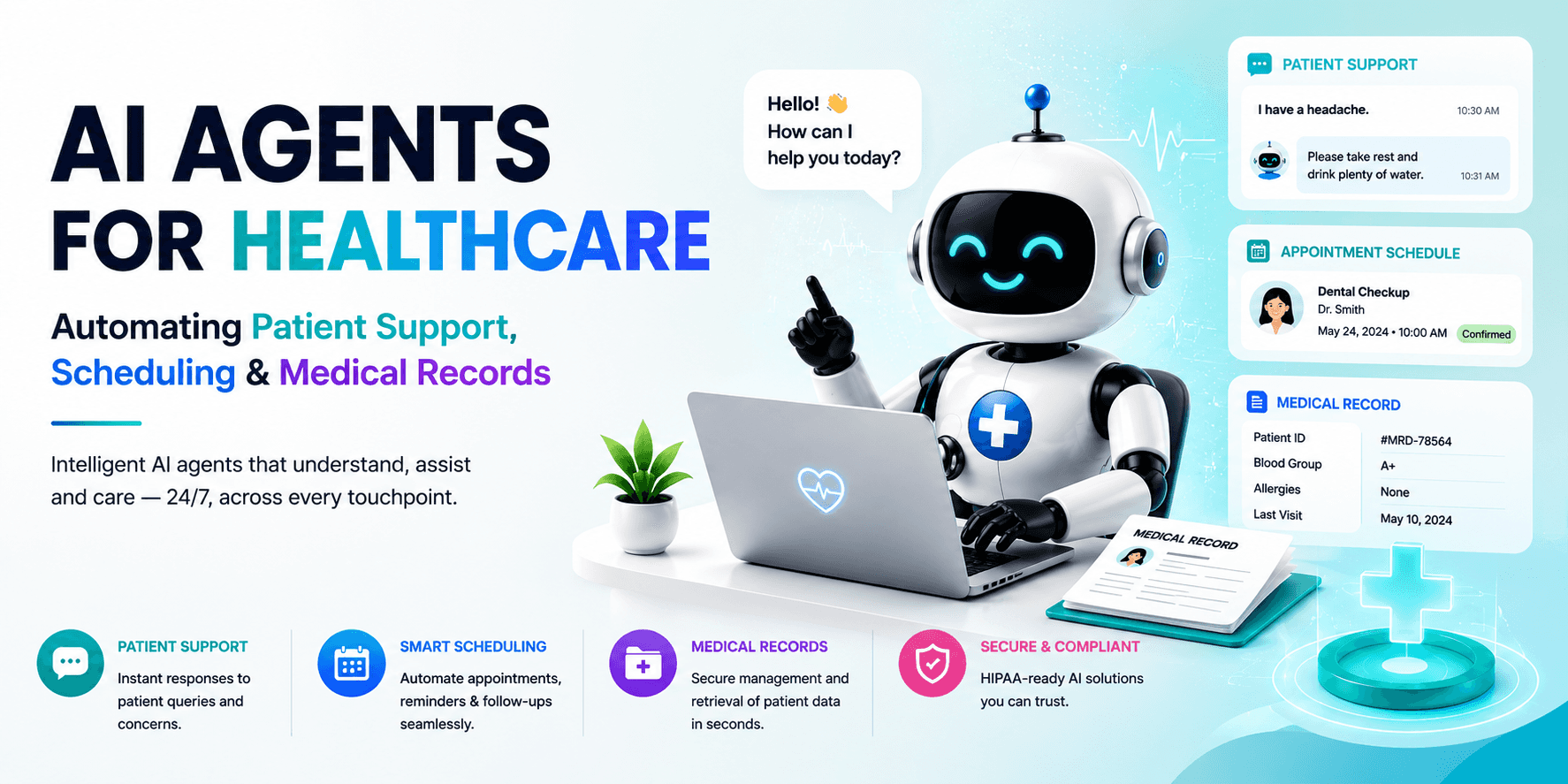
AI agents for healthcare are intelligent software systems that automate patient support, appointment scheduling, medical record retrieval, and administrative tasks. Unlike basic chatbots, AI agents understand context, access healthcare systems, use multiple tools, and provide personalized assistance while helping hospitals improve efficiency and patient satisfaction.
Healthcare Is Changing Faster Than Ever
Healthcare has become more digital than ever before.
Patients now expect:
- Instant appointment booking
- 24/7 support
- Faster responses
- Digital prescriptions
- Online consultations
- Easy access to medical records
However, many hospitals and clinics still rely on manual processes.
Receptionists answer the same questions repeatedly.
Nurses spend valuable time scheduling appointments.
Administrative staff search through patient records.
Doctors wait for paperwork before making decisions.
These repetitive tasks increase operational costs and reduce the time available for patient care.
This is where AI agents are making a significant difference.
Instead of replacing healthcare professionals, AI agents help them work more efficiently by automating routine tasks and providing intelligent assistance.
What Are AI Agents for Healthcare?
An AI agent is an intelligent software assistant that can understand requests, make decisions, retrieve information, and perform actions automatically.
In healthcare, AI agents can:
- Answer patient questions
- Schedule appointments
- Send appointment reminders
- Retrieve medical records
- Help with insurance information
- Support telemedicine
- Assist hospital staff
- Route emergency requests
- Provide medication reminders
- Collect patient information before consultations
Unlike traditional automation tools, AI agents use large language models (LLMs), business rules, and connected healthcare systems to complete tasks intelligently.
Why Healthcare Needs AI Agents
Healthcare professionals spend a large portion of their day on administrative work.
Common challenges include:
- Long patient waiting times
- Missed appointments
- High call volumes
- Repetitive patient questions
- Manual record management
- Administrative overload
- Staff shortages
- Slow response times
These problems affect both hospitals and patients.
Patients become frustrated.
Staff become overwhelmed.
Hospitals lose efficiency.
AI agents help solve these challenges by handling repetitive work automatically while allowing healthcare professionals to focus on delivering quality care.
Traditional Healthcare Process vs AI-Powered Healthcare

The result is faster service, happier patients, and more efficient healthcare operations.
AI Agents vs Traditional Healthcare Chatbots
Many people confuse AI agents with chatbots.
Although both interact with users, they have very different capabilities.

Example
A patient asks:
"Can I reschedule tomorrow's appointment?"
A chatbot might respond:
"Please call the hospital."
An AI agent can:
- Identify the patient
- Access the scheduling system
- Check doctor availability
- Offer alternative time slots
- Confirm the new appointment
- Send an updated confirmation message
This level of automation improves both efficiency and patient satisfaction.
How AI Agents Work in Healthcare
Behind every healthcare AI agent is a workflow that combines language understanding, reasoning, and system integration.
A typical process looks like this:
The patient asks a question ↓ AI Agent understands the request ↓ Checks hospital systems ↓ Retrieves relevant information ↓ Makes a decision ↓ Performs the required action ↓ Provides a personalized response
For example:
Patient:
"Book an appointment with a cardiologist next Monday."
The AI agent can:
- Verify the patient's identity.
- Access the hospital scheduling system.
- Check cardiologist availability.
- Recommend suitable time slots.
- Reserve the appointment.
- Update the hospital calendar.
- Send a confirmation by SMS, email, or WhatsApp.
- Schedule a reminder before the visit.
The patient completes the entire process in minutes without waiting for a receptionist.
Key Capabilities of Healthcare AI Agents
Modern healthcare AI agents can perform a wide range of tasks, including:
Patient Support
- Answer common healthcare questions
- Provide hospital information
- Guide patients through services
- Explain procedures and preparation steps
Appointment Scheduling
- Book appointments
- Reschedule visits
- Cancel appointments
- Send reminders
- Manage waiting lists
Medical Records Assistance
- Retrieve patient history
- Display lab reports
- Access prescriptions
- Summarize previous consultations (with proper authorization)
Administrative Automation
- Insurance verification
- Billing support
- Patient registration
- Digital form collection
- Follow-up reminders
Healthcare Staff Assistance
- Retrieve clinical guidelines
- Summarize patient information
- Search internal knowledge bases
- Automate documentation tasks
Benefits for Patients
Patients experience several improvements when AI agents are integrated into healthcare systems.
They receive:
- Faster responses
- 24/7 support
- Easier appointment booking
- Timely reminders
- Personalized interactions
- Reduced waiting times
- Better access to healthcare information
- Convenient digital experiences
Patients no longer need to spend long periods waiting on phone calls or searching through hospital websites.
The AI agent becomes their first point of contact.
AI-Powered Patient Support: Delivering 24/7 Healthcare Assistance
One of the biggest challenges in healthcare is managing patient communication.
Every day, hospitals receive thousands of questions, such as the following:
- What are your consultation timings?
- How do I book an appointment?
- Is my lab report ready?
- What documents should I bring?
- Which doctor should I consult?
- What are your emergency services?
- Can I reschedule my appointment?
Most of these questions are repetitive.
Without AI, hospital staff spend valuable time answering the same questions repeatedly.
With an AI agent, patients receive instant answers anytime.
How AI Patient Support Works
The patient asks a question ↓ AI understands the request ↓ Searches hospital knowledge base ↓ Retrieves accurate information ↓ Responds instantly
Example Conversation
Patient
I have a fever. Which department should I visit?
AI Agent
Based on your symptoms, you should consult a General Physician. Would you like me to book an appointment?
Another example:
Patient
Is my blood test report available?
AI Agent
Yes. Your report is ready. Would you like to download it or send it to your registered email?
The AI agent understands the request instead of simply matching keywords.
How AI Agents Improve Patient Experience
Healthcare is not only about treatment.
It is also about experience.
Patients appreciate:
- Faster responses
- Easy appointment booking
- Personalized communication
- Simple navigation
- Less waiting
- Convenient digital services
Instead of waiting in a phone queue, patients can interact naturally through:
- Hospital websites
- Mobile applications
- SMS
- Voice assistants
- Patient portals
The experience becomes simple and stress-free.
AI Appointment Scheduling
Appointment management is one of the most common healthcare tasks.
Without automation, the process often involves:
- Phone calls
- Manual calendar checks
- Reception staff
- Follow-up calls
- Rescheduling
- Reminder messages
AI agents automate the entire workflow.
Smart Appointment Scheduling
Unlike traditional booking systems, AI agents can make intelligent decisions.
For example, they can:
- Recommend the earliest available doctor
- Suggest nearby clinics
- Check specialist availability
- Avoid scheduling conflicts
- Prioritize emergency cases
- Handle cancellations automatically
- Fill cancelled slots quickly
This improves hospital utilisation and reduces idle time.
Automated Appointment Reminders
Missed appointments cost hospitals significant revenue.
Patients often forget their appointments.
AI agents automatically send reminders through the following:
- SMS
- Mobile notifications
- Voice calls
Example:
One week before
Your appointment with Dr. Sharma is scheduled for Monday at 10:00 AM.
One day before
Reminder: Your appointment is tomorrow at 10:00 AM.
Two hours before
We're expecting you today at 10:00 AM. Reply YES to confirm.
These reminders reduce no-show rates and improve operational efficiency.
AI Agents for Medical Records Management
Medical records contain valuable patient information.
Examples include:
- Medical history
- Lab reports
- Prescriptions
- Diagnoses
- Allergies
- Vaccination history
- Imaging reports
- Previous consultations
Searching these records manually can be time-consuming.
AI agents retrieve information within seconds.
Example
The doctor asks:
Show the patient's last three blood test reports.
Instead of searching manually,
the AI retrieves:
- Blood report (May)
- Blood report (March)
- Blood report (January)
The doctor spends less time searching and more time treating the patient.
Intelligent Medical Record Search
Traditional systems search by exact fields.
AI agents search by meaning.
Example:
The doctor asks:
Show all patients diagnosed with diabetes and hypertension in the last six months.
The AI can retrieve matching records without requiring complex manual searches.
This helps clinicians make faster decisions.
AI Agents in Telemedicine
Telemedicine has become an essential part of modern healthcare.
Patients expect virtual consultations to be quick and convenient.
AI agents enhance telemedicine by:
- Collecting patient information before consultations
- Verifying identity
- Recording symptoms
- Scheduling virtual appointments
- Uploading reports
- Sharing prescriptions
- Sending follow-up reminders
The doctor begins the consultation with all relevant information already prepared.
AI Agents for Hospitals
Hospitals have multiple departments.
Examples include:
- Reception
- Emergency
- Radiology
- Pharmacy
- Laboratory
- Billing
- Insurance
- Outpatient services
Each department generates repetitive administrative work.
AI agents help by automating:
- Patient registration
- Bed availability inquiries
- Department routing
- Insurance verification
- Billing questions
- Report collection
- Appointment booking
This reduces administrative workload significantly.
AI Agents for Clinics
Small clinics often operate with limited staff.
Receptionists manage:
- Phone calls
- Walk-ins
- Appointments
- Billing
- Patient inquiries
AI agents become virtual receptionists.
They can:
- Book appointments
- Send reminders
- Answer FAQs
- Collect patient details
- Manage follow-ups
The clinic delivers better service without increasing staffing costs.
AI Agents for Diagnostic Centers
Diagnostic centres receive hundreds of report-related questions.
Examples include:
- Is my report ready?
- Can I download my report?
- When can I collect my report?
- What preparation is needed for my test?
AI agents provide immediate answers.
They also:
- Schedule lab tests
- Share preparation instructions
- Notify patients when reports are ready
- Send digital reports securely
AI Agents for Pharmacies
Modern pharmacies do more than dispense medicines.
AI agents can:
- Refill prescriptions
- Send medication reminders
- Check medicine availability
- Suggest generic alternatives (where appropriate)
- Track recurring prescriptions
- Answer dosage-related FAQs (within approved guidance)
Patients receive timely support without waiting for a pharmacist to answer routine questions.
Real-World Healthcare AI Use Cases
Hospital Reception Assistant
Handles:
- General inquiries
- Department directions
- Appointment booking
- Doctor availability
- Visitor information
Available 24/7.
Chronic Disease Management
Patients with diabetes or hypertension require regular follow-ups.
AI agents can:
- Send medication reminders
- Track follow-up appointments
- Monitor symptom updates
- Encourage treatment adherence
Emergency Triage Support
AI agents can collect basic information before connecting patients to emergency services.
Examples include:
- Symptoms
- Age
- Existing conditions
- Location
This helps prioritise urgent cases more efficiently.
Post-Discharge Follow-Up
After discharge, AI agents can:
- Check patient recovery
- Send medication reminders
- Schedule follow-up visits
- Answer recovery-related questions
- Alert staff if concerning symptoms are reported
This supports better continuity of care.
Mental Health Support
AI agents can provide the following:
- Initial emotional support
- Guided wellness resources
- Appointment scheduling with counselors
- Daily well-being check-ins
They do not replace clinicians but improve access and engagement.
ROI and Business Benefits of AI Agents in Healthcare
Many hospitals first ask one question before investing in AI.
"What is the return on investment (ROI)?"
The answer is simple.
AI agents reduce administrative work while improving patient satisfaction.
Instead of hiring additional staff for repetitive tasks, hospitals can automate routine operations.
Key Business Benefits
Reduce Administrative Costs
AI agents automate:
- Patient registration
- Appointment booking
- Appointment reminders
- FAQ responses
- Medical record retrieval
- Insurance inquiries
Staff can focus on higher-value work.
Improve Patient Satisfaction
Patients receive:
- Instant responses
- 24/7 support
- Faster appointment booking
- Personalized assistance
- Reduced waiting times
Better patient experiences often lead to higher retention and positive reviews.
Increase Staff Productivity
Doctors and nurses spend less time on administrative tasks.
Examples include:
- Searching medical records
- Filling repetitive forms
- Answering common questions
Instead, they can dedicate more time to patient care.
Reduce Missed Appointments
Missed appointments affect hospital revenue.
AI agents send:
- WhatsApp reminders
- SMS reminders
- Email notifications
- Follow-up confirmations
This significantly lowers no-show rates.
Faster Decision-Making
Doctors receive patient information instantly.
Instead of searching multiple systems, AI summarises the following:
- Medical history
- Previous consultations
- Test reports
- Allergies
- Current medications
This supports faster clinical decisions.
AI Agent Architecture for Healthcare
A healthcare AI agent is more than just an LLM.
It combines multiple components to deliver intelligent assistance.

Each component has a specific role.
Large Language Model
The LLM understands user questions and generates natural responses.
Examples include:
- GPT
- Claude
- Gemini
- Llama
Vector Database
Stores:
- Hospital knowledge
- Clinical guidelines
- Patient preferences
- Previous conversations
Examples include:
- Pinecone
- Qdrant
- Chroma
- pgvector
- Weaviate
Hospital Systems
The AI connects with:
- Electronic Health Records (EHR)
- Electronic Medical Records (EMR)
- Hospital Information Systems (HIS)
- Customer Relationship Management (CRM)
- Laboratory systems
- Pharmacy systems
- Billing systems
This allows the AI to perform real tasks instead of simply answering questions.
Integration with Healthcare Systems
A successful AI agent should integrate with existing hospital software.
Electronic Health Records (EHR)
The AI can:
- Retrieve patient history
- Display diagnoses
- View medications
- Access allergies
- Review treatment plans
Electronic Medical Records (EMR)
AI agents help clinicians by:
- Summarizing patient records
- Searching historical visits
- Displaying previous prescriptions
- Identifying important medical events
Hospital Information System (HIS)
Integration enables:
- Bed management
- Admission details
- Discharge information
- Department routing
- Staff scheduling
Customer Relationship Management (CRM)
Healthcare CRM systems manage:
- Patient communication
- Follow-ups
- Marketing campaigns
- Wellness reminders
AI agents automate these interactions while keeping communication personalised.
Security and Compliance
Healthcare data is highly sensitive.
AI agents must be designed with security from the beginning.
Essential Security Measures
- End-to-end encryption
- Role-based access control
- Multi-factor authentication
- Audit logs
- Secure APIs
- Data masking
- Secure cloud infrastructure
Regulatory Compliance
Depending on the country, healthcare organisations may need to comply with regulations such as the following:
- HIPAA (United States)
- GDPR (European Union)
- Local healthcare privacy regulations
Compliance requirements vary by jurisdiction, so organisations should ensure their AI systems meet the regulations applicable to where they operate.
Healthcare AI Agent Implementation Roadmap
A phased implementation reduces risk and improves adoption.
Phase 1
Identify repetitive tasks.
Examples:
- Appointment booking
- FAQs
- Reminder messages
Phase 2
Build the knowledge base.
Include:
- Hospital services
- Department information
- Doctor profiles
- Policies
- Frequently asked questions
Phase 3
Connect hospital systems.
Integrate with:
- Scheduling
- EHR
- EMR
- CRM
- Billing
Phase 4
Train the AI agent.
Test using:
- Real patient scenarios
- Staff feedback
- Clinical workflows
Phase 5
Pilot deployment.
Launch within one department.
Measure:
- Patient satisfaction
- Response accuracy
- Appointment completion
- Staff productivity
Phase 6
Scale across the organisation.
Expand to:
- Emergency department
- Pharmacy
- Diagnostics
- Telemedicine
- Multi-location hospitals
Best Practices
Successful healthcare AI projects follow these principles.
Keep Humans in the Loop
AI should assist healthcare professionals, not replace them.
Complex or high-risk clinical decisions should always involve qualified clinicians.
Use Reliable Knowledge Sources
AI should answer questions using:
- Hospital policies
- Approved clinical guidelines
- Verified medical information
Continuously Improve
Monitor:
- Accuracy
- User satisfaction
- Failed interactions
- Patient feedback
Update the AI regularly.
Protect Patient Privacy
Only authorised users should access patient information.
Security must remain a priority throughout the system lifecycle.
Start Small
Begin with:
- FAQs
- Scheduling
- Reminders
Expand to advanced capabilities later.
Future of AI Agents in Healthcare
Healthcare AI is evolving rapidly.
Future capabilities may include:
- Personalized care coordination
- Voice-enabled clinical assistants
- Predictive appointment management
- Intelligent care navigation
- Advanced clinical documentation support
- AI-assisted medical coding
- Smarter remote patient monitoring
- Multi-agent healthcare systems
- Personalized patient education
- Cross-hospital collaboration
Hospitals adopting AI thoughtfully today will be better positioned to improve operational efficiency and patient experiences in the future.
Frequently Asked Questions
1. What is an AI healthcare agent?
An AI healthcare agent is intelligent software that automates patient support, appointment scheduling, administrative workflows, and information retrieval.
2. How is an AI agent different from a chatbot?
Chatbots follow predefined scripts.
AI agents understand context, integrate with healthcare systems, and complete tasks automatically.
3. Can AI agents access medical records?
Yes, when integrated with authorised healthcare systems and appropriate security controls, AI agents can retrieve relevant patient information.
4. Can AI agents schedule appointments?
Yes.
They can:
- Book appointments
- Reschedule visits
- Cancel appointments
- Send reminders
5. Are AI agents available 24/7?
Yes.
They can provide continuous support without depending on office hours.
6. Can AI agents reduce hospital costs?
Yes.
By automating repetitive administrative tasks, they can improve efficiency and reduce operational overhead.
7. Which healthcare organisations benefit most?
- Hospitals
- Clinics
- Diagnostic centers
- Telemedicine providers
- Pharmacies
- Medical laboratories
8. Can AI agents integrate with EHR systems?
Yes.
Most modern AI platforms can integrate securely with EHR, EMR, HIS, CRM, and scheduling systems.
9. Are AI agents secure?
They can be secure when implemented with encryption, access controls, audit logging, and compliance with applicable healthcare regulations.
10. How long does implementation take?
The timeline depends on project scope.
A basic AI patient support agent may take 6–10 weeks, while enterprise-wide healthcare AI platforms may require 4–8 months.
Conclusion
Healthcare organisations are under increasing pressure to deliver faster, more personalised, and more efficient patient care. At the same time, staff face growing administrative workloads that reduce the time available for clinical care.
AI agents help address these challenges by automating routine tasks such as patient support, appointment scheduling, medical record retrieval, and administrative workflows. Rather than replacing healthcare professionals, they enable doctors, nurses, and administrative teams to focus on what matters most—caring for patients.
When combined with secure system integrations, strong governance, and human oversight, AI agents become a valuable part of a modern digital healthcare strategy.
Transform Healthcare Operations with AI Agents
Looking to build an AI-powered healthcare solution?
Infiniapps develops custom AI agents for hospitals, clinics, telemedicine providers, diagnostic centres, and healthcare startups.
Our healthcare AI solutions can help you:
- Automate patient support
- Streamline appointment scheduling
- Integrate with EHR, EMR, and HIS platforms
- Build secure AI assistants
- Improve operational efficiency
- Deliver better patient experiences
Ready to modernise your healthcare services with AI? Contact Infiniapps to build a secure, scalable healthcare AI solution tailored to your organisation.