AI Agent Development Company for E-commerce
 Sasikumar
Online shopping has changed how people buy products. Customers now expect fast deliveries, instant support, personalized recommendations, and a smooth shopping experience across every channel.
However, many e-commerce businesses still struggle with repetitive customer queries, delayed responses, abandoned carts, and disconnected customer experiences.
This is where AI agents are making a significant impact.
Unlike traditional chatbots that simply answer predefined questions, AI agents understand customer intent, retrieve information from multiple systems, perform actions, and automate complete business workflows.
Whether it's tracking an order, recommending products, handling returns, recovering abandoned carts, or answering customer questions 24/7, AI agents help e-commerce businesses improve customer satisfaction while reducing operational costs.
What Are AI Agents for E-commerce?
AI agents are intelligent software assistants that automate customer interactions and business workflows across the e-commerce journey.
They can:
- Track customer orders
- Answer support questions
- Recommend products
- Recover abandoned carts
- Process returns
- Personalize shopping experiences
- Assist customers 24/7
Unlike traditional chatbots, AI agents understand context, connect with business systems, and perform actions automatically.
Key Benefits
- Faster customer support
- Better shopping experiences
- Higher customer satisfaction
- Increased sales through personalization
- Reduced support workload
- Lower operational costs
- Improved customer retention
AI agents are intelligent digital assistants that help online stores automate customer interactions and internal operations.
Unlike rule-based chatbots, AI agents can:
- Understand customer questions
- Access order information
- Search product catalogs
- Connect with CRM systems
- Retrieve shipping updates
- Recommend products
- Complete business actions
Instead of simply answering questions, they help customers complete tasks.
For example:
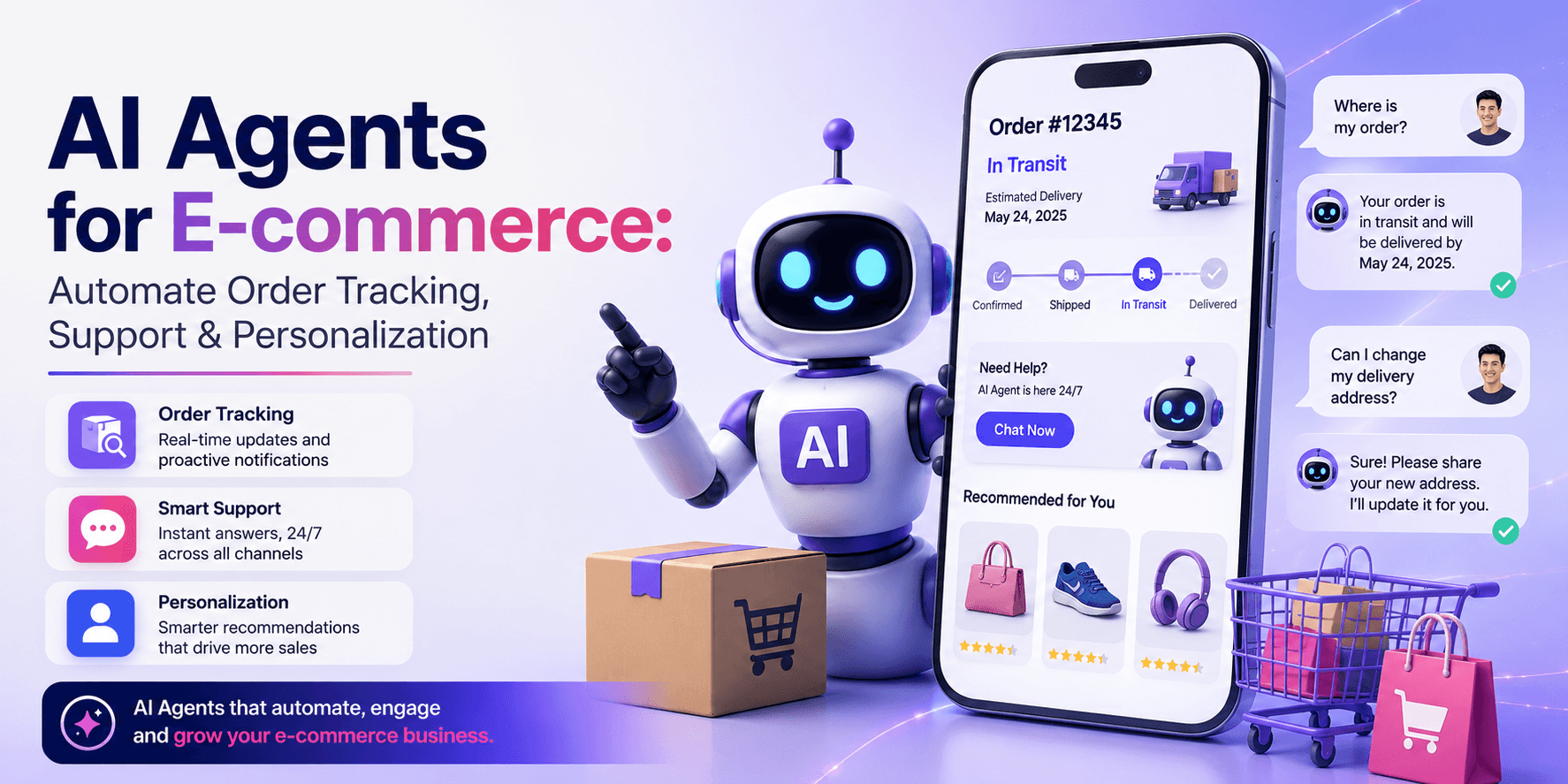
A customer asks:
"Where is my order?"
The AI agent:
- Identifies the customer
- Retrieves the order
- Checks shipping information
- Estimates delivery time
- Provides live tracking
- Sends delivery updates if requested
The customer receives an immediate, personalized answer without waiting for a support representative.
Why Traditional E-commerce Support Falls Short
Customer expectations have increased dramatically.
People expect instant responses, accurate information, and personalized experiences every time they shop.
Unfortunately, many online stores still rely on manual support processes.
Repetitive Customer Questions
Support teams spend a large portion of their day answering the same questions:
- Where is my order?
- Can I cancel my order?
- How do I return a product?
- When will my refund arrive?
- Which size should I choose?
- Is this product available?
These repetitive tasks consume valuable time.
Long Response Times
Customers don't like waiting.
If support takes several hours—or even days—to respond, customers may:
- Cancel orders
- Leave negative reviews
- Switch to competitors
- Avoid future purchases
Fast responses improve customer satisfaction and build trust.
Limited Personalization
Many e-commerce websites still display the same products to every visitor.
However, every customer has different interests.
Without personalization, businesses miss opportunities to:
- Increase average order value
- Improve conversion rates
- Encourage repeat purchases
AI agents solve this by learning from customer behaviour and recommending relevant products.
Disconnected Systems
Customer information is often spread across multiple platforms, such as:
- Shopify
- WooCommerce
- Magento
- CRM
- Order Management System
- Payment Gateway
- Shipping Providers
- Inventory Management
Support teams spend time switching between systems to answer simple questions.
AI agents connect these systems and present unified information in seconds.
How AI Agents Work in E-commerce
AI agents combine artificial intelligence, business data, and workflow automation to deliver intelligent customer experiences.
Step 1: Customer Asks a Question
Examples:
- Where is my order?
- Recommend running shoes under ₹5,000.
- Cancel my order.
- Return this product.
- Apply my discount code.
Step 2: AI Understands the Request
The AI identifies the customer's intent using natural language understanding.
It recognizes not only keywords but also the context behind the request.
Step 3: Retrieve Business Data
The AI agent securely connects to business systems such as the following:
- E-commerce platform
- CRM
- Inventory
- Shipping provider
- Payment gateway
- Product catalog
- Customer history
This ensures responses are based on real-time information.
Step 4: Perform Actions
Instead of only answering questions, AI agents can take action.
Examples include:
- Generate tracking links
- Update delivery addresses
- Initiate returns
- Create support tickets
- Recommend products
- Apply discounts
- Notify customers about shipment updates
Step 5: Deliver Personalized Responses
The AI combines customer history, preferences, and real-time business data to generate helpful, personalized responses.
This creates a smoother shopping experience and reduces the need for manual support.
AI Agents vs Traditional Chatbots

Traditional chatbots are useful for answering simple, predefined questions.
AI agents go much further by understanding requests, accessing business systems, and completing tasks on behalf of customers.
Why Businesses Are Investing in AI Agents
E-commerce companies are adopting AI agents because they deliver measurable business value.
Key outcomes include the following:
- Faster customer support
- Higher customer satisfaction
- Reduced support costs
- Increased sales through personalization
- Better customer retention
- More efficient operations
- Improved shopping experiences
- Scalable 24/7 customer service
Instead of replacing customer support teams, AI agents handle repetitive tasks, allowing human agents to focus on complex issues and relationship-building.
AI Agents for Order Tracking
One of the most common questions every online store receives is:
"Where is my order?"
Customers expect instant updates after making a purchase. If they don't receive timely information, they may contact support multiple times, increasing operational costs and reducing satisfaction.
AI agents solve this problem by providing real-time order tracking without human intervention.
Real-Time Order Status
An AI agent connects with your
- E-commerce platform
- Order Management System (OMS)
- Warehouse Management System (WMS)
- Shipping carrier
- Logistics provider
It can instantly provide updates such as the following:
- Order Confirmed
- Payment Received
- Processing
- Packed
- Shipped
- Out for Delivery
- Delivered
Customers receive accurate information in seconds.
Proactive Delivery Notifications
Instead of waiting for customers to ask, AI agents automatically send updates.
Examples:
- Your order has been confirmed.
- Your package has been shipped.
- Your order is out for delivery.
- Your package has been delivered.
This proactive communication reduces customer anxiety and support inquiries.
Delivery Issue Resolution
If an order is delayed, the AI agent can:
- Explain the reason for the delay
- Share a revised delivery estimate
- Escalate urgent cases to a human agent
- Create a support ticket automatically
Customers stay informed without repeatedly contacting support.
AI Agents for Customer Support
Customer support is essential to every successful e-commerce business.
Traditional support teams often spend their time answering repetitive questions, leaving less time for complex issues.
AI agents provide instant, consistent, and personalized assistance 24/7.
Frequently Asked Questions
Customers often ask:
- Where is my order?
- Can I cancel my order?
- What is your return policy?
- How long does shipping take?
- Is this product in stock?
- Which payment methods do you accept?
- How do I exchange a product?
AI agents answer these questions instantly using your latest business policies and product information.
Multi-Channel Support
Customers interact with brands across multiple channels.
AI agents can support conversations through:
- Website chat
- Mobile apps
- Facebook Messenger
- Instagram Direct
- Voice assistants
The conversation stays consistent, regardless of the channel.
Intelligent Escalation
Some issues require human intervention.
Examples include:
- Damaged products
- Fraud investigations
- Complex refund disputes
- High-value customer requests
The AI agent identifies these situations and transfers the conversation to the right support representative, along with the complete conversation history.
AI Agents for Product Personalization
Modern customers expect personalized shopping experiences.
Showing the same products to every visitor often leads to lower engagement and missed sales opportunities.
AI agents analyze customer behavior and recommend products that are most relevant to each individual.
Personalized Recommendations
AI agents use information such as the following:
- Browsing history
- Purchase history
- Wish lists
- Recently viewed products
- Favorite categories
- Budget preferences
Based on this information, the AI suggests products that are more likely to match the customer's interests.
Cross-Selling
Example:
A customer purchases a smartphone.
The AI agent recommends:
- Phone case
- Screen protector
- Wireless charger
- Earbuds
This increases the average order value while helping customers discover useful accessories.
Upselling
If a customer is viewing an entry-level laptop, the AI can recommend:
- A model with more storage
- Better performance
- Longer battery life
The recommendation is based on customer needs rather than random promotions.
Personalized Promotions
Instead of offering identical discounts to everyone, AI agents create targeted offers.
Examples:
- Special discount for repeat customers
- Personalized birthday offers
- Category-specific coupons
- Loyalty rewards
- Product restock alerts
This improves customer engagement and encourages repeat purchases.
AI Agents for Cart Recovery
Cart abandonment is one of the biggest challenges in e-commerce.
Many customers add products to their cart but leave before completing the purchase.
AI agents help recover these lost sales.
Intelligent Reminders
The AI agent automatically sends reminders when a customer abandons a cart.
Examples:
- You left something behind.
- Your cart is waiting.
- Complete your purchase today.
Personalized Recovery Messages
Instead of generic reminders, AI agents personalize messages using:
- Customer name
- Product details
- Previous purchases
- Shopping behavior
This makes follow-up messages more relevant and engaging.
Limited-Time Offers
The AI can encourage conversions with:
- Discount coupons
- Free shipping
- Bonus reward points
- Exclusive offers
These incentives are delivered only when appropriate, helping improve conversion rates without overusing discounts.
AI Agents for Returns & Refunds
Returns are a normal part of online shopping.
However, manual return processes can frustrate customers and increase operational costs.
AI agents simplify the experience.
Return Eligibility Check
Customers ask:
"Can I return this product?"
The AI verifies:
- Purchase date
- Return window
- Product category
- Return policy
- Product condition requirements
Customers receive immediate guidance without waiting for support.
Return Request Automation
The AI agent can:
- Create return requests
- Generate return labels
- Schedule pickups
- Notify warehouse teams
- Track return progress
This reduces manual work for both customers and support staff.
Refund Tracking
Customers can ask:
- Has my refund been processed?
- When will I receive my money?
The AI retrieves refund status directly from the payment system and provides real-time updates.
Real-World Business Use Cases
Fashion Retail
A clothing retailer receives thousands of customer inquiries every week.
Before AI:
- Long support queues
- Manual order tracking
- Slow response times
After implementing AI agents:
- Instant order tracking
- Personalized outfit recommendations
- Automated return processing
- Faster customer support
The customer experience improves while support teams handle fewer repetitive requests.
Electronics Store
Customers frequently ask:
- Which laptop should I buy?
- Is this compatible?
- Can I upgrade later?
AI agents analyze customer requirements and recommend products based on budget, specifications, and intended use.
Grocery Delivery Platform
Customers need quick updates on delivery status.
AI agents provide:
- Real-time driver tracking
- Delivery notifications
- Substitution suggestions
- Order modifications before dispatch
This reduces uncertainty and improves customer trust.
Business Benefits of AI Agents in E-commerce
Organizations implementing AI agents often experience improvements across multiple areas.
Faster Customer Support
Customers receive answers within seconds instead of waiting in support queues.
Higher Customer Satisfaction
Personalized interactions and proactive communication create a better shopping experience.
Lower Support Costs
By automating repetitive requests, AI agents reduce the workload on customer service teams.
Increased Sales
Smarter recommendations, cart recovery, and personalized promotions help improve conversion rates and average order value.
Better Customer Retention
Customers are more likely to return when they receive fast support and personalized experiences.
Scalable Operations
AI agents can handle thousands of customer interactions simultaneously, making them well suited for seasonal peaks and business growth.
AI Agent Architecture for E-commerce
An AI agent is much more than a chatbot. It combines artificial intelligence, business logic, and integrations with your e-commerce ecosystem to automate customer interactions and business operations.
AI Agent Architecture

The AI agent retrieves information, reasons about the request, performs actions, and provides accurate responses in real time.
System Integrations
AI agents become significantly more valuable when connected to existing business systems.
E-commerce Platform
The AI accesses:
- Products
- Inventory
- Customer accounts
- Orders
- Discounts
- Coupons
Supported platforms may include Shopify, WooCommerce, Magento, BigCommerce, and custom e-commerce solutions.
CRM Integration
The AI can retrieve:
- Customer history
- Previous purchases
- Loyalty status
- Support interactions
- Customer preferences
This enables personalized conversations.
Inventory Management
Customers often ask:
- Is this product available?
- When will it be back in stock?
The AI checks live inventory and provides accurate availability information.
Shipping Integration
The AI connects with logistics providers to provide the following:
- Live tracking
- Delivery estimates
- Shipment status
- Delay notifications
Payment Gateway
Customers can ask:
- Was my payment successful?
- When will my refund arrive?
The AI retrieves payment information securely without requiring manual support.
Future of AI in E-commerce
AI agents are expected to become even more capable.
Future applications include:
- Voice shopping assistants
- Hyper-personalized product recommendations
- Predictive inventory management
- Autonomous customer service
- AI shopping companions
- Visual search and image-based shopping
- AI-powered loyalty programs
- Intelligent pricing recommendations
- Multi-agent retail operations
- Predictive customer retention
Businesses that invest in AI thoughtfully today will be better positioned to deliver exceptional customer experiences tomorrow.
Frequently Asked Questions
What is an AI agent for e-commerce?
An AI agent is intelligent software that automates customer support, order tracking, product recommendations, and other e-commerce workflows.
How is an AI agent different from a chatbot?
Traditional chatbots answer predefined questions.
AI agents understand context, integrate with business systems, perform actions, and automate workflows.
Can AI agents track customer orders?
Yes. They retrieve real-time shipping information and provide live delivery updates.
Can AI agents recommend products?
Yes. They analyze browsing behavior, purchase history, and preferences to suggest relevant products.
Can AI agents process returns?
Yes. They can verify eligibility, create return requests, generate shipping labels, and track refunds.
Can AI agents recover abandoned carts?
Yes. They can send personalized reminders and offers to encourage customers to complete their purchases.
Are AI agents secure?
They can be secure when implemented with strong authentication, encryption, role-based access control, and secure integrations.
Which e-commerce businesses benefit the most?
- Fashion retailers
- Electronics stores
- Grocery delivery services
- Beauty brands
- Furniture retailers
- D2C brands
- Marketplaces
- B2B e-commerce platforms
Do AI agents replace customer support teams?
No. They automate repetitive tasks, allowing support teams to focus on complex customer issues and relationship building.
How long does implementation take?
A basic AI support agent can often be implemented in 6–10 weeks, while a fully integrated enterprise solution may take 3–6 months, depending on complexity.
Conclusion
Customer expectations continue to rise in e-commerce. Shoppers want instant support, accurate order updates, personalized recommendations, and seamless post-purchase experiences.
AI agents help businesses meet these expectations by automating repetitive tasks such as order tracking, customer support, product recommendations, cart recovery, and returns. Rather than replacing customer service teams, they enable employees to focus on solving complex issues and delivering exceptional customer experiences.
When implemented with reliable data, secure integrations, and ongoing optimization, AI agents become a valuable competitive advantage for modern e-commerce businesses.
Transform Your E-commerce Business with AI Agents
Looking to build AI-powered shopping experiences?
Infiniapps develops custom AI agents for e-commerce businesses that automate customer support, order tracking, personalization, and operational workflows.
Our AI solutions can help you:
- Automate customer support
- Enable real-time order tracking
- Deliver personalized product recommendations
- Recover abandoned carts
- Simplify returns and refunds
- Integrate with Shopify, WooCommerce, Magento, CRM, and ERP platforms
Ready to create a smarter e-commerce experience? Contact Infiniapps to build a secure, scalable AI agent tailored to your online business.