AI Agent Memory: How to Give Your AI Agent Long-Term Context Using Vector Databases
 Sasikumar
AI agents can answer questions, use tools, and automate tasks. However, they cannot naturally remember information across conversations. This limitation makes it difficult to build personalised and intelligent AI systems.
Building an AI agent with long-term memory is only one part of a successful AI solution. Learn more about our AI agent development services.
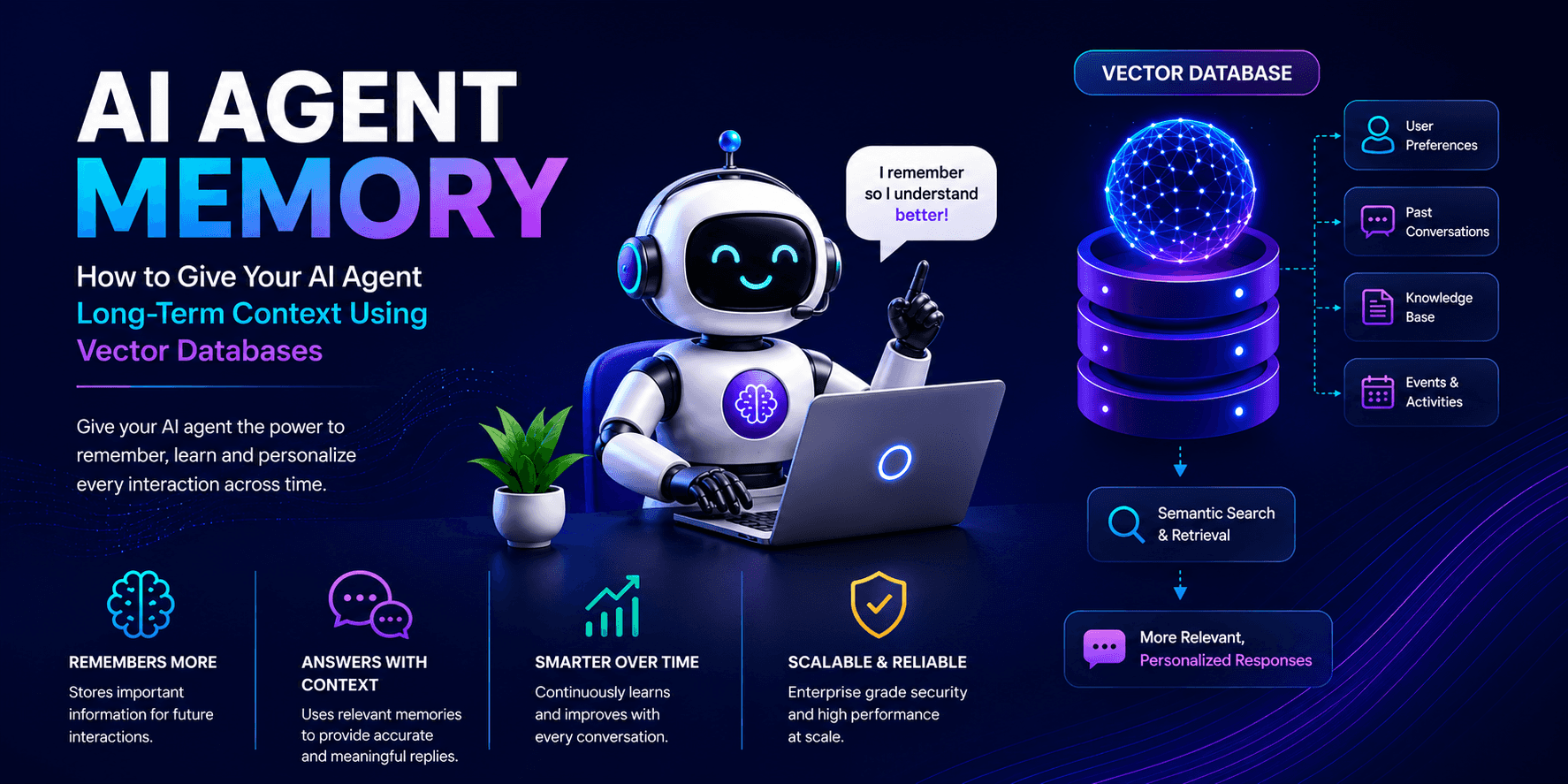
AI agent memory solves this problem by storing important information outside the Large Language Model (LLM). Instead of relying only on the model's context window, developers use vector databases to save and retrieve memories. These memories are converted into embeddings, stored efficiently, and retrieved whenever the AI needs relevant context.
What is AI Agent Memory?
AI agent memory is the ability of an AI agent to store and retrieve information beyond its current conversation. It uses technologies such as embeddings and vector databases to remember previous interactions, user preferences, documents, and business knowledge. This allows AI agents to provide personalised and context-aware responses over time.
AI Agent Memory: The Missing Piece of Intelligent AI
Large language models like GPT-5, Claude, Gemini, and Llama are incredibly powerful.
They can:
- Answer questions
- Write code
- Summarize documents
- Generate reports
- Call APIs
- Use external tools
But they all have one major limitation.
They forget.
Once the conversation becomes too long or ends, the AI no longer remembers what happened.
Imagine talking to a human who forgets every conversation after you leave the room.
You would need to explain everything again.
That is exactly how an AI agent behaves without memory.
This is why modern AI agents use long-term memory.
Instead of expecting the LLM to remember everything, developers give the AI an external memory system using vector databases.
This allows the AI to remember users, previous conversations, company documents, and business knowledge for weeks, months, or even years.
Why Do AI Agents Need Memory?
Let's understand this with a simple example.
Imagine you build an AI customer support agent.
A customer says:
"My name is Sarah."
The AI replies correctly.
Later, the customer says:
"What is my name?"
The AI answers:
"Sarah."
Everything works.
Now imagine Sarah returns next week.
She asks:
"Can you continue helping me?"
Without memory, the AI says:
"Please tell me your name."
It completely forgot.
That creates a poor user experience.
Now imagine the AI has long-term memory.
Sarah returns.
The AI immediately responds:
"Welcome back, Sarah. Last week we discussed your invoice issue. Would you like to continue?"
This feels intelligent.
The only difference is memory.
Why Can't Large Language Models Remember Forever?
Many people think GPT or Claude already has memory.
Actually, they do not.
They only have a context window.
The context window is like the AI's short-term working memory.
Everything inside the current conversation is visible.
Everything outside it disappears.
For example:
Imagine writing on a whiteboard.
The whiteboard can hold only a certain amount of information.
When it becomes full, you erase the oldest notes to make room for new ones.
That is exactly how an LLM works.
The context window is the whiteboard.
Once information falls outside that window, the model cannot use it unless you provide it again.
This is why long conversations eventually lose earlier details.
Short-Term Memory vs Long-Term Memory
Understanding this difference is essential for AI agent development.

Think of it like this.
Short-term memory is your working desk.
Only today's files are on it.
Long-term memory is your filing cabinet.
You can store thousands of files and retrieve them whenever needed.
AI agents need both.
What Is AI Agent Memory?
AI agent memory is a system that allows an AI to remember information beyond the current conversation.
Instead of storing memories inside the LLM, the AI stores them in external storage.
That storage may contain:
- User preferences
- Past conversations
- Business rules
- Product manuals
- Meeting notes
- Company documents
- Customer history
- Support tickets
- Policies
- Personalization data
Whenever the AI receives a new question, it searches its memory for relevant information.
Only the relevant memories are sent to the LLM.
The LLM then produces a better answer.
Where Does AI Memory Live?
Memory does not live inside GPT.
It usually lives in systems like the following:
- Pinecone
- ChromaDB
- pgvector
- Weaviate
- Milvus
- Qdrant
These are called 'vector databases'.
They are designed to search information based on meaning instead of exact keywords.
What Is a Vector Database?
A vector database is a database designed to store and search embeddings.
Instead of storing only text, it stores the mathematical representation of text.
This allows the AI to search by meaning.
Example:
Stored memory:
"Sarah likes vegetarian food."
Later the user asks:
"What food should I order?"
The words "vegetarian food" are not exactly repeated.
But the vector database understands the semantic meaning and retrieves the stored memory.
Traditional databases cannot do this efficiently.
Why Can't SQL Databases Solve This Alone?
Suppose your database stores:
Sarah likes vegetarian food.
The user asks:
Suggest a healthy meal.
SQL searches for exact words.
It may not find "vegetarian".
A vector database searches meaning.
It understands that vegetarian meals are related to healthy food.
This is why modern AI agents rely on vector databases for memory retrieval.
What Are Embeddings?
Embeddings are one of the most important concepts in AI.
An embedding converts text into numbers.
Those numbers capture the meaning of the text.
For example:
Text:
I love pizza.
Embedding:
[0.42, -0.18, 0.76, 0.91...]
Humans cannot understand these numbers.
Machines can.
Similar sentences produce similar vectors.
Example:
"I enjoy pizza."
"I like Italian food."
These embeddings are mathematically close.
This allows the AI to retrieve related memories even when the wording changes.
How AI Agent Memory Works
A modern AI agent follows a simple memory workflow.
Step 1
The user sends a message.
Example:
"I manage three hospitals."
Step 2
The AI decides this information is important.
Step 3
The sentence is converted into an embedding.
Step 4
The embedding is stored in a vector database.
Step 5
Days later, the user asks:
"Show me reports for my hospitals."
Step 6
The AI converts this new question into another embedding.
Step 7
The vector database searches for similar memories.
Step 8
It finds:
"User manages three hospitals."
Step 9
That memory is sent to the LLM.
Step 10
The AI answers with full context.
To the user, it feels like the AI remembered naturally.
In reality, it retrieved the memory from a vector database.
Why This Architecture Matters
Without memory, every conversation starts from zero.
With memory, every conversation builds on previous interactions.
This makes AI agents
- More personalized
- More accurate
- More helpful
- Better suited for enterprise applications
It also reduces repetitive questions, improves customer experience, and enables truly context-aware automation.
AI Agent Memory Architecture: How Long-Term Memory Works
Understanding AI agent memory becomes much easier when you see the complete flow.
Imagine an AI sales agent.
A customer says:
"Our company has 250 employees and uses Salesforce."
The AI should remember this information because it may become useful later.
Here is what happens behind the scenes.

Instead of asking users to repeat themselves, the AI remembers important information and uses it at the right time.
Types of AI Agent Memory
Not every memory is the same.
Just like humans have different types of memory, AI agents also organise memories differently.
1. Working Memory
Working memory is temporary.
It exists only during the current conversation.
Example:
User:
Summarize this PDF.
The AI keeps the PDF context while answering.
Once the conversation ends, this memory disappears.
Working memory is fast but short-lived.
2. Episodic Memory
Episodic memory stores past interactions.
Example:
- Customer asked for pricing last week.
- Customer reported a login issue yesterday.
- Customer booked a demo last month.
When the customer returns, the AI can continue from where it left off.
This creates a natural conversation.
3. Semantic Memory
Semantic memory stores knowledge.
Instead of remembering conversations, it remembers facts.
Examples:
- Company policies
- Product documentation
- HR rules
- Medical guidelines
- Technical manuals
This memory changes less frequently.
Many enterprise AI systems rely heavily on semantic memory.
4. Procedural Memory
Procedural memory stores processes.
Examples:
- Invoice approval workflow
- Employee onboarding steps
- Loan approval process
- Customer escalation process
Instead of remembering facts, it remembers how to perform tasks.
This is useful for workflow automation.
RAG vs Long-Term Memory
Many beginners think Retrieval-Augmented Generation (RAG) and AI memory are the same.
They are related, but they solve different problems.

Example
RAG answers:
"What is our refund policy?"
Memory answers:
"Last time you purchased the Enterprise plan."
Modern AI agents often combine both.
The workflow becomes the following:
User Question
↓
Retrieve Company Knowledge (RAG)
↓
Retrieve User Memory
↓
Combine Both
↓
Generate Final Answer
This produces much more intelligent responses.
Best Vector Databases for AI Agent Memory
Many vector databases are available today.
Each has strengths for different use cases.

Pinecone
Best for:
- Enterprise AI
- High availability
- Large-scale applications
Advantages
- Fully managed
- Fast similarity search
- Excellent scalability
Chroma
Best for:
- Learning
- Prototypes
- Local development
Advantages
- Easy setup
- Open source
- Python friendly
pgvector
Best for:
Companies already using PostgreSQL.
Advantages
- No separate database required
- Simple deployment
- SQL support
Qdrant
Best for:
Production AI applications needing high performance.
Advantages
- Fast
- Lightweight
- Excellent filtering
Weaviate
Best for:
Enterprise knowledge bases.
Advantages
- Graph capabilities
- Rich metadata
- Hybrid search
Milvus
Best for:
Very large AI systems.
Advantages
- Massive scalability
- Distributed architecture
- High performance
Real-World AI Agent Memory Examples
Healthcare AI Agent
The AI remembers:
- Previous appointments
- Medical history
- Preferred doctor
- Allergies
When the patient returns, the AI continues naturally.
Customer Support Agent
The AI remembers:
- Previous tickets
- Purchased products
- Subscription plan
- Common issues
Customers no longer repeat information.
Sales AI Agent
The AI remembers:
- Budget
- Company size
- Industry
- Previous meetings
- Interested products
Sales conversations become much more personalised.
HR AI Assistant
The AI remembers:
- Employee department
- Leave history
- Company policies discussed
- Training completed
This improves internal support.
Education AI Tutor
The AI remembers:
- Student progress
- Weak subjects
- Previous quizzes
- Learning speed
Lessons become personalised for each student.
Best Practices for AI Agent Memory
Building memory is not just about storing everything.
Good AI agents store only useful information.
Store Important Information Only
Good memories include:
- User preferences
- Business facts
- Previous decisions
- Important conversations
Avoid storing every sentence.
Remove Duplicate Memories
Repeated memories increase storage and reduce retrieval quality.
Regular cleanup keeps memory efficient.
Add Metadata
Each memory should include metadata such as the following:
- User ID
- Timestamp
- Category
- Source
- Importance score
Metadata improves retrieval accuracy.
Rank Memories
Recent memories are not always the most important.
Ranking by relevance produces better responses.
Protect Sensitive Data
Memory often contains private information.
Use:
- Encryption
- Access control
- Role-based permissions
- Data retention policies
Security is essential in enterprise AI.
Frequently Asked Questions
What is AI agent memory?
AI agent memory is a system that stores and retrieves important information outside the LLM so the AI can remember users, conversations, and knowledge over time.
Does ChatGPT have long-term memory?
LLMs have limited conversational memory. Long-term memory for AI agents is typically built using external storage such as vector databases.
Why do AI agents use vector databases?
Vector databases search information based on meaning rather than exact words, making them ideal for semantic memory retrieval.
What is the difference between memory and context window?
The context window is temporary and limited by tokens. Long-term memory is persistent and stored externally.
Can SQL databases replace vector databases?
Traditional SQL databases can store embeddings, especially with extensions like pgvector, but dedicated vector databases provide better semantic search and scalability.
Which vector database is best?
It depends on the project.
- Pinecone → Enterprise
- Chroma → Learning
- pgvector → PostgreSQL users
- Qdrant → Production AI
- Weaviate → Knowledge platforms
- Milvus → Large-scale AI
Is RAG the same as AI memory?
No.
RAG retrieves knowledge from documents.
AI memory retrieves personalised user information and previous interactions.
Can AI memory improve customer experience?
Yes.
It reduces repeated questions, personalises responses, and creates more natural conversations.
Conclusion
Large language models are powerful, but they cannot remember everything on their own.
To build intelligent AI agents, you need more than a good model. You need a memory system that stores important information, retrieves it when needed, and provides the LLM with the right context.
Vector databases, embeddings, and retrieval workflows make this possible. Together, they transform an AI agent from a tool that answers isolated questions into an assistant that learns, remembers, and improves over time.
Whether you are building a customer support bot, healthcare assistant, sales agent, HR assistant, or enterprise AI platform, long-term memory is one of the most important capabilities you can add.
Building an AI Agent with Long-Term Memory?
At Infiniapps, we design and develop enterprise AI agents with advanced memory architectures using vector databases, embeddings, Retrieval-Augmented Generation (RAG), and modern LLM frameworks.
Whether you need a customer support AI, healthcare assistant, sales agent, or custom enterprise AI solution, our team can help you build scalable, context-aware AI agents that remember what matters.
Ready to build smarter AI agents? Contact Infiniapps to discuss your AI development project today.