AI Agents vs AI Chatbots: What are the Key Difference?
 Sasikumar
AI agents and AI chatbots may seem similar, but they differ significantly in autonomy, decision-making, and their ability to perform complex tasks beyond simple conversations.
You have probably heard both terms. AI chatbot. AI agent. They sound similar. And many people use them interchangeably.
But they are not the same thing. Not even close.
If you pick the wrong one for your business, you waste money. You automate the wrong things. And you still do most of the work yourself.
What Is an AI Chatbot?
An AI chatbot is a program that talks to people. You type a question. It types back an answer.
That is it. It responds. It does not act. It does not do things for you.
Chatbots are great for:
- Answering customer questions on your website
- Giving quick product information
- Handling simple support requests
- Qualifying leads with a short conversation
- Providing FAQs without a human agent
Most chatbots follow a script. Even the smart AI-powered ones — like the chat widget on a website — mostly respond to what you type, then wait for your next message.
They do not go off and do things on their own.
📌 Real Example: You go to a software website. A chat box pops up. You type 'What is your price?' The chatbot replies with pricing info and asks if you want to book a demo. That is a chatbot doing its job.
What Is an AI Agent?
An AI agent is different. It does not just talk. It thinks and acts.
You give it a goal. It figures out the steps. Then it does them — one by one — without you having to guide it at every turn.
An AI agent can:
- Search the web for information
- Read and write files
- Send emails or messages
- Fill in forms and click buttons
- Use tools like calendars, CRMs, or databases
- Make decisions based on what it finds
- Hand off work to another AI agent if needed
Think of it like this. A chatbot is a receptionist who answers the phone. An AI agent is an employee who actually does the work.
📌 Real Example: You tell an AI agent: 'Find me 20 leads in the healthcare sector, check their LinkedIn profiles, and send each one a personalised connection request.' The agent does all of that. You just check the results.
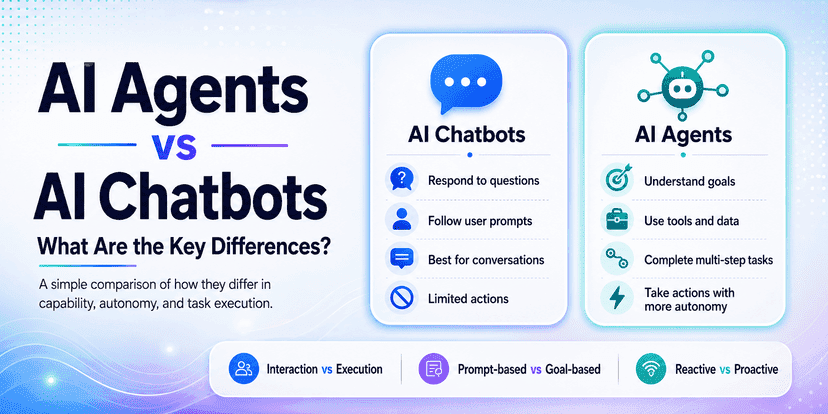
AI Chatbot vs AI Agent — Side-by-Side Comparison
Here is a clear comparison to help you see the difference at a glance:

The 5 Key Differences Between AI Chatbots and AI Agents
1. Who Drives the Conversation?
With a chatbot, YOU drive. You ask. It answers. If you stop asking, it stops doing anything.
With an AI agent, THE AGENT drives. You give it a goal once. It keeps working until the job is done.
2. Can It Use Tools?
Chatbots mostly talk. That is their only tool — language.
AI agents can use dozens of tools. They can search Google. Send a Slack message. Update a spreadsheet. Book a calendar slot. All in one workflow.
3. Does It Have Memory?
Most chatbots forget everything when the conversation ends. Each session starts fresh.
AI agents can have memory. They remember past interactions, preferences, and context. This makes them smarter over time.
4. Can It Make Decisions?
A chatbot follows its training. If you ask something it was not trained on, it guesses or says it does not know.
An AI agent can reason. It evaluates situations and chooses what to do next. It adapts when things do not go as planned.
5. What Can It Automate?
Chatbots automate conversations. That is useful — but limited.
AI agents automate entire workflows. Multiple steps. Multiple tools. Multiple decisions. All without you being involved at each step.
When Should You Use a Chatbot?
A chatbot is the right choice when:
- You need simple, instant answers: Support FAQs, product info, business hours
- You want to qualify leads fast: Asking basic questions before passing to a human
- Budget is tight: Chatbots are cheaper to build and maintain
- Your workflows are simple: One question, one answer — no complex steps needed
- Speed matters most: Chatbots reply in seconds with no delay
✅ Good Chatbot Use Cases: Website support widget | Lead capture form | Order status check | FAQ page replacement | Appointment booking
When Should You Use an AI Agent?
An AI agent is the right choice when:
- Tasks have multiple steps: Research → draft → send → track – all in one flow
- You want to save serious time: Agents handle hours of work in minutes
- Your workflows involve tools: CRM, email, calendar, spreadsheets, databases
- You want automation that improves: Agents learn and adapt – chatbots do not
- Mistakes are costly: Agents can check their own work before acting
✅ Good AI Agent Use Cases: Lead research and outreach | Customer support triage + resolution | HR screening and scheduling | Finance report generation | Marketing campaign execution | E-commerce order management
Real-World Examples: Chatbot vs Agent in Action
Scenario 1: Customer Support
Chatbot approach: A customer asks 'Where is my order?' The chatbot replies with a tracking link. Done. If the order is lost, the chatbot cannot help further.
AI agent approach: A customer reports their order is lost. The AI agent checks the shipping system, sees the delay, issues a replacement, emails the customer with an update, and logs the case in the CRM — all without a human.
Scenario 2: Sales Outreach
Chatbot approach: A visitor fills in a form. The chatbot sends a welcome message and asks what they are looking for.
AI agent approach: The agent finds the lead's company, researches their pain points on LinkedIn, writes a personalised email, sends it, waits for a reply, and books a follow-up if there is no response in 48 hours.
Scenario 3: HR and Recruitment
Chatbot approach: A candidate submits a CV. The chatbot confirms receipt and tells them to expect a reply in 5 days.
AI agent approach: The agent reads the CV, scores it against the job spec, checks for red flags, schedules an interview if the score is high enough, and sends the hiring manager a summary report.
3 Common Mistakes Businesses Make
Mistake 1: Using a Chatbot When You Need an Agent
Many businesses build a chatbot to handle customer support. It answers basic questions. But when things get complex — refunds, escalations, multi-step issues — the chatbot fails. Customers get frustrated. Humans still have to step in.
Fix: If your support tasks have more than 2 steps, use an AI agent.
Mistake 2: Building an Agent When a Chatbot Would Do
Some businesses over-engineer. They build a complex AI agent just to answer FAQs. That is expensive and slow to build for a simple problem.
Fix: If your task is basically 'question and answer', a chatbot is enough.
Mistake 3: Thinking They Are the Same Thing
This is the most common mistake. Businesses buy a chatbot tool and expect agent-level results. They wonder why it cannot complete tasks or make decisions.
Fix: Know what you need before you buy. Conversation? Chatbot. Action? Agent.
Frequently Asked Questions
What is the main difference between an AI chatbot and an AI agent?
A chatbot answers questions. An AI agent completes tasks. Chatbots respond to what you say. Agents plan, decide, and act — without you guiding each step.
Is ChatGPT a chatbot or an AI agent?
ChatGPT started as a chatbot. It answers questions and holds conversations. But when you give it tools — like web search or code execution — it starts to behave more like an AI agent. The newer versions of ChatGPT with plugins and tools are closer to AI agents.
Which is better — an AI chatbot or an AI agent?
Neither is better overall. It depends on what you need. Chatbots are better for simple, fast conversations. AI agents are better for multi-step work and complex automation. Most businesses need both — chatbots for front-line queries and agents for back-end workflows.
Can an AI agent replace a chatbot?
Technically yes — an AI agent can do everything a chatbot can and more. But agents cost more to build and run. For simple tasks, a chatbot is cheaper and faster to deploy. Use agents where the added capability is worth the cost.
How much does it cost to build an AI agent vs a chatbot?
A basic chatbot can cost from $500 to $5,000 depending on complexity. A custom AI agent typically starts from $5,000 to $50,000+ depending on the number of tools, integrations, and workflows involved. AI agent development companies in India offer these at 40–60% lower cost than US or UK agencies.
Do AI agents need human supervision?
It depends on the use case. Most production AI agents have a human-in-the-loop for high-stakes decisions — like approving large payments or sending mass communications. For lower-risk tasks — like research, drafting, or data entry — they can run fully autonomously.
Key Takeaways
✅ AI Chatbot: Talks to users, answers questions, follows a script
✅ AI Agent: Plans, acts, uses tools, completes multi-step tasks autonomously
✅ Use a chatbot when you need fast, simple conversations
✅ Use an AI agent when you need to automate real work and save hours
✅ Most businesses need both — chatbots at the front, agents at the back
✅ The future: AI agents are becoming the standard for business automation in 2026 and beyond
Conclusion
The difference between an AI chatbot and an AI agent is not small. It is the difference between a tool that talks and a tool that works.
Chatbots are fast, affordable, and great for conversations. AI agents are powerful, flexible, and built for real automation.
If you only need to handle incoming questions, a chatbot is enough. If you want to automate workflows, save hours every week, and let AI handle complex multi-step tasks, you need an AI agent.
The good news? Both are more accessible than ever. You do not need a big tech team or a huge budget to get started. You just need to know what you want to achieve.
Still Not Sure Which One Your Business Needs?
You have read the difference. You know chatbots talk and AI agents act.
Now the question is, which one is right for you?
That depends on your workflows, your team size, your tools, and your goals. And the fastest way to find out is to talk to someone who has built both.
At InfiniappsAI, we have built 50+ AI solutions for businesses across 15+ countries. We will tell you in 30 minutes exactly what you need — chatbot, agent, or both — and how to get started without wasting time or budget.