AI Agent Development Company for Insurance
 Sasikumar
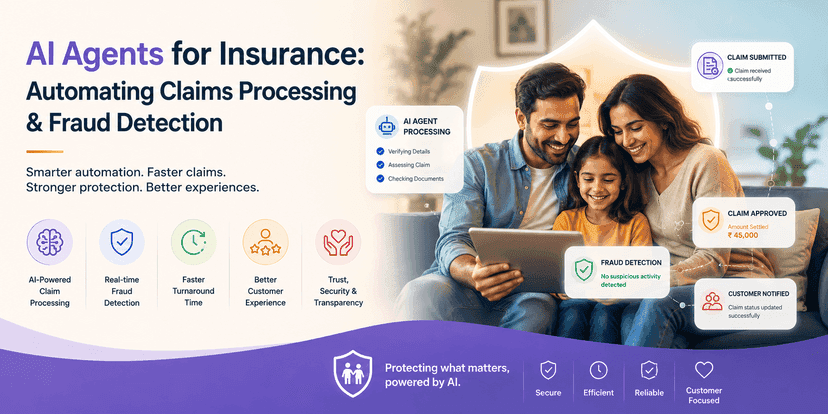
AI agents help insurance companies automate claims processing, detect fraud, improve customer service, and reduce operational costs. They can review documents, verify policy information, assess damage using AI models, identify suspicious claims, communicate with customers, and support human adjusters. Instead of replacing employees, AI agents automate repetitive work, allowing insurance teams to focus on complex decisions and better customer experiences.
What are AI agents in insurance?
AI agents are intelligent software systems that perform insurance tasks without constant human involvement. They can collect claim documents, verify customer information, detect fraud, communicate with policyholders, and assist claim adjusters. They use artificial intelligence, machine learning, natural language processing (NLP), and automation to complete work faster and more accurately.
The insurance industry is changing fast.
Insurance companies process thousands of claims every day.
Every claim requires many steps.
These include:
- Collecting customer information
- Reading policy documents
- Checking coverage
- Reviewing photos
- Detecting fraud
- Communicating with customers
- Approving or rejecting claims
Many of these tasks are still done manually.
Manual work creates problems.
It slows down claim approvals.
It increases operating costs.
It also makes it harder to detect fraud.
Customers expect fast service.
They want updates in minutes, not days.
This is why many insurers are adopting AI agents.
AI agents work around the clock.
They can understand documents, analyse images, search databases, make decisions based on business rules, and communicate with customers automatically.
Instead of replacing insurance professionals, AI agents remove repetitive work so employees can focus on complex cases and customer relationships.
As artificial intelligence becomes more advanced, AI agents are becoming a key part of modern insurance operations.
What Are AI Agents in Insurance?
AI agents are intelligent software systems that can understand information, make decisions, and complete insurance tasks with little or no human intervention.
Unlike traditional automation, AI agents do more than follow fixed rules.
They can:
- Understand natural language
- Read policy documents
- Analyze claim forms
- Process emails
- Review accident photos
- Detect unusual claim patterns
- Communicate with customers
- Learn from previous cases
- Use multiple business systems together
Think of an AI agent as a digital insurance assistant.
It can complete work from start to finish while collaborating with human claim adjusters when needed.
How AI Agents Work
A typical insurance AI agent follows these steps:
- Receives a claim.
- Reads submitted documents.
- Extracts important information.
- Verifies policy coverage.
- Checks customer history.
- Looks for fraud indicators.
- Calculates the estimated claim amount.
- Sends updates to the customer.
- Escalates complex cases to a human adjuster.
This allows claims to move much faster than traditional manual processes.
Why Insurance Companies Are Adopting AI Agents
Insurance companies face growing pressure to deliver faster service while controlling costs and reducing fraud.
Customers expect a digital experience similar to online banking, e-commerce, and travel platforms. Long claim processing times and repeated requests for information can lead to frustration and lower customer satisfaction.
AI agents help insurers address these challenges by automating repetitive tasks and improving operational efficiency.
1. Faster Claims Processing
Manual claims handling often involves reviewing multiple documents, verifying policy details, and coordinating with different teams.
AI agents can perform many of these tasks automatically, reducing the time required to process straightforward claims.
Business Impact
- Faster claim approvals
- Shorter customer wait times
- Improved customer satisfaction
- Higher operational efficiency
2. Reduced Operational Costs
Claims processing requires significant manual effort.
AI agents automate repetitive work, allowing employees to focus on complex investigations and customer support.
This can help reduce administrative overhead and improve resource allocation.
Examples include:
- Automatic document review
- Data extraction
- Policy verification
- Customer notifications
- Status updates
3. Better Fraud Detection
Insurance fraud costs companies billions of dollars each year.
Traditional fraud detection often relies on manual investigations or predefined rules.
AI agents can analyse large volumes of data to identify unusual patterns that may indicate fraudulent activity.
Examples include:
- Duplicate claims
- Repeated repair invoices
- Unusual claim timing
- Identity inconsistencies
- Suspicious payment behavior
AI agents can flag these claims for human review before payment is approved.
4. Improved Customer Experience
Customers want quick and transparent communication.
AI agents provide:
- Instant claim status updates
- 24/7 customer support
- Faster responses
- Personalized communication
- Automated reminders
This helps build trust and improves the overall claims experience.
5. Higher Employee Productivity
Insurance professionals spend a significant amount of time on repetitive administrative tasks.
AI agents can handle routine activities while employees focus on the following:
- Complex claims
- Customer relationships
- Fraud investigations
- High-value decision-making
This improves productivity without replacing human expertise.
How AI Agents Automate Claims Processing
Claims processing is one of the most important and resource-intensive workflows in the insurance industry.
A single claim often passes through multiple departments before it is approved or rejected. Each handoff increases processing time and the chance of human error.
AI agents streamline this entire workflow by automating repetitive tasks and assisting human adjusters where judgment is required.
Traditional Claims Processing
A typical manual workflow looks like this:

This process can take several days or even weeks, depending on claim complexity.
AI-Powered Claims Processing
With AI agents, many of these steps happen automatically.

Step-by-Step Example
Imagine a customer files a car insurance claim after a minor accident.
Step 1: Claim Submission
The customer uploads:
- Accident photos
- Driver's licence
- Vehicle registration
- Repair estimate
The AI agent confirms that all required documents have been received.
Step 2: Document Understanding
The AI agent reads every submitted file and extracts key information, such as:
- Policy number
- Date of incident
- Vehicle details
- Estimated repair cost
- Accident location
No manual data entry is required.
Step 3: Policy Verification
The AI agent checks whether:
- The policy is active
- Premium payments are up to date
- The reported incident is covered
- Coverage limits apply
If information is missing, the AI agent automatically requests it from the customer.
Step 4: Damage Assessment
Using computer vision models, the AI agent reviews uploaded images to estimate the extent of visible damage.
It can compare the damage with historical claims and repair data to support consistent assessments.
Step 5: Fraud Screening
Before recommending approval, the AI agent analyses the claim for potential fraud signals, such as
- Duplicate submissions
- Altered documents
- Inconsistent customer information
- Unusual claim timing
- Links to previously flagged claims
Suspicious cases are routed to a fraud investigation team.
Step 6: Recommendation and Human Review
For straightforward claims that meet predefined business rules, the AI agent prepares a recommendation.
Human adjusters review exceptions, complex cases, or claims that require expert judgement.
This human-in-the-loop approach balances speed with oversight.
AI Agents for Fraud Detection
Insurance fraud is one of the biggest challenges facing insurers today.
Fraud can happen in many ways. Some people submit fake claims. Others exaggerate the value of damage. Organised fraud groups may file multiple claims using false identities or staged accidents.
Traditional fraud detection relies on manual investigations and rule-based systems. These methods can miss new fraud patterns and take a long time to complete.
AI agents improve fraud detection by analysing large amounts of data in real time and identifying unusual behaviour that deserves further investigation.
Important: AI agents do not make the final legal decision about fraud. Instead, they assign a risk score, explain why a claim looks suspicious, and send high-risk cases to fraud investigators.
How AI Agents Detect Insurance Fraud
AI agents combine information from many sources instead of looking at one document at a time.
They can analyse:
- Claim history
- Policy details
- Customer behavior
- Device information
- Location data (when available and permitted)
- Repair estimates
- Medical reports
- Previous claims
- Payment history
- External fraud databases (where integrated)
The AI agent compares the new claim with historical patterns and identifies unusual activity.
Common Fraud Indicators AI Agents Can Identify

Example: AI Agent Detecting Fraud
Imagine a customer submits a vehicle insurance claim.
The AI agent automatically performs several checks:
- Reads the claim form.
- Verifies the policy.
- Reviews uploaded accident photos.
- Compares repair estimates with similar repairs.
- Checks whether the same photos have appeared in previous claims.
- Looks for duplicate claims linked to the customer or vehicle.
- Reviews previous claim history.
The AI agent discovers that:
- The same repair invoice appeared in another claim.
- Damage photos closely resemble images from a previous submission.
- The repair estimate is significantly higher than similar cases.
The claim receives a high fraud risk score.
Instead of approving payment, the AI agent routes the claim to the Special Investigation Unit (SIU) with an explanation of the detected risks.
This helps investigators focus on cases that need attention while allowing genuine claims to move forward more quickly.
Real-World Use Cases of AI Agents in Insurance
AI agents can support many areas of insurance operations beyond claims processing.
1. First Notice of Loss (FNOL)
The First Notice of Loss is the customer's first report of an incident.
An AI agent can:
- Collect claim details
- Ask follow-up questions
- Upload documents
- Schedule inspections
- Create the claim automatically
This reduces manual work and improves response times.
2. Automated Document Processing
Insurance claims often include:
- Medical reports
- Police reports
- Repair estimates
- Invoices
- Identity documents
- Policy documents
AI agents can read these documents, extract relevant information, and enter it into the claims system, reducing manual data entry.
3. Policy Verification
Before processing a claim, insurers need to confirm:
- Policy status
- Coverage type
- Deductibles
- Coverage limits
- Payment status
AI agents perform these checks automatically and highlight any issues for review.
4. Customer Support
Customers frequently ask questions such as:
- Has my claim been received?
- What documents are missing?
- When will I receive payment?
- Is my policy active?
- What is covered?
AI agents can provide instant, consistent responses at any time of day while escalating complex questions to human representatives.
5. Underwriting Assistance
AI agents can support underwriting by:
- Collecting applicant information
- Reviewing submitted documents
- Identifying missing details
- Summarizing risk factors
- Preparing recommendations for underwriters
The final underwriting decision remains with qualified professionals.
6. Renewal Management
Before policy renewal, AI agents can:
- Review policy history
- Identify coverage gaps
- Suggest suitable policy options
- Send renewal reminders
- Answer customer questions
This helps improve customer retention and renewal rates.
7. Compliance Support
Insurance companies operate in a highly regulated environment.
AI agents can assist by:
- Tracking required documents
- Recording audit trails
- Monitoring workflow completion
- Flagging compliance issues
- Generating reports for internal review
Human oversight remains essential for regulatory decisions.
Benefits of AI Agents in Insurance
Faster Claims
Routine claims can move through the workflow much more quickly because repetitive tasks are automated.
Better Customer Experience
Customers receive:
- Faster responses
- Clear status updates
- Reduced paperwork
- Improved transparency
Lower Operating Costs
Automation reduces repetitive manual work, allowing employees to focus on complex cases.
Improved Fraud Detection
AI agents help identify suspicious patterns earlier, supporting faster investigations and reducing potential losses.
Higher Employee Productivity
Claims professionals spend less time on administrative tasks and more time on customer service, investigations, and decision-making.
More Consistent Decisions
AI agents apply business rules consistently, helping reduce variability in routine processes.
Challenges of Implementing AI Agents
AI agents deliver significant value, but successful implementation requires careful planning.
Data Quality
Poor-quality data leads to unreliable AI outputs.
Organisations should maintain accurate, complete, and up-to-date records.
System Integration
AI agents often need to connect with the following:
- Policy administration systems
- Claims management platforms
- CRM systems
- Document repositories
- Payment systems
Well-designed integrations improve reliability and reduce manual work.
Privacy and Security
Insurance companies handle sensitive personal information.
Best practices include:
- Encrypting sensitive data
- Applying role-based access controls
- Maintaining audit logs
- Monitoring AI system activity
- Following applicable privacy regulations
Human Oversight
AI agents should support—not replace—human expertise.
High-value, complex, or legally sensitive decisions should continue to involve experienced professionals.
Employee Adoption
Employees need training to understand:
- How AI agents work
- When to trust recommendations
- When to override AI suggestions
- How to handle exceptions
Successful adoption depends on clear governance and ongoing education.
The Future of AI Agents in Insurance
AI agents are expected to become more capable over time.
Future developments may include:
- Multi-agent systems that coordinate across claims, underwriting, customer service, and compliance.
- Voice-enabled AI assistants for customers and agents.
- More advanced image and video analysis for damage assessment.
- Personalised policy recommendations based on customer needs.
- Predictive analytics that help identify risks before claims occur.
- Greater collaboration between human experts and AI systems.
Rather than replacing insurance professionals, AI agents are likely to become trusted digital coworkers that help teams work faster and make better-informed decisions.
Frequently Asked Questions
What are AI agents in insurance?
AI agents are intelligent software systems that automate tasks such as claims processing, document analysis, customer communication, fraud detection, and workflow management while supporting human employees.
How do AI agents improve claims processing?
They automate repetitive steps including document review, data extraction, policy verification, fraud screening, and customer updates, helping insurers process routine claims more efficiently.
Can AI agents detect insurance fraud?
Yes. AI agents analyse claim data, customer history, documents, and behavioural patterns to identify potentially suspicious claims. Final fraud determinations should be made by qualified investigators.
Will AI agents replace insurance employees?
No. AI agents are designed to assist employees by handling repetitive work, while human professionals continue to manage complex cases, investigations, and critical decisions.
Which insurance sectors can benefit from AI agents?
AI agents can support:
- Health insurance
- Auto insurance
- Property insurance
- Travel insurance
- Life insurance
- Commercial insurance
Are AI agents secure?
They can be, provided organisations implement appropriate security measures such as encryption, access controls, audit logging, continuous monitoring, and compliance with relevant regulations.
How long does it take to implement AI agents?
The timeline depends on the complexity of the use case and existing systems. Many organisations begin with a focused pilot project before expanding to additional workflows.
Conclusion
The insurance industry is under constant pressure to improve customer experience, reduce costs, and respond to fraud more effectively. Traditional manual processes can slow claims, increase operational overhead, and make it harder to scale.
AI agents offer a practical way to modernise insurance operations. They can automate routine tasks, assist claims teams, identify potentially fraudulent activity, and provide customers with faster, more transparent service. By combining automation with human expertise, insurers can improve efficiency while maintaining appropriate oversight for important decisions.
Organisations that adopt AI thoughtfully—starting with well-defined use cases, high-quality data, strong governance, and human review—will be better positioned to deliver faster claims processing, stronger fraud prevention, and a better customer experience.
The future of insurance is not about replacing people. It is about enabling insurance professionals with intelligent tools that help them make faster, more informed decisions and focus on delivering greater value to policyholders.
Ready to Transform Your Insurance Operations with AI?
Whether you're looking to automate claims processing, strengthen fraud detection, improve customer service, or modernise underwriting, AI agents can help streamline operations and support smarter decision-making.
At InfiniApps AI, we design and develop enterprise AI agents tailored to insurance workflows. Our solutions integrate with existing systems, automate repetitive processes, and keep humans in control of critical decisions.
Talk to our AI experts today to explore how custom AI agents can help your insurance business improve efficiency, reduce costs, and deliver better experiences for policyholders.