AI Agent Development Company for Finance & Banking
 Sasikumar
Banks and financial institutions are changing faster than ever. Customers expect instant service. Fraud is becoming more advanced. Regulations continue to grow. At the same time, banks must reduce costs while improving customer experiences.
Traditional software can automate simple tasks, but it often struggles when decisions become complex or when data comes from multiple systems.
This is where AI agents for finance and banking make a significant difference.
Unlike traditional automation, AI agents can understand requests, analyse financial data, make decisions, interact with banking systems, and complete tasks with little human intervention.
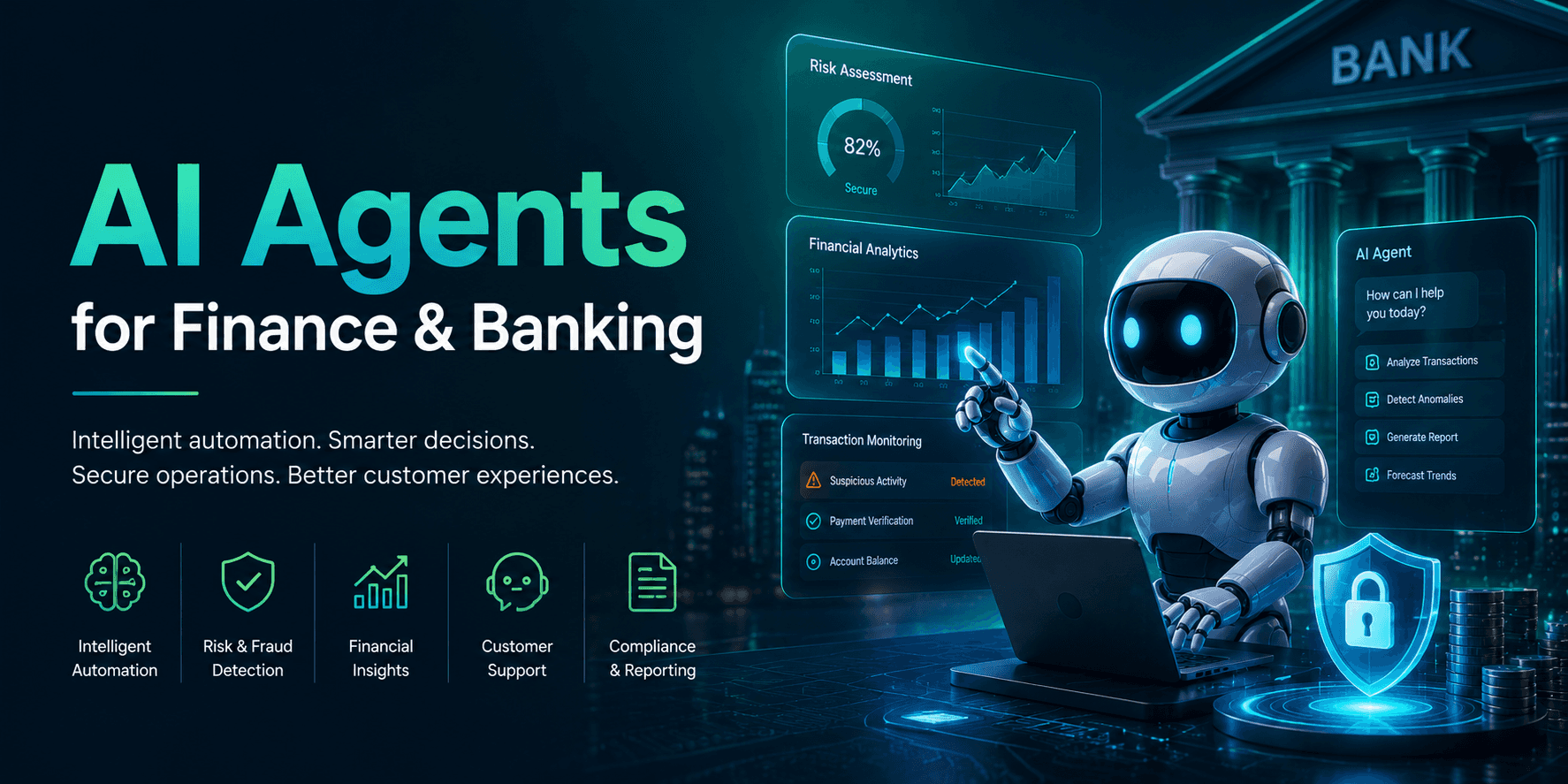
From fraud detection to loan processing, customer support to financial planning, AI agents are helping banks become faster, safer, and more efficient.
AI agents for finance and banking are intelligent software systems that can understand financial tasks, analyse information, make decisions, and perform actions automatically.
They help banks:
- Detect fraud faster
- Improve customer support
- Process loans
- Monitor compliance
- Analyze financial risk
- Personalize banking services
- Automate repetitive work
- Reduce operational costs
Unlike chatbots, AI agents can reason, plan, use tools, retrieve data, and complete multi-step workflows.
What Are AI Agents?
An AI agent is intelligent software that can understand goals, make decisions, use available tools, and complete tasks on behalf of users.
Unlike traditional automation that follows predefined rules, AI agents can adapt to different situations and make context-aware decisions.
The AI agent completes an entire financial workflow instead of answering only one question.
Why Finance & Banking Need AI Agents
The financial industry faces several challenges every day.
1. Rising Customer Expectations
Customers expect:
- Instant responses
- 24/7 support
- Personalized advice
- Faster approvals
- Secure transactions
Waiting hours or days is no longer acceptable.
AI agents provide instant assistance anytime.
2. Increasing Fraud
Financial fraud grows more sophisticated every year.
Examples include:
- Credit card fraud
- Identity theft
- Money laundering
- Fake accounts
- Suspicious transactions
- Phishing attacks
Human teams cannot review millions of transactions in real time.
AI agents continuously monitor activity, identify unusual behavior, and alert security teams within seconds.
3. Complex Regulations
Banks must comply with regulations such as:
- Know Your Customer (KYC)
- Anti-Money Laundering (AML)
- GDPR
- PCI DSS
- Basel III
- Local banking regulations
Manual compliance is time-consuming and prone to errors.
AI agents automate monitoring, document validation, reporting, and audit preparation.
4. High Operational Costs
Banks spend significant resources on repetitive tasks, including:
- Document verification
- Loan processing
- Data entry
- Customer support
- Account verification
- Report generation
AI agents automate these processes, allowing employees to focus on higher-value work.
5. Massive Data Volumes
Banks generate enormous amounts of data every day, including:
- Transactions
- Loan applications
- Customer profiles
- Credit histories
- Market data
- Investment information
AI agents analyse this information in real time and generate actionable insights that humans would struggle to produce quickly.
How AI Agents Work in Finance & Banking
An AI agent follows a structured workflow to complete financial tasks.

This approach enables intelligent, secure, and traceable automation.
Traditional Banking Software vs AI Agents

AI agents complement existing banking systems rather than replacing them.
Core Capabilities of AI Agents in Banking
Modern AI agents combine several capabilities.
Reasoning
Evaluate financial situations before responding.
Example:
Should this transaction be approved?
Planning
Break complex tasks into multiple steps.
Example:
Loan Approval
↓
Verify identity
↓
Check credit score
↓
Review income
↓
Assess risk
↓
Generate approval recommendation
Memory
Remember customer preferences and previous interactions.
Examples:
- Preferred language
- Investment goals
- Frequently used services
- Risk tolerance
Tool Usage
Connect to banking systems, databases, APIs, and compliance platforms.
Examples:
- Core Banking System
- CRM
- Payment Gateway
- Credit Bureau
- Fraud Detection Engine
- Identity Verification Service
Continuous Learning
Improve recommendations based on new financial data while operating within governance and compliance policies.
Why AI Agents Are Better Than Traditional Chatbots
Many people confuse AI agents with chatbots.
They are not the same.

Example:
Customer:
"I need a home loan."
Chatbot:
"Please visit your nearest branch."
AI Agent:
- Collects customer information
- Verifies identity
- Retrieves credit history
- Estimates eligibility
- Suggests suitable loan options
- Explains interest rates
- Initiates the application
- Schedules follow-up if needed
The AI agent completes meaningful work rather than simply providing information.
Benefits of AI Agents for Finance & Banking
Organisations adopting AI agents can realise several operational and customer-focused benefits.
- Faster customer service with 24/7 availability
- Improved fraud detection through real-time monitoring
- Reduced operational costs by automating repetitive work
- More accurate compliance reporting
- Better loan and credit decision support
- Personalized financial recommendations
- Increased employee productivity
- Consistent customer experiences across channels
- Scalable operations during peak demand
- Faster decision-making using real-time analytics
These advantages make AI agents a valuable addition to modern banking, helping institutions deliver secure, efficient, and customer-centric services.
Real-World Use Cases of AI Agents in Finance & Banking
AI agents are already transforming how banks, insurance companies, fintech firms, investment companies, and credit institutions operate. They automate repetitive work, support employees, improve customer experiences, and help organisations make faster, data-driven decisions.
Below are some of the most impactful use cases.
1. AI Agents for Customer Support
Customer support is one of the first areas where AI agents deliver measurable value.
Unlike traditional chatbots that provide scripted answers, AI agents understand context, access customer information, use banking tools, and complete entire tasks.
What AI Agents Can Do
- Check account balances
- Show recent transactions
- Block lost or stolen cards
- Reset passwords
- Update contact information
- Schedule appointments
- Open support tickets
- Answer product questions
- Guide customers through banking services
Example Workflow
Customer: "I lost my debit card." │ ▼ AI Agent verifies identity │ ▼ Checks account ownership │ ▼ Blocks the card immediately │ ▼ Orders a replacement card │ ▼ Shares delivery details │ ▼ Sends confirmation message
Benefits
- 24/7 customer service
- Faster response times
- Reduced waiting queues
- Lower support costs
- Improved customer satisfaction
2. AI Agents for Fraud Detection
Fraud is becoming more sophisticated every year.
Banks process millions of transactions daily, making manual monitoring impossible.
AI agents analyse transactions in real time and identify suspicious activities before financial losses occur.
AI Agent Checks
- Unusual spending
- New device login
- Different location
- High-value transaction
- Multiple failed login attempts
- Rapid transfers
- Suspicious payment patterns
Example
A customer normally shops in Chennai.
Suddenly:
- Login from another country
- ₹2,50,000 transfer
- New device
- Midnight transaction
The AI agent immediately:
- Flags the transaction
- Blocks payment temporarily
- Sends verification request
- Alerts fraud team
- Records the investigation
Benefits
- Reduced fraud losses
- Real-time protection
- Faster investigation
- Better customer trust
3. AI Agents for Loan Processing
Loan approvals often require reviewing many documents and checking multiple systems.
AI agents automate much of this process.
AI Agent Workflow
Loan Application ↓ Collect documents ↓ Verify identity ↓ Check income ↓ Retrieve credit score ↓ Analyze repayment history ↓ Calculate risk ↓ Recommend approval ↓ Human review (if required) ↓ Loan decision
Documents Reviewed
- PAN
- Aadhaar
- Salary slips
- Bank statements
- Income Tax Returns
- Employment details
- Credit reports
Benefits
- Faster approvals
- Fewer manual errors
- Better risk assessment
- Improved customer experience
4. AI Agents for Credit Risk Assessment
Every loan carries some level of risk.
AI agents analyse thousands of data points to estimate whether an applicant is likely to repay a loan.
Factors Considered
- Credit score
- Monthly income
- Existing loans
- Payment history
- Employment stability
- Savings
- Spending habits
- Debt-to-income ratio
The AI agent generates a risk score that helps loan officers make informed decisions. Final approval should remain under appropriate human oversight, especially for high-value or complex cases.
5. AI Agents for Personalized Banking
Every customer has different financial goals.
AI agents provide personalised recommendations based on spending behavior, savings patterns, and financial objectives.
Examples
The AI agent may recommend:
- Better savings accounts
- Investment opportunities
- Credit cards with suitable rewards
- Insurance products
- EMI planning
- Budget improvements
- Retirement plans
Example
Customer:
"I want to save ₹5 lakh in three years."
The AI agent:
- Reviews income
- Calculates expenses
- Suggests monthly savings
- Recommends investment options
- Tracks progress
- Sends reminders
6. AI Agents for Investment Advisory
Investment advisors spend considerable time researching markets.
AI agents support advisors by collecting and analysing market information.
AI Agent Activities
- Monitor stock markets
- Analyze company reports
- Review financial news
- Evaluate risks
- Track portfolios
- Suggest portfolio rebalancing
- Generate investment summaries
Note: Investment recommendations should comply with applicable regulations and include appropriate human review where required.
7. AI Agents for Compliance Monitoring
Banks operate under strict regulations.
Missing compliance requirements can result in significant penalties.
AI agents continuously monitor compliance activities.
They Can Monitor
- AML (Anti-Money Laundering)
- KYC verification
- Suspicious transactions
- Customer due diligence
- Sanctions screening
- Regulatory reporting
Benefits
- Reduced compliance workload
- Faster reporting
- Improved audit readiness
- Better regulatory compliance
8. AI Agents for KYC Verification
Know Your Customer (KYC) is mandatory for financial institutions.
AI agents automate verification while reducing manual effort.
Workflow
Customer Uploads Documents ↓ OCR Extracts Information ↓ Identity Verification ↓ Face Match ↓ Database Validation ↓ Risk Check ↓ KYC Status Generated
Benefits
- Faster onboarding
- Lower verification costs
- Reduced fraud
- Improved customer experience
9. AI Agents for Collections & Payment Reminders
Banks manage thousands of loans and EMIs.
AI agents automate payment reminders while adapting communication based on customer behavior.
AI Agent Tasks
- Send EMI reminders
- Notify due dates
- Offer payment options
- Suggest repayment plans
- Escalate overdue accounts
- Generate collection reports
Communication can occur through:
- SMS
- Mobile apps
- Voice assistants
10. AI Agents for Internal Banking Operations
Not every AI agent serves customers directly.
Many improve internal efficiency.
Examples include:
- Employee help desk
- HR support
- IT troubleshooting
- Policy search
- Knowledge management
- Document generation
- Meeting summaries
- Regulatory document search
AI Agent Architecture for Finance & Banking
A production-ready AI agent typically follows this architecture:

Technologies Behind AI Agents
A typical AI agent stack may include:
AI Models
- OpenAI GPT
- Claude
- Gemini
- Llama
Agent Frameworks
- OpenAI Agents SDK
- LangGraph
- CrewAI
- AutoGen
- PydanticAI
Databases
- PostgreSQL
- MySQL
- MongoDB
Vector Databases
- pgvector
- Pinecone
- Weaviate
- Qdrant
- Milvus
Cloud Platforms
- AWS
- Microsoft Azure
- Google Cloud
Security
- OAuth 2.0
- Multi-Factor Authentication (MFA)
- TLS Encryption
- AES-256 Encryption
- Role-Based Access Control (RBAC)
- Audit Logging
Challenges of Implementing AI Agents
While AI agents provide significant benefits, successful deployment requires careful planning.
Data Privacy
Financial institutions manage highly sensitive customer information.
Best practices include:
- Encrypt data at rest and in transit
- Apply least-privilege access
- Maintain comprehensive audit logs
- Follow data retention policies
Regulatory Compliance
AI agents should operate within applicable regulations.
Examples include:
- KYC
- AML
- GDPR
- PCI DSS
- Local financial regulations
Integration with Legacy Systems
Many banks rely on older core banking platforms.
A phased integration approach using APIs and middleware often reduces implementation risk.
Model Accuracy
AI outputs should be validated, especially for decisions that affect customers financially.
Use:
- Human approval workflows
- Confidence thresholds
- Regular model evaluation
- Continuous monitoring
Best Practices for Implementing AI Agents
To maximise value:
- Start with a high-impact use case such as customer support or fraud monitoring.
- Integrate with existing banking systems through secure APIs.
- Keep humans involved in high-risk financial decisions.
- Encrypt sensitive data and enforce strong identity controls.
- Continuously monitor AI performance and retrain models when needed.
- Log all AI actions for transparency and auditability.
- Regularly test for bias, security vulnerabilities, and regulatory compliance.
- Educate employees on how to work effectively with AI systems.
- Future of AI Agents in Finance & Banking
- AI agents are becoming a core part of digital banking. Over the next few years, they will evolve from task automation tools into intelligent financial assistants that help both customers and employees make better decisions.
- Here are the key trends shaping the future.
1. Hyper-Personalized Banking
- Future AI agents will understand each customer's financial habits, goals, and preferences.
- Instead of offering the same products to everyone, they will recommend services tailored to individual needs.
- For example, an AI agent may:
- Recommend a better savings plan
- Suggest investments based on risk tolerance
- Alert customers before overspending
- Offer personalized loan options
- Create monthly budgets automatically
2. Autonomous Banking Operations
- AI agents will handle more complex banking workflows with minimal human intervention.
- Examples include:
- Opening new accounts
- Processing loan applications
- Verifying customer identity
- Monitoring compliance
- Detecting fraud
- Preparing regulatory reports
- Employees will focus on complex decision-making and customer relationships while AI handles repetitive tasks.
3. AI-Powered Financial Advisors
- Instead of generic investment suggestions, AI agents will become intelligent financial assistants.
- They will:
- Analyze market trends
- Track customer portfolios
- Recommend portfolio adjustments
- Forecast financial goals
- Explain investment risks in simple language
- These systems will assist financial advisors rather than replace them.
4. Real-Time Fraud Prevention
- Future AI agents will identify suspicious activity even before transactions are completed.
- Using behavioural analytics, device intelligence, and transaction history, AI agents can:
- Detect unusual behavior
- Prevent unauthorized payments
- Stop identity theft
- Reduce false fraud alerts
- Improve customer trust
5. Multi-Agent Banking Systems
- Instead of relying on one AI system, banks will deploy specialized AI agents that work together.
- Example:
- Customer Agent │ ▼ Loan Agent │ ▼ Risk Assessment Agent │ ▼ Compliance Agent │ ▼ Document Verification Agent │ ▼ Payment Processing Agent
- Each AI agent focuses on a specific task while collaborating with others to complete the full workflow.
6. Voice-Enabled Banking
- Customers will increasingly interact with banks using voice assistants.
- Examples:
- "Show my account balance."
- "Transfer ₹5,000 to my savings account."
- "How much did I spend on groceries this month?"
- "Can I afford a home loan?"
- AI agents will understand natural language, retrieve information securely, and complete authorized actions.
7. Stronger AI Governance
- As AI becomes more involved in financial services, governance will become even more important.
- Financial institutions will invest in:
- Explainable AI (XAI)
- Human approval workflows
- Bias detection
- Model monitoring
- Secure audit trails
- Responsible AI policies
- Trust and transparency will remain essential for successful AI adoption.
Frequently Asked Questions
What is an AI agent in banking?
- An AI agent is intelligent software that can understand requests, analyse financial information, make decisions, use banking tools, and complete tasks such as customer support, fraud detection, and loan processing.
How are AI agents different from chatbots?
- Chatbots mainly answer predefined questions.
- AI agents can reason, plan, use multiple systems, retrieve data, and complete end-to-end banking workflows.
Are AI agents secure enough for banks?
- Yes, when implemented correctly. Banks should combine AI with encryption, identity verification, access controls, monitoring, audit logging, and regulatory compliance to protect sensitive financial data.
Can AI agents replace bank employees?
- No. AI agents automate repetitive tasks and provide decision support, but human expertise remains essential for complex financial decisions, relationship management, and regulatory oversight.
Which banking departments can use AI agents?
- AI agents can support:
- Customer service
- Loan processing
- Fraud detection
- Risk management
- Compliance
- Wealth management
- Investment advisory
- Operations
- HR
- IT support
- Internal knowledge management
What technologies are commonly used to build AI agents?
- Popular technologies include:
- AI Models
- OpenAI GPT
- Claude
- Gemini
- Llama
- Agent Frameworks
- OpenAI Agents SDK
- LangGraph
- CrewAI
- AutoGen
- PydanticAI
- Vector Databases
- pgvector
- Pinecone
- Weaviate
- Qdrant
- Milvus
- Cloud Platforms
- AWS
- Microsoft Azure
- Google Cloud
How long does it take to implement an AI agent?
- The timeline depends on complexity.
- Simple customer support agent: 4–8 weeks
- Internal operations agent: 6–10 weeks
- Enterprise banking AI platform: 3–9 months
- A phased rollout with pilot testing is usually the most effective approach.
Conclusion
AI agents are reshaping finance and banking by combining intelligent decision-making with automation. They reduce manual work, strengthen fraud detection, improve customer service, accelerate loan processing, and support regulatory compliance.
As AI technology continues to mature, financial institutions that invest in secure, responsible, and customer-focused AI solutions will be better equipped to deliver faster, smarter, and more reliable banking experiences.
The future of banking is not simply digital—it is intelligent, proactive, and AI-assisted.
Build Secure AI Agents for Your Finance & Banking Business
Looking to automate banking operations, improve fraud detection, deliver personalised customer experiences, or streamline compliance?
Our AI experts design and develop secure, enterprise-grade AI agents tailored for financial institutions, fintech companies, digital banks, and insurance providers.
Our AI agent development management services include the following:
- Fraud Detection AI Agents
- Loan Processing Automation
- KYC & AML AI Solutions
- Wealth Management AI Assistants
- Internal Knowledge AI Agents
- Compliance & Regulatory AI Systems
- Custom Enterprise AI Agent Development
Ready to transform your financial services with AI? Contact our team to discuss your AI strategy and build intelligent banking solutions designed for security, scalability, and long-term business value.