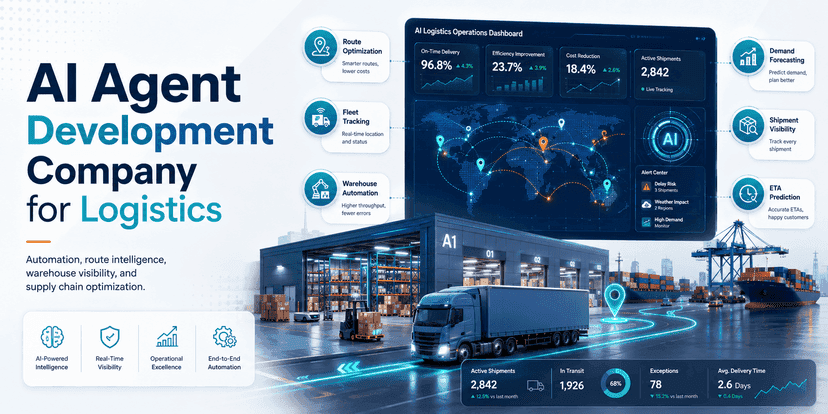
AI Agent Development Company for Logistics
 Sasikumar
Logistics teams make thousands of decisions every day. They route shipments. They coordinate warehouses. They handle delivery problems. They update customers. They move data between systems.
But logistics is unpredictable. Traffic changes. Trucks break down. Orders get delayed. Stock levels shift. Customer needs change too. This is why logistics companies need smart systems. These systems must read information, pick the right action, and work across many tools at once.
An AI agent development company builds these smart systems for logistics. It doesn't just build another chatbot or dashboard. It builds AI agents that watch logistics activity, follow clear rules, use business tools, and help make (or even make) operational decisions.
AI agents fit logistics well because they can handle long, multi-step tasks. They can pull data, check conditions, call other software, update systems, alert people, and flag risky situations for humans to review. OpenAI describes agents as systems that use models, tools, instructions, and coordination to finish tasks. IBM describes supply-chain agents in a similar way: software that watches conditions, reduces risk, makes choices, and acts within a company's rules.
This guide covers what logistics AI agents are, where they add value, how they get built, what they need, and how to pick the right partner to build one.
What Is an AI Agent in Logistics?
An AI agent is software built to reach a goal. It does this by reading information, choosing actions, and using connected tools.
In logistics, you might ask an agent:
Find shipments that may miss their delivery window. Suggest the best fix.
To do this, the agent might:
- Pull up active shipment data
- Check which vehicles and drivers are free
- Check traffic, weather, and road conditions
- Compare these against delivery promises
- Flag shipments at risk
- Work out new routes or carriers
- Update the transport system
- Tell the operations team
- Send new delivery details to the customer
- Log why it made each choice
A basic rules-based system can do some of this, but only when every condition is already mapped out. An AI agent adds a layer of reasoning. This helps it handle new situations, messy information, and decisions with many steps.
Still, an AI agent isn't a fully independent system. It must work inside clear limits: permissions, approval rules, business policies, and points where it hands off to a human.
Why Logistics Companies Are Turning to AI Agents
Modern logistics networks are complex. They include warehouses, suppliers, carriers, freight forwarders, drivers, customers, regulators, and internal software. Data sits in many places: ERP systems, warehouse software, transport systems, tracking tools, spreadsheets, emails, and customer portals.
IBM points to forecasting, route planning, inventory tracking, and cost cutting as real uses of AI in supply chains. DHL's Logistics Trend Radar lists AI as a key technology for the future of logistics.
Five main pressures drive companies to adopt AI agents.
Growing complexity. One shipment can involve many events, documents, systems, and people. Teams must read changing data and react fast, over and over.
Poor real-time visibility. Many companies have tracking data, but staff still have to read it by hand, spot problems, and decide what to do.
Repetitive admin work. Staff spend a lot of time copying data, checking statuses, writing reports, and answering routine questions.
Higher customer expectations. Customers want accurate delivery times, fast fixes, and updates before they even have to ask.
Disconnected systems. Logistics software often lives in separate silos. Staff switch between tools and copy data by hand because the systems don't talk to each other.
AI agents can sit on top of these systems and connect them. They usually don't replace existing software. Instead, they help people and tools work together better.
Key Ways Logistics Companies Use AI Agents
The best AI agents solve one clear business problem. They aren't built around the technology itself.
1. Smarter Route Planning
A route-planning agent looks at delivery stops, truck capacity, vehicle rules, traffic, time windows, and business priorities.
It can suggest:
- The best delivery order
- Backup routes when something goes wrong
- Moving loads between trucks
- Priority changes for urgent orders
- Ways to combine shipments
- Which driver or carrier to use
The agent updates its suggestions as conditions change. Big changes may need a dispatcher's approval. Small, low-risk changes can happen automatically.
2. Watching Shipments and Handling Problems
Logistics teams get huge amounts of tracking data. The hard part isn't collecting it — it's knowing which events actually matter.
An exception-handling agent can:
- Track shipment milestones
- Spot missing scans or odd stops
- Flag likely delays
- Judge how serious the impact will be
- Look into what caused it
- Suggest a fix
- Alert the right team
- Send approved updates to the customer
DHL points to supply-chain visibility tools as a useful way to track goods, spot bottlenecks, and react faster. This lets staff focus on the problems that truly need their attention, instead of checking every shipment by hand.
3. Helping With Demand Forecasting
Forecasting tools produce numbers, but planners still need to make sense of the changes and act on them.
A demand-planning agent can combine the following:
- Past demand
- Current order volume
- Seasonal trends
- Promotions
- Stock on hand
- Supplier lead times
- Local events
- Other limits on operations
The agent can explain why demand is shifting, point out shaky forecasts, and suggest changes to buying, capacity, or stock. The goal isn't to replace planners. It's to give them faster answers and clearer choices.
4. Automating Warehouse Work
Warehouses run on constant decisions: receiving, storage, picking, restocking, packing, and shipping.
AI agents can help with:
- Dock scheduling
- Deciding what to receive first
- Suggesting where to store items
- Restock alerts
- Prepping picking batches
- Assigning labor
- Handling order problems
- Coordinating maintenance
- Checking that orders are ready to ship
For example, a warehouse agent might notice that urgent orders need stock from a hard-to-reach spot. It could flag the restock, set up the task, and assign it through the warehouse system.
5. Smarter Inventory Management
An inventory agent watches stock levels, how fast items move, order commitments, and restocking needs.
It can help spot:
- Possible stockouts
- Too much stock
- Slow-moving items
- Wrong inventory counts
- Sudden demand shifts
- Good times to reorder
- Chances to move stock between warehouses
Instead of just handing you another report, it can explain the issue, suggest a fix, and start an approved task.
6. Managing Freight and Carriers
Picking the right carrier means weighing price, capacity, route coverage, service, and risk.
A carrier-management agent can:
- Compare quotes
- Check past performance
- Confirm capacity and coverage
- Spot contract terms
- Recommend which carrier to use
- Track service compliance
- Build performance summaries
A human manager can still approve the pick before booking costly or sensitive shipments.
7. Automating Customer Service
Logistics support teams answer the same questions over and over:
- Where's my shipment?
- When will it arrive?
- Why is it late?
- Can I change the delivery address?
- Has it shipped yet?
- What paperwork is missing?
A customer-service agent can pull up live shipment data and give a real answer, based on what's actually happening.
If something needs action, it can
- Open a support ticket
- Ask for delivery instructions
- Alert operations
- Start a reschedule
- Flag damaged or lost shipments
- Send updates before the customer asks
Unlike a basic FAQ bot, this kind of agent connects to real systems and can actually finish tasks.
8. Handling Documents and Compliance
Logistics runs on paperwork: invoices, bills of lading, delivery notes, packing lists, customs forms, and certificates.
A document-processing agent can:
- Sort incoming files
- Pull out key details
- Check that required info is present
- Match documents to shipment data
- Flag mismatches
- Ask for missing information
- Send documents for approval
- Update internal systems
Important legal and customs calls should still go through proper review. The agent just cuts down manual work and makes information easier to find.
9. Predicting Maintenance Needs
Fleet and equipment data can reveal maintenance risks before they cause problems.
An agent might:
- Watch vehicle sensor data
- Spot unusual patterns
- Compare them to repair history
- Estimate how much this will affect operations
- Suggest an inspection
- Check open maintenance slots
- Create a work order
- Suggest a backup vehicle
DHL has shown how combining vehicle, sensor, compliance, and trip data can boost safety and efficiency.
10. Supporting Sustainability Goals
A sustainability agent brings together shipment, route, fuel, carrier, and vehicle data.
It can help teams:
- Estimate shipment emissions
- Compare route options
- Spot inefficient vehicle use
- Suggest combining loads
- Check carrier sustainability records
- Build environmental reports
This matters most when sustainability data is scattered across many systems.
What Does a Logistics AI Agent Development Company Actually Do?
A good development team does more than just plug a language model into a logistics database. It turns a business problem into a safe, working, measurable AI system.
Discovery. The team studies your current processes, staff roles, existing software, decision points, manual handoffs, data, risks, and success metrics. The goal is to find where an agent adds real value without adding unneeded complexity.
Picking the right use case. Not every task needs an AI agent. A good partner checks whether the task involves messy decisions, unstructured data, many tools, repeated digging for answers, heavy staff effort, clear success measures, and manageable risk. OpenAI's own guidance says to focus on tasks where simple automation struggles — especially ones with tricky rules or messy data. Simple, predictable steps are often better handled the old-fashioned way.
Designing the agent. The team defines the agent's goal, rules, tools, data access, memory needs, approval points, escalation rules, expected outputs, and how it handles failure. Some setups use one agent. Others use several, each with its own job — for example, one agent spots a delay, another checks routes, another handles customer messages, and another checks compliance. Multiple agents make sense only when specializing actually helps.
Preparing the data. Good AI needs good data. The team may need to clean up fields, remove duplicates, match IDs across systems, build knowledge sources, set access rules, index documents, and build pipelines to keep data fresh. Agents should only see the data they truly need for the task — nothing more.
Connecting systems. A logistics agent may need to talk to transport systems, warehouse systems, ERP platforms, order systems, CRM software, tracking tools, mapping services, carrier portals, email tools, document storage, and reporting tools. These connections usually run through APIs, webhooks, databases, or secure middleware. IBM's Supply Chain Intelligence Suite, for instance, offers APIs built for this kind of custom integration.
Building and testing. The team builds the agent's logic, tools, integrations, interface, and controls. Testing should cover accuracy, tool use, permissions, edge cases, failure recovery, security, load handling, response quality, human approval steps, and tricky or adversarial scenarios. It must also be tested against real logistics situations, including missing information and surprise events.
Launch and monitoring. After launch, the team tracks task completion, accuracy, tool failures, escalation rates, processing time, cost per task, staff adoption, business results, security issues, and model behaviour. AI systems need ongoing checks, because data, processes, and models keep changing.
Key Parts of a Logistics AI Agent
A working logistics agent usually has these layers:
The AI model. This reads instructions and data, picks the next step, and writes responses. Choosing a model means weighing reasoning power, speed, cost, memory needs, output quality, and privacy needs.
Tools. These let the agent take action — checking shipments, calculating routes, updating statuses, creating tasks, sending alerts, generating documents, opening tickets, or asking for human approval. Each agent should only get the tools it truly needs.
Knowledge and search. The agent may need access to procedures, contracts, service policies, warehouse rules, product limits, route rules, compliance documents, and past incident records. This helps the agent use approved company knowledge instead of guessing.
Memory. Some logistics tasks run for hours or days. The agent may need to remember the current issue, past actions, pending approvals, and customer messages. This memory should follow clear retention rules.
Coordination. This controls the order in which agents and tools run. OpenAI names tools, handoffs, guardrails, sessions, and tracing as key pieces of this system.
Visibility. Teams need to see what data the agent used, which tools it called, why it picked an action, whether it got approval, what it produced, and where things broke. Logs and tracing matter for fixing problems and staying accountable.
Security, Control, and Human Oversight
Logistics agents often touch sensitive data: customer records, shipment locations, pricing, contracts, and supplier details. Security needs to be built in from day one.
Key controls include:
- Role-based access
- Giving only the access needed, nothing more
- Data encryption
- Safe handling of passwords and keys
- Keeping client data separate
- Audit logs
- Tool-level permissions
- Approval steps
- Checking inputs and outputs
- Data retention rules
- Monitoring and a plan for incidents
An agent should never get full, unchecked access to your systems. A route agent might suggest a new route but shouldn't be able to change a contract. A customer-service agent might check a shipment's status but shouldn't reveal internal pricing.
Human approval should be required for the following:
- High-value shipments
- Contract changes
- Legal or regulatory decisions
- Dangerous goods
- Big financial impact
- Customer compensation
- Major route changes
- Sensitive data
- Safety-critical actions
NIST's AI Risk Management Framework offers useful principles for building trust into AI systems. Companies should still adjust it to fit their own risks and rules.
How to Measure Success
Judge an agent by real business results, not just how well it writes.
Operations: on-time delivery rate, route-planning time, time to fix problems, order-processing speed, warehouse output, empty miles, inventory accuracy, vehicle use.
Staff: manual steps removed, time saved per case, cases handled per person, escalation rate, adoption rate, and job satisfaction.
Customers: response time, rate of proactive updates, first-contact fixes, delivery-estimate accuracy, satisfaction, complaints.
The AI system itself: task success rate, tool accuracy, how often it gives unsupported answers, how often humans need to correct it, speed, cost per task, how often safety limits kick in.
Set a baseline before you build anything. Otherwise, it's hard to prove the agent actually helped.
What Does It Cost?
Cost depends on how complex the problem is – not on the label "AI agent".
A small proof of concept using one data source and one tool costs less than a full platform running across many warehouses, carriers, and customer channels.
Costs are shaped by:
- Number of workflows
- How hard the integrations are
- Data quality
- Interfaces needed
- Model and hosting choices
- Security needs
- Approval workflows
- Number of business locations
- Real-time processing needs
- Testing needs
- Ongoing support
Don't pick a vendor just because they quote the lowest price. A cheap prototype can get expensive fast if it can't be governed, monitored, connected, or scaled.
A step-by-step approach usually works best:
- Pick one high-value use case.
- Build a small, controlled test version.
- Try it with real users.
- Measure the results.
- Strengthen security and reliability.
- Expand to more workflows.
How to Choose the Right Development Partner
The right partner understands both AI and how logistics actually works. Ask potential vendors:
Do they start with the problem, not the tech? They should ask about your delays, exceptions, systems, users, and goals before pitching a solution.
Can they connect to your current systems? A useful agent has to work with the tools you already use.
How do they control what the agent does? They should clearly explain permissions, approvals, guardrails, and escalation steps.
How will they test it? Look for real testing, scenario checks, monitoring, and human feedback — not just a demo.
Can they explain the design? They should be able to tell you what the agent can do, what it can access, what it stores, when a human must approve something, and how failures are handled.
Do they build with security in mind from the start?
Can they support it after launch? A good partner offers monitoring, upkeep, and support once it's live.
Do they avoid giving the agent too much freedom? More autonomy isn't always better. The best setups give an agent just enough power to add value while keeping people in control.
Infiniapps.ai as Your Logistics AI Partner
Infiniapps.ai helps logistics companies build AI agents, smart workflows, and connected digital tools. We start with your operational problem — not with a ready-made product.
We help with:
- Shipment monitoring
- Route and dispatch support
- Warehouse automation
- Customer-service agents
- Document and data processing
- Demand and inventory tools
- Exception handling
- Carrier coordination
- Custom dashboards
- Mobile and web apps
- API and system integrations
Our process runs in five stages:
Discovery — We study your workflows, systems, goals, and users.
Design — We plan the agent's behaviour, tools, user journey, security, and approval limits.
Development — We build and test the agent, workflows, interfaces, and integrations.
Integration — We connect it to your approved systems and data.
Deployment — We launch it, watch how it performs, and improve it over time.
This process is built to create AI systems that are practical, scalable, and tied to real business results.
Frequently Asked Questions
What is an AI agent development company for logistics?
A company that builds AI systems for multi-step logistics tasks. These systems can watch shipments, study data, use tools, suggest actions, and run workflows across logistics platforms.
How is this different from a chatbot?
A chatbot mostly just talks. An AI agent can also pull live data, call other software, update systems, start workflows, and finish real tasks.
Can it connect to our TMS or WMS?
Yes, as long as your platform has a way to connect — like an API, webhook, database link, or secure middleware. The exact setup depends on your system.
Will AI agents replace logistics staff?
The real goal is cutting repetitive work and helping people make faster, better decisions. Humans still need to oversee safety, legal, and high-impact actions.
Can small logistics companies use this?
Yes. You don't need to automate your whole supply chain. Start with one focused task, like shipment updates, document extraction, or delay alerts.
How long does it take to build one?
A small proof of concept moves faster than a full platform, but timing depends on your integrations, data, security needs, and workflow complexity. A discovery phase comes first, so you get a real estimate.
Are these agents secure?
They can be, if built right. Strong identity checks, limited tool access, encryption, approval steps, monitoring, and audit logs all need to be part of the build.
Final Thoughts
Logistics companies don't need another tool that just shows more data. They need technology that helps teams understand what's happening, make decisions, and respond faster.
An AI agent development company builds that layer — connecting models, rules, tools, data, and human approval into one working system.
The best logistics agents aren't built to automate everything. They're built to solve one real problem, safely and in a way you can measure.
Start with a workflow that has:
- High manual effort
- Repeated decisions
- Data you can actually access
- Clear business value
- Manageable risk
- Results you can measure
Once that works, you can grow into a full network of connected, smart logistics processes.
Infiniapps.ai helps logistics companies go from AI ideas to working solutions — covering discovery, design, development, integration, and launch.
Ready to build an AI agent for your logistics operations? Visit Infiniapps.ai and start planning a smarter, more connected logistics workflow.